

While we’ve made major strides in generating renewable energy, storing that green power to use when the Sun isn’t shining or the wind isn’t blowing remains a major engineering challenge.
Researchers have developed many creative concepts — storing it in cranes that hoist humongous concrete blocks up and down, inside hot giant rocks, or spinning turbines by pumping water out of deep, decommissioned mines — none have yet proved practical enough for wide deployment.
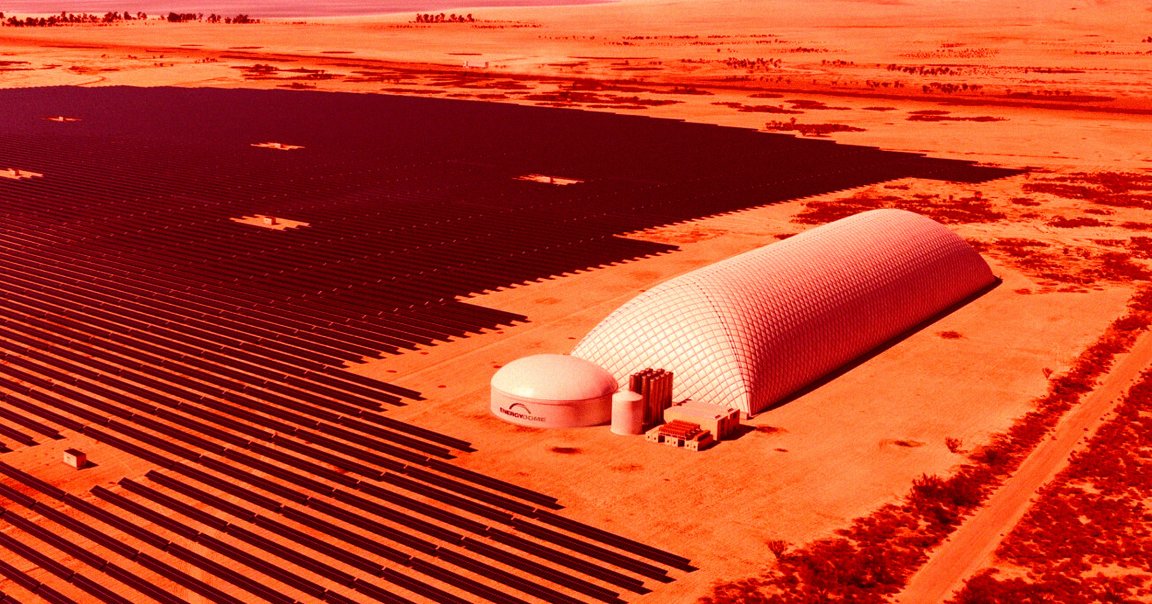
Now, as IEEE Spectrum reports, a Milan-based company called Energy Dome has come up with an intriguing approach that stores energy in enormous domes that are filled with compressed carbon dioxide gas.
The idea behind the “CO2 battery” is simple. By compressing the gas using excess green power, it can later be depressurized to spin large turbines. A fully charged facility can store a formidable 200 megawatt-hours of electricity — enough to power around 6,000 homes for a full day.
To charge, the battery uses a thermal-energy storage system to cool the CO2 down to ambient pressure, and a condenser turns it into a liquid over a span of ten hours. To discharge it, the CO2 is evaporated and heated to power the turbine.
The goal is to bridge the gap between when renewable energy is available and when it’s actually needed through a “long-term duration energy storage” (LDES) solution. For instance, solar energy generation may hit its peak during the day, but peak household demand lags hours behind when people are home in the evening.
The idea has even caught the attention of Google, which announced a partnership with Energy Dome earlier this year. Now, IEEE Spectrum reports that the tech giant “plans to rapidly deploy the facilities in all of its key data-center locations in Europe, the United States, and the Asia-Pacific region.”
Energy Dome is currently working on a pilot CO2 battery built on five hectares of flat land in Sardinia, Italy. If successful, it wants to expand rapidly, popping up similar facilities across the world, starting with a separate plant in Karnataka, India. Authorities are also working on laying the groundwork for another in Wisconsin.
Google’s senior lead for energy strategy, Ainhoa Anda, told IEEE Spectrum that one big benefit of the approach is that it’s one-size-fits-all.
“We’ve been scanning the globe seeking different solutions,” he said, adding that “standardization is really important, and this is one of the aspects that we really like” about Energy Dome.
“They can really plug and play this,” Anda added.
The tech giant is looking to start in places where the electricity grid is already reliable and has a surplus of renewable energy that needs to be stored. Nearby data centers can then tap into the CO2 battery.
Unlike other renewable energy storage solutions, CO2 batteries don’t need special minerals, supply chains for complex parts, or constant upkeep.
And it’s not just Google looking to harness the benefits of LDES. China is also working on constructing CO2 batteries, according to IEEE.
Nonetheless, questions surrounding the concept’s long-term economic viability remain. For one thing, a CO2 battery’s footprint is considerably larger than a lithium-ion battery storage facility. There’s also the shortcoming that plagues all bubbles: the threat of a puncture, which could release thousands of tons of CO2 into the atmosphere.
But proponents argue it’s worth the risks.
“It’s negligible compared to the emissions of a coal plant,” Energy Dome CEO Claudio Spadacini told IEEE Spectrum.
More on renewable energy storage: The Amount of Electricity Generated From Solar Is Suddenly Unbelievable