

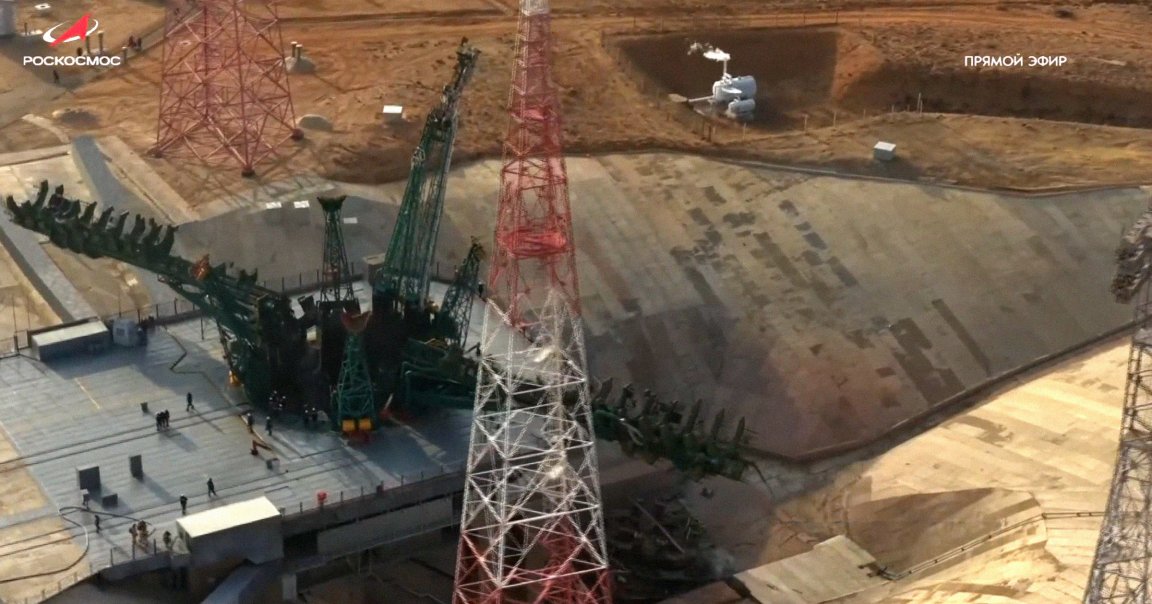
The launch pad of Russia’s Baikonur Cosmodrome spaceport in Kazakhstan sustained significant damage following a botched Soyuz launch last week.
While the Soyuz MS-28 crew on board the rocket, including cosmonauts Sergey Kud-Sverchkov and Sergey Mikayev, as well as NASA astronaut Christopher Williams, safely made it to the International Space Station, the launch pad was heavily damaged in the process. Drone footage shows the platform’s mobile maintenance cabin lying upside down inside the flame trench, with experts telling NASASpaceflight that it could take months if not years to be repaired.
It’s a significant setback, because the damaged pad is Russia’s only certified launch site for crewed missions to space.
NASA has now acknowledged the incident. The space agency closely collaborates with its Russian counterpart, Roscosmos, on staffing the ISS, despite strained US-Russia relations. Apart from Russia’s Soyuz capsules, the only other currently available method to fly astronauts to the orbital outpost is SpaceX’s Dragon spacecraft.
“NASA is aware Roscosmos is inspecting Launch Pad 6 at Site 31 following launch of the Soyuz MS-28 on November 27 from the Baikonur Cosmodrome in Kazakhstan,” a NASA spokesperson told Futurism in a statement. “NASA coordinates closely with its international partners, including Roscosmos, for the safe operations of the International Space Station and its crew members.”
The agency also confirmed that the MS-28 crew “safely arrived at the space station” following their launch, but didn’t elaborate on whether the incident would impact any future crewed missions, referring Futurism to reach out to Roscosmos, which didn’t reply by press time.
In a November 27 statement posted to Telegram, Roscosmos confirmed “damage to a number of elements of the launchpad.”
“All the necessary reserve elements are there to restore it and the damage will be eliminated very soon,” the agency added.
Despite that initial optimism, the botched launch will likely shake up NASA and Roscosmos’ plans to keep ISS operations going, four years ahead of its scheduled retirement. A future Progress cargo ship resupply mission has already been delayed from December 21 to sometime next year. The next crewed Soyuz mission is currently slated for July 2026.
Russia’s willingness to keep operations on board the aging outpost going has been shaky, particularly after the country’s invasion of Ukraine greatly strained relations between the two powers. In late 2024, former Roscosmos head Yuri Borisov confirmed that Russia would be supporting operations at least until 2028, a stark reversal from his predecessor, Dmitry Rogozin’s threats of abandoning it.
“How committed is the Russian leadership to fixing that launchpad and continuing the contributions to the International Space Station program?” Voyager Technologies senior official Jeff Manber told the New York Times. “It’s going to be extremely interesting to see how indeed they respond.”
More on the incident: Severe Accident Destroys Russia’s Ability to Launch Astronauts Into Space