

Last month, Chinese astronauts on board the country’s Tiangong space station discovered cracks in the window of their return vehicle, the Shenzhou-20, which officials suspected were the result of a space debris strike.
The Shenzhou-20 spacecraft was deemed not safe enough to return its crew after the cracks were found, prompting an orbital game of musical chairs as the China Manned Space Agency (CMSA) launched an emergency uncrewed replacement spacecraft, Shenzhou-22, to the station.
The goal was to provide the Shenzhou-21 crew, who arrived at the station right as the cracks were discovered, with an emergency escape vehicle, since the Shenzhou-21 spacecraft they’d flown up in had to step in to bring the Shenzhou-20 crew back to Earth, leaving their replacements temporarily stranded aboard the station.
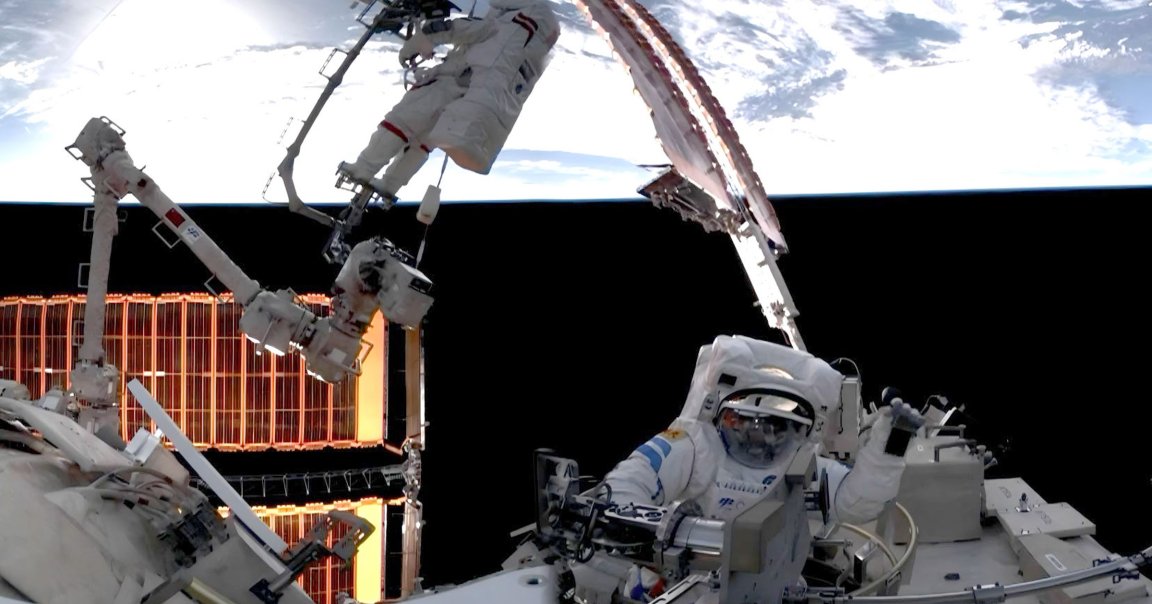
Now, two of the Shenzhou-21 crew clambered outside of the space station late Monday to inspect the damage to the window of the Shenzhou-20 capsule, as SpaceNews reports.
Mission commander Zhang Lu and fellow crewmember Wu Fei, who became the youngest Chinese astronaut to perform an EVA during the walk at age 32, according to the CMSA, spent a total of eight hours outside of the station, taking the time to photograph and assess the damage.
While we await the results of their investigation, it’s an impressive turnaround time. In a matter of weeks, China’s space program identified issues with its spacecraft, sent a replacement vehicle, and ventured outside of the station to get a better sense of what happened.
As SpaceNews points out, China has successfully launched five rockets since December 5, with three Long March rockets blasting off within just 24 hours to build out a megaconstellation of satellites.
But despite that launch prowess, China’s presence in Earth’s orbit is as vulnerable to space debris strikes as any other nation. The International Space Station, for instance, has to repeatedly fire its thrusters to avoid colliding with space junk. Even satellites are at risk of setting off a potentially disastrous chain reaction.
To avoid its Tiangong station sustaining further damage, the two spacewalking astronauts also installed a “space debris protection system,” though the CMSA stopped short of elaborating on what the system entails.
If everything goes according to plan, the damaged Shenzhou-20 spacecraft may one day get a new lease on life. According to CMSA officials, astronauts may try to reinforce the window during a future spacewalk.
“Shenzhou-20 will eventually return to Earth without a crew,” CMSA chief spokesman Ji Qiming told state-run broadcaster CCTV earlier this month, as quoted by the South China Morning Post. “That process will yield the most realistic test data, extremely valuable and meaningful for our future work.”
Fortunately, nobody was harmed throughout the ordeal. The Shenzhou-20 crew returned to Earth on board the Shenzhou-21 spacecraft on November 14. Meanwhile, the remaining Shenzhou-21 crew members have the Shenzhou-22 capsule to rely on in case of an emergency.
More on the incident: China Launches Emergency Mission to Its Space Station, Putting NASA to Shame