

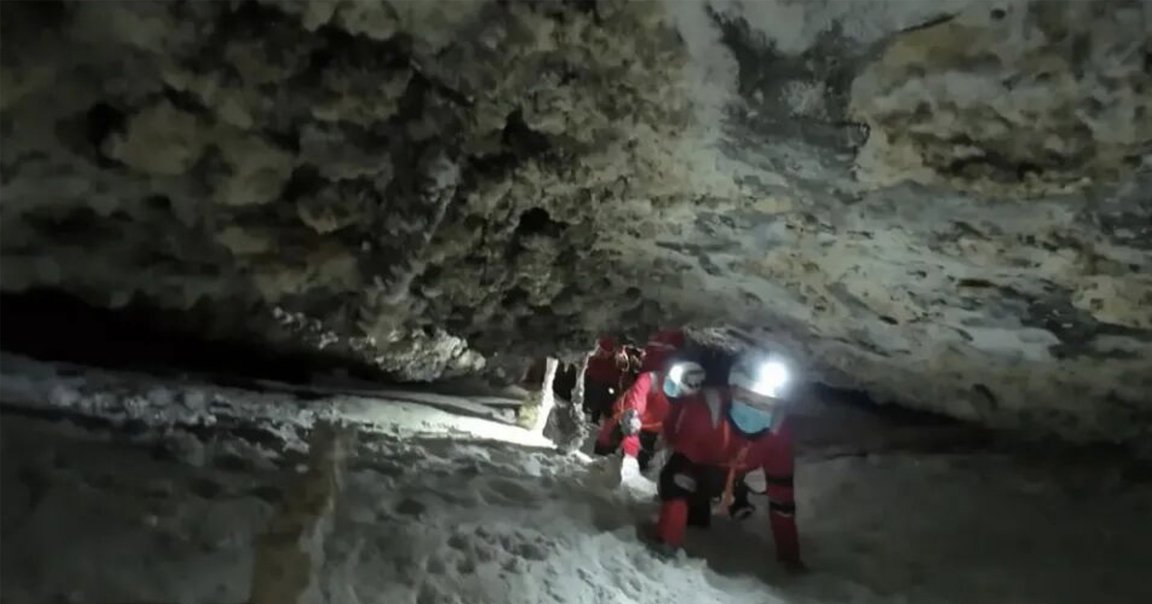
Forget Mars. For 28 member of China’s astronaut corps, the brave new world is a dark, damp hole in the ground — cut off from light, wind, and even the internet.
As reported by Space News, the China Astronaut Research and Training Center (CARTC) just wrapped up a month-long training regimen meant to prepare future and veteran astronauts for lunar landing missions. The astronauts were split into four groups, each of which spent nearly a week in underground isolation.
While they were down there, each team completed work in cave mapping, environmental monitoring, long-distance communication, as well as psychological and behavioral training, according to the China National Space Administration.
While it isn’t known which cave the astronauts braved, the CNSA notes the system was located somewhere in the Wulong District of Chongqing. This area is home to massive karst formations like the Wulong Three Bridges, the largest natural stone arches in Asia, as well as the Xiaozhai Heavenly Pit, the world’s largest sinkhole. It also contains the famous Furong Cave, a UNESCO world heritage site and one of the largest limestone caverns in the world.
CARTC researchers had been scouting caves across China for the training program since 2016. At least 10 alternative caves were also considered, in regions like Guangxi, Hunan, and Guizhou. After rating each cavern based on metrics like training challenge, geological stability, and safety, program administrators settled on the one in Chongqing, where conditions most accurately resembled the “extreme environment of space,” the CNSA said.
The training mirrored a similar program run by the European Space Agency, called the Cooperative Adventure for Valuing and Exercising human behavior and performance Skills (CAVES). One of the directors of the Chinese cave training, veteran astronaut Ye Guangfu, also participated in a 2016 CAVES training in a European cavern.
“Compared with the cave training in Europe, our support team inside the cave intervened as little as possible,” Ye told the state news agency Xinhua. “This approach pushed astronauts to rely on their own judgment, unlocking both individual initiative and their full problem-solving potential.”
“It was so dark that I couldn’t see my own hands in front of my face,” Tang Hongbo told the agency. A veteran of the Shenzhou-12 and Shenzhou-17 spaceflight missions, Tang served as commander of the second team to face the underground trials. “In that kind of darkness, the mental pressure is overwhelming.”
More on China: China Installs Defensive Countermeasures on Space Station