

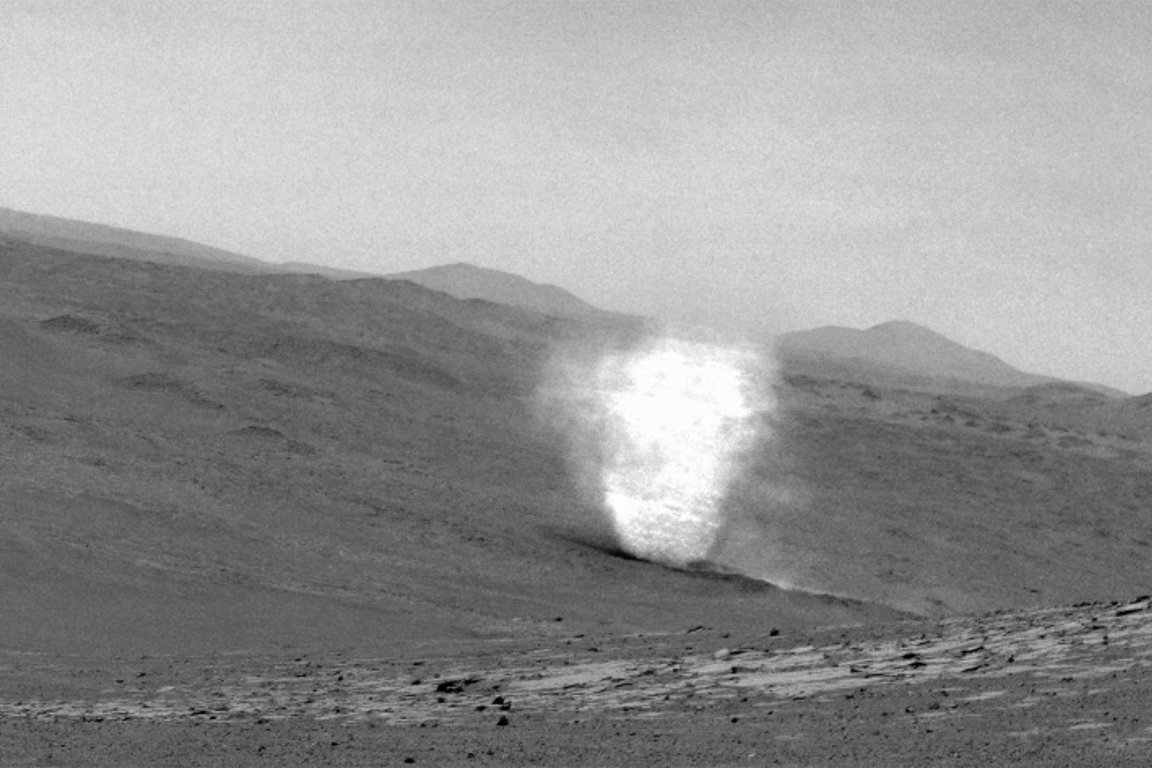
There’s an electrifying new development in Mars science. NASA’s Perseverance rover has just captured proof of a weather phenomenon that was long suspected, but until now, never observed: electric discharges that brew within the dust devils that torment Mars’ surface.
The discovery, described in a new study in the journal Nature, confirms that lightning discharges occur in the Martian atmosphere. The dust devils that the discharges appear in are a common fixture on the Red Planet. Like on Earth, they’re whirlwinds created by rapidly rising columns of warm air heated by their proximity to the ground, shooting their way through the cool air which falls to take the rising warm air’s place.
On Mars specifically, it was suspected that dust trapped in this whirlwind whips together to create a static charge through friction, a manifestation of the same so-called triboelectric effect that causes a spark after you shuffle across a carpet and touch a metal doorknob.
“Triboelectric charging of sand and snow particles is well documented on Earth, particularly in desert regions, but it rarely results in actual electrical discharges,” lead author Baptiste Chide, a member of the Perseverance science team and a planetary scientist at L’Institut de Recherche en Astrophysique et Planétologie in France, said in a NASA statement about the research. “On Mars, the thin atmosphere makes the phenomenon far more likely, as the amount of charge required to generate sparks is much lower than what is required in Earth’s near-surface atmosphere.”
That lightning on Mars had eluded detection until now was a long source of frustration to Mars scientists, as it had already been established to take place on other planets like Saturn and Jupiter, which are far more distant and aren’t observed up close by robots as we do the Red Planet.
The finding required some astonishing good luck. The detection was made by a microphone on the rover’s SuperCam instrument designed to analyze the acoustics of Martian rocks zapped by the SuperCam laser — or in other words, to record sound, not zips of static discharges.
But the instrument kept picking up more and more electrical disturbances, in all logging 55 since its mission began in 2021, NASA said. Sixteen of them were recorded when a dust devil passed directly over the rover. Because the the number of discharges didn’t increase during the planet’s frequent dust storms, the scientists surmise that it must be coming from the dust devils instead — which, in another fortunate twist, happened to pass by the rover more often than anyone anticipated, allowing them to confirm the suspicion.
The discovery has exciting implications. Lightning can cause unique chemical reactions and affect the chemical balance of the planet’s surface, perhaps altering the odds of creating complex compounds — and possibly even organic molecules.
More on Mars: Scientist Say They’ve Found Caves on Mars That May Contain Life