

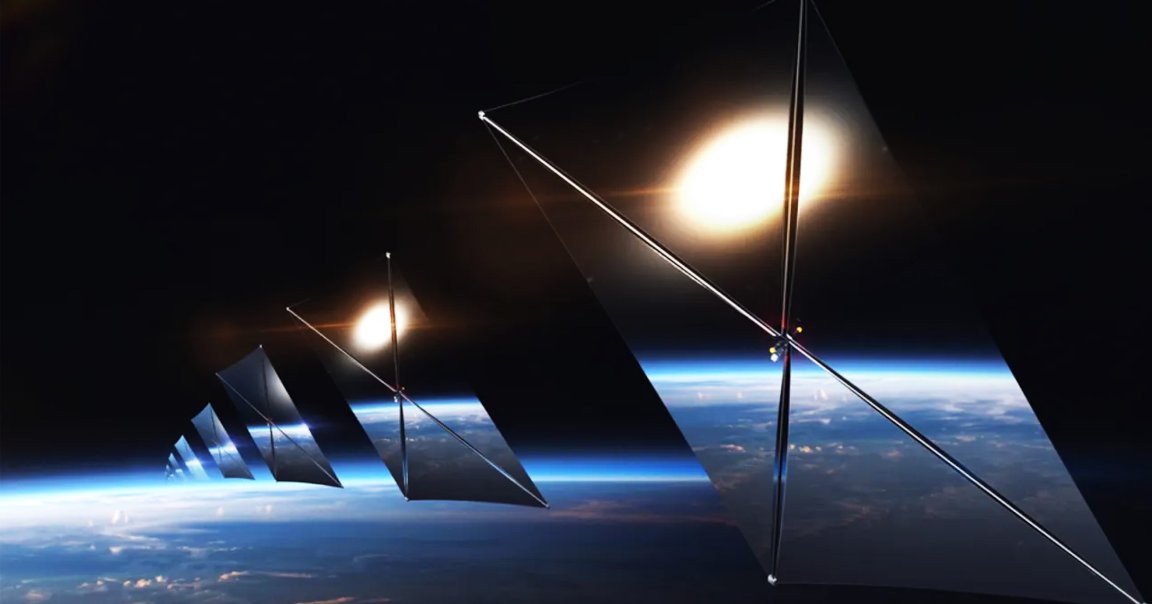
The US Federal Communication Commission is reviewing an application to launch and deploy a massive mirror satellite in space that would reflect beams of sunlight onto darkened portions of the Earth.
In theory, it could be used to power solar farms, light up a city that never sleeps, or provide lighting during emergency scenarios, argues the startup behind the idea, Reflect Orbital. And the prototype satellite, equipped with a 60-foot mirror, would just be the beginning. Reflect Orbital envisions deploying 50,000 mirror satellites in orbit around the Earth — over five times the size of the largest satellite constellation in the world, operated by SpaceX.
“We’re trying to build something that could replace fossil fuels and really power everything,” CEO Ben Nowack told The New York Times.
It would be lucrative if pulled off. Nowack imagines charging about $5,000 per hour for the light of a single mirror, and potentially splitting revenues from the electricity generated by solar farms. By the end of 2028, he’s targeting the launch of 1,000 satellites.
The idea is as far-fetched as it is controversial. But something like it has been attempted before. In 1993, the Russian satellite Znamya, or “Banner,” deployed a 65-foot-wide sheet of mylar that reflected a beam of light twice as bright as the Moon, illuminating a roughly three mile wide circle onto the Earth below like an orbital spotlight. It didn’t prove to be practical, however, with ground observers noticing no more than a flash of light, and it was exorbitantly expensive to pull off.
Even so, it has the potential to massively disrupt the environment and interfere with many human operations. And the far-reaching consequences of such a technology is exposing the limits of the FCC’s remit.
Experts fear that light from space mirrors could disrupt circadian rhythms in nature, posing a problem for flora and fauna alike. Animals might breed at the wrong time, and hibernating insects and migrating birds could be confused, Martha Hotz Vitaterna, a research professor of neurobiology at Northwestern University, told the NYT. And plants could bloom when pollinators aren’t active.
“The implications for wildlife, for all life, are enormous,” added Vitaterna, who is co-director of the Center for Sleep and Circadian Biology.
Astronomers, meanwhile, fear that it could threaten their entire profession by interfering with observations of deep space — an issue that is already posed by satellite constellations that have ballooned in size in recent decades.
These questions are more or less moot to the FCC, however. As a communications agency, its chief concern is that the satellite’s communications don’t interfere with other signals and that the satellite deorbits and destroys itself safely.
“We just don’t have a regulatory process for these types of novel space activities yet,” warned Roohi Dalal, an astronomer and director of public policy at the American Astronomical Society.
But would it even work? Michael Brown, an astronomer at Australia’s Monash University, did the math and found that even with tens of thousands of satellites, Reflect Orbital’s efforts would barely make a dent. “Over 3,000 satellites would be required to produce the equivalent of just 20 percent of the midday Sun at a single site,” he wrote in a formal comment on the startup’s FCC application quoted by the NYT. With 87,000 satellites it could provide a fifth of the Sun’s midday illumination to 27 sites.
“I think his idea keeps coming up because it has a certain simplicity and elegance,” Brown told the NYT. “But when you start crunching the numbers, and the numbers are pretty easy to crunch, then you find there’s a lot of serious issues with it.”
More on space: Rapid Space Launches Shifting the Chemistry of Earth’s Atmosphere