

Space has never been more accessible than it is today.
Launches have become an almost daily occurrence as companies and governments from around the world continue to build out satellite mega-constellations in the sky. As a result, we’re rapidly filling up the orbit around our planet with active spacecraft — and plenty of dangerous detritus as well.
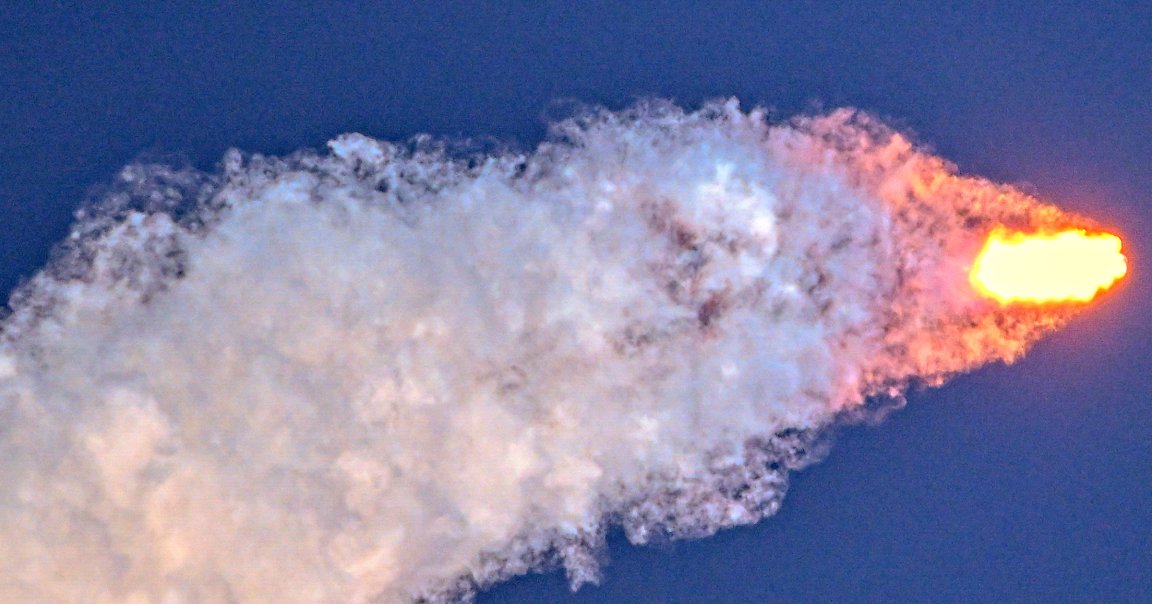
And beyond the chance of collisions, all of that activity could have potentially grave environmental consequences as well. The Earth’s atmosphere is being littered with new metal aerosols from burning spacecraft and rockets, as University of Southampton environmental science professor Ian Williams explained in a new essay for The Conversation.
Many satellites are designed to deorbit upon their retirement and burn up in the Earth’s atmosphere, which at the incredible scale of today’s spacetech industry could already by fundamentally altering the chemistry of our planet’s natural defense mechanism.
Not all is lost yet. It’s still possible that scientists, including Williams and his colleagues, will come up with new ways to recover materials or advocate for longer-lasting satellites, efforts that could protect our atmosphere from feeling the hurt in the long run.
Still, it’s cause for concern. Williams pointed to several studies warning of metal oxides depleting the ozone layer, or heating up the stratosphere, among other potentially harmful environmental effects.
Aluminum oxides from reentering satellites can “catalyze the chemistry that destroys the ozone layer,” Williams argued. “Meanwhile, rocket exhaust — especially black carbon (soot) from rocket engines powered by hydrocarbon propellants — warms the stratosphere and alters winds.”
In one 2025 study, researchers simulated the “potential yearly emission of 10,000 metric tons of alumina from reentering space debris” and found major accumulations of the stuff in the atmosphere between latitudes of 6.2 and 18.6 miles. The aluminum oxides triggered changes in the “mesospheric heating rates,” temperature anomalies that were “accompanied by changes in wind speed in the polar vortex.”
Researchers have also found that rocket launches could effectively negate a global, decades-long effort to reduce our reliance on chlorofluorocarbons (CFCs), which are synthetic organic compounds used in refrigerants and aerosols that have long been known to deplete the ozone layer. One study published in June found that the “ozone layer is slowly healing from the effects of CFCs, yet global-mean ozone abundances are still two percent lower than measured prior to the onset of CFC-induced ozone depletion.”
That’s not to mention the ever-present danger of space junk falling onto people or property — the odds of which may be small, but not zero. While instances of people getting hurt remain extremely rare, we’ve already seen large pieces of rocket stages crashing down in rural areas, including farms. Growing satellite constellations have also caused major disruptions for ground-based telescopes, appearing as bright streaks in observations.
But there may be a better option than having satellites reenter the atmosphere after they’re deemed no longer useful. For one, as Williams explained, we could make a dent by recovering some of the orbital debris. The professor and his colleagues calculated that the amount of scrap value of all orbital debris combined amounts to around $1.2 trillion, which could make recovery financially attractive — if we can figure out how to capture it, that is.
We could also greatly extend the lives of satellites by servicing them in orbit and designing them from the ground up for repair and refueling.
Williams argued it’s important to act now, especially considering the “science in this area is still maturing.”
“We need coordinated measurements and modelling of soot, alumina and metals in the middle atmosphere,” he argued. “The direction of travel is clear: under high growth scenarios, space launches and routine burn-ups of satellites can slow ozone healing and reshape the stratosphere.”
“Under smarter, circular economy scenarios, we can have a clean sky,” Williams concluded.
More on satellite launches and the environment: Constant Space Launches Turning Earth’s Atmosphere Into a “Crematorium,” Scientists Say