

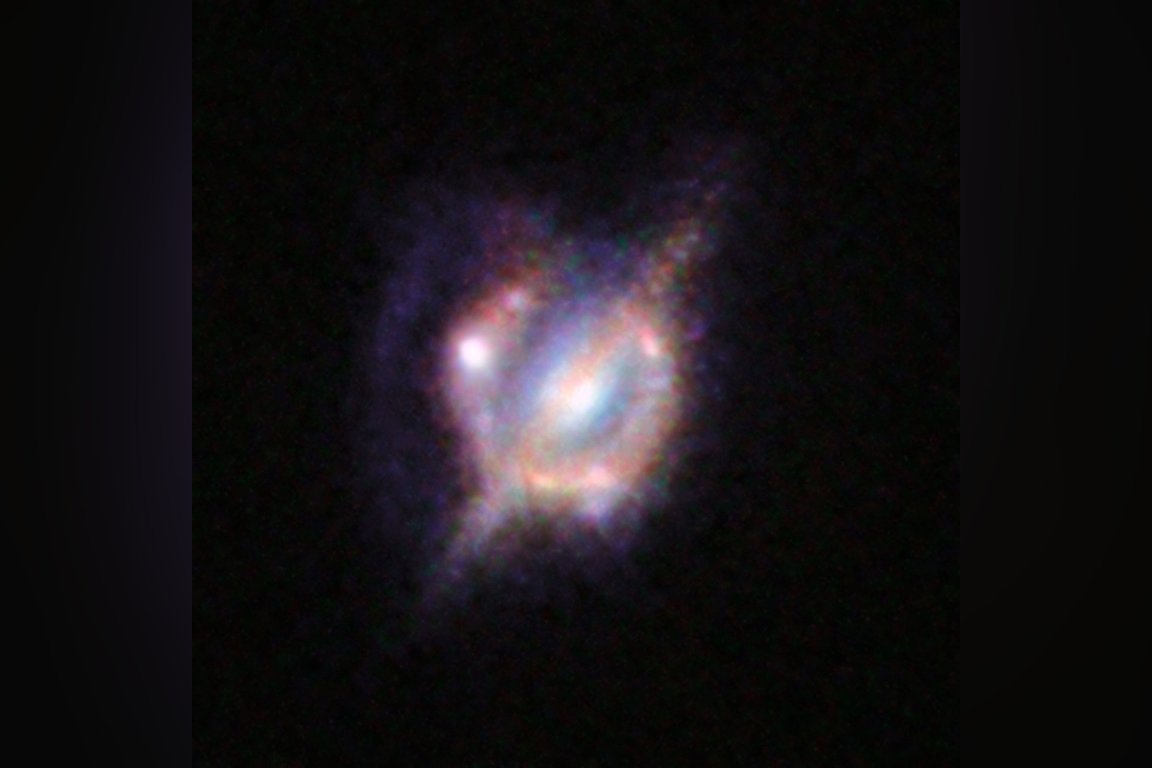
Astronomers using the MeerKAT telescope in South Africa have discovered a powerful microwave laser beam firing off in the distant reaches of the cosmos.
The high-energy emission, known as a maser — and more colloquially, a “space laser” — is produced by the collision of two galaxies. And in their new paper accepted for publication in the journal Monthly Notices of the Royal Astronomical Society and highlighted by New Scientist, the astronomers say it’s the most powerful of its kind ever found.
Detected nearly 8 billion light years away in a galaxy called H1429-0028, the signal was fortuitously amplified by an effect called gravitational lensing, in which the gravity of another galaxy interposed between the Earth and the signal warps the light behind it like a giant magnifying glass.
“This system is truly extraordinary,” lead author Thato Manamela, a postdoctoral researcher at the University of Pretoria, said in a statement about the work. “We’re seeing the radio equivalent of a laser halfway across the universe.”
Fundamentally, masers — and lasers — are focused beams of light in the same frequency. In the realm of astrophysics, these can arise from clouds of dust being excited into a higher energy state from the light emitted by other sources, like stars and black holes in the middle of a feeding frenzy, causing them to release photons. Then the light produced by these interactions cause other particles to become excited and release yet more photons in the same wavelength.
In the case of a galactic merger, the clouds of gas from the colliding realms compress to form stars that produce light, which then can excite hydroxyl molecules. These can be so luminous that astronomers call them “megamasers.” But this latest maser is so powerful that the researchers argue that it warrants an even higher classification: a “gigamaser.”
The lensing effect, plus the signal’s extraordinary luminosity, immediately caught the astronomers’ attention when they probed H1429-0028 with MeerKAT, a radio telescope comprising 64 different antennae linked together.
“We had a quick look at the 1667 megahertz [frequency], just to see whether it was even detectable, and there was this booming, huge [signal]. It was immediately the record,” coauthor Roger Deane, an associate professor at UP, told New Scientist. “It was serendipitous.”
The gigamaser’s strength is about “100,000 times the luminosity of a star, but in a distant galaxy, concentrated into a very, very small part of the [electromagnetic] spectrum,” he added.
Megamasers, let alone gigamasers, are rare. But because the conditions that produce them are so specific, astronomers can use them to infer the conditions of the distant and ancient cosmos. With upgrades to the MeerKAT telescope, the researchers say there’s more of these to be uncovered. “This is just the beginning,” Manamela said in the statement. “We don’t want to find just one system — we want to find hundreds to thousands.”
More on space: Scientists Intrigued as Prominent Star Suddenly Winks Out of Existence