

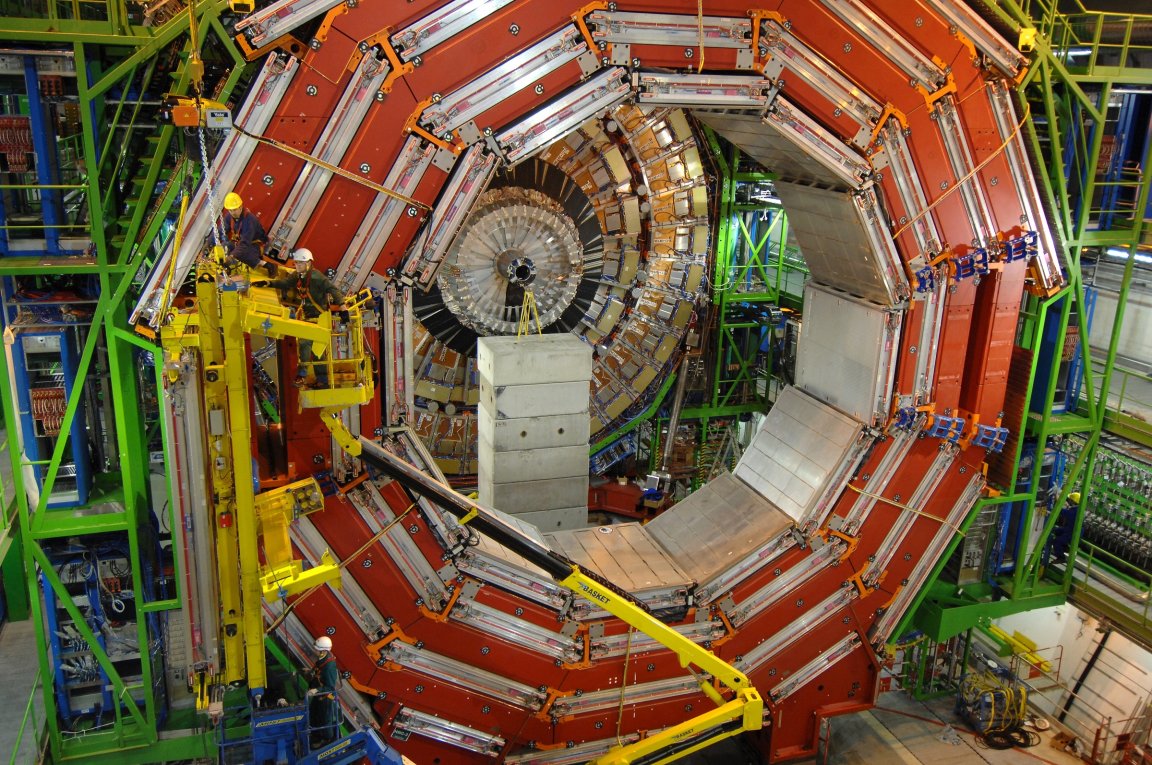
The Large Hadron Collider is going to be shut down — not permanently, but for a pretty long time — and the famous atom smasher’s eventual final retirement is also something that top scientists are now considering.
A 16-mile ring-shaped tunnel near the Swiss-French border, the underground particle accelerator is designed to replicate the cosmos’s extreme conditions shortly after the big bang by whipping up particles to near light speed, at which point physics begins to become extremely weird and counterintuitive. In 2012, scientists used the LHC to discover the existence of the Higgs boson, an elementary particle that, through incredibly esoteric quantum properties, is essentially responsible for giving all other particles their mass.
Even something responsible for one of the most important scientific discoveries in history needs a facelift, however. Beginning in June, engineers will start upgrading the device so that it can carry out ten times the number of particle collisions it currently can do, something that will allow for far more experiments to be conducted, yielding still more troves of data. The project, dubbed the high-luminosity LHC, will take some five years to complete — and while surely worth it in the long run, that’s an immense amount of down time.
Rest assured, the LHC won’t be going dark without leaving physicists quite a bit of homework to complete before its return, according to Mark Thomson, the new director general of CERN, the intergovernmental organization and physics lab that oversees the particle accelerator.
“The machine is running brilliantly and we’re recording huge amounts of data,” Thomson, a professor of experimental particle physics at the University of Cambridge, told The Guardian. “There’s going to be plenty to analyze over the period. The physics results will keep on coming.”
The LHC will be offline during almost all of Thomson’s term, which started on New Year’s Day. In fact, CERN doesn’t expect the high-luminosity LHC to be operational again until mid-2030. But while it may sound like Thomson is taking the reins at a less exciting period in the device’s history, he says he’s thrilled to be giving it a makeover.
“It’s an incredibly exciting project,” Thomson told the newspaper. “It’s more interesting than just sitting here with the machine hammering away.”
Thomson is also taking charge as CERN is planning the LHC’s successor. The leading candidate to replace it, per The Guardian, is the gargantuan Future Circular Collider, which at a proposed 56 miles in circumference would make the Hadron look like the kiddie pool. The first stage, designed to smash together electrons and positrons — the latter are the former’s anti-matter counterpart — would be built in the late 2040s, with another stage taking its place in the 2070s to accelerate protons to even higher speeds.
The FCC’s fate, though, is anything but certain. Its slated cost of nearly $19 billion is too much for CERN to pay on its own, according to The Guardian, and there’s also questions swirling over whether huge particle accelerators represent the best way to probe some of the biggest questions in science, such as the nature of dark matter and dark energy.
Thomson, though, is still a believer in the big atom smasher.
“We’ve not got to the point where we have stopped making discoveries and the FCC is the natural progression. Our goal is to understand the universe at its most fundamental level,” he told The Guardian. “And this is absolutely not the time to give up.”
More on physics: Giant Chinese Orb Detects “Ghost Particles” While Buried Under Mountain