

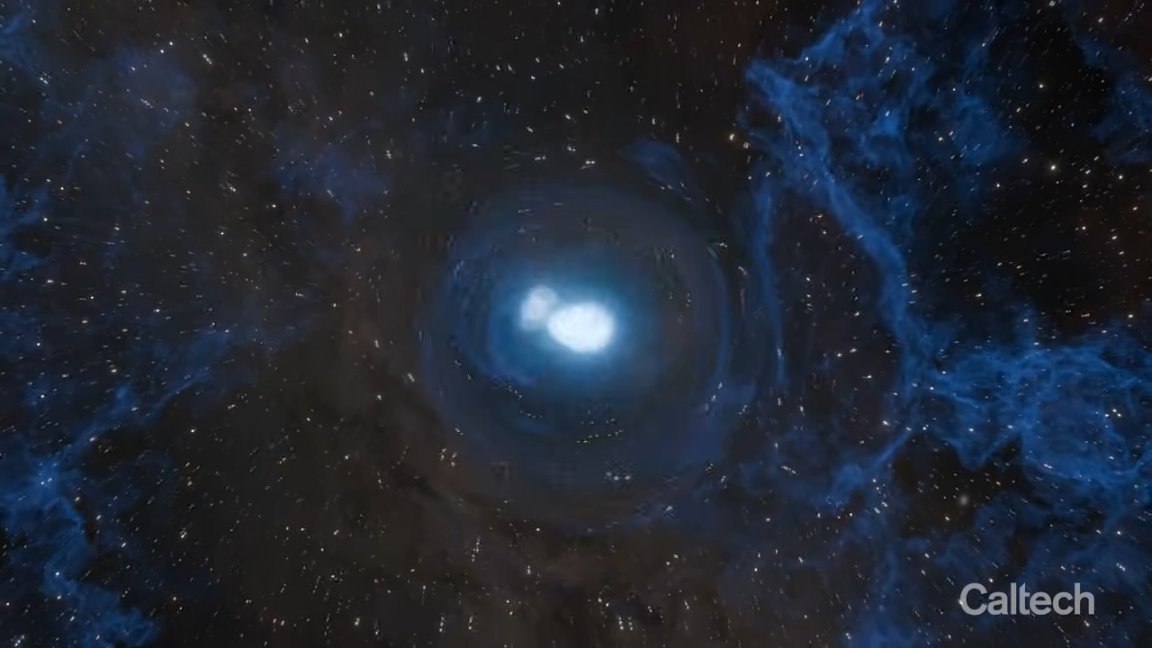
A team of astronomers believe they’ve witnessed a star split in half before merging back together again, triggering an ungodly double explosion that’s sending seismic ripples through both the scientific community and spacetime itself.
The incredible event, designated AT2025ulz, may represent an entirely new class of astrophysical phenomena: a “superkilonova,” meaning an even more spectacular iteration on the already elusive kilonova.
Extraordinary claims require extraordinary evidence, and the findings, described in a study published in The Astrophysical Journal Letters, aren’t hard proof — but they undoubtedly point to something strange afoot.
“Everybody was intensely trying to observe and analyze it, but then it started to look more like a supernova, and some astronomers lost interest. Not us,” lead author Mansi Kasliwa, an astronomer at Caltech, said in a statement about the finding.
Massive stars typically die in an explosion called a supernova, seeding the cosmos with heavy metals and producing a distinct signature. Sometimes, the blasts leave behind an ultra-dense core called a neutron star, which contains more mass than the Sun in a sphere roughly the size of a city.
These, too, can go out with a bang. Neutron stars can be found in binary pairs, and when their incredible gravity draws them together, their collision causes an equally catastrophic explosion called a kilonova. To date, there is only one confirmed detection of a kilonova, which are far rarer than supernovas. One study suggested there’s only ten star systems in the entire Milky Way that will explode this way.
When astronomers were first clued in to AT2025ulz, which is located 1.3 billion light years away, they were getting mixed signals. On August 18, 2025, two observatories, LIGO in the US and Virgo in Europe, detected powerful gravitational waves, or ripples that surge through the fabric of our reality at the speed of light. The signal suggested a merger between two massive objects, like the collision between neutron stars that causes kilonovas.
Hours later, the Zwicky Transient Facility in California looked at the source and found a rapidly fading red object. The light signature was consistent with the aftermath of a kilonova, which glows red from forging heavy elements like gold during the blast.
Days later, though, a curveball was dealt. AT2025ulz brightened, turned blue, and showed signs of hydrogen all across its spectra of light — the telltale sign of a supernova.
The researchers suggest that it may be neither supernova nor kilonova, but a superkilonova. In this scenario, the original star exploded in a supernova and essentially split in twain to birth two, smaller neutron stars, not just one. Trapped inside the remnants of the supernova, the twin stars then spiraled together and exploded in a kilonova, whose signature was initially hidden by the original star’s remains. The hypothesis is supported by gravitational wave data indicating that at least one of the stars was less massive than the Sun.
“We do not know with certainty that we found a superkilonova, but the event nevertheless is eye opening,” Kasliwa said.
More on space: James Webb Discovers Planet Shaped Like Lemon