

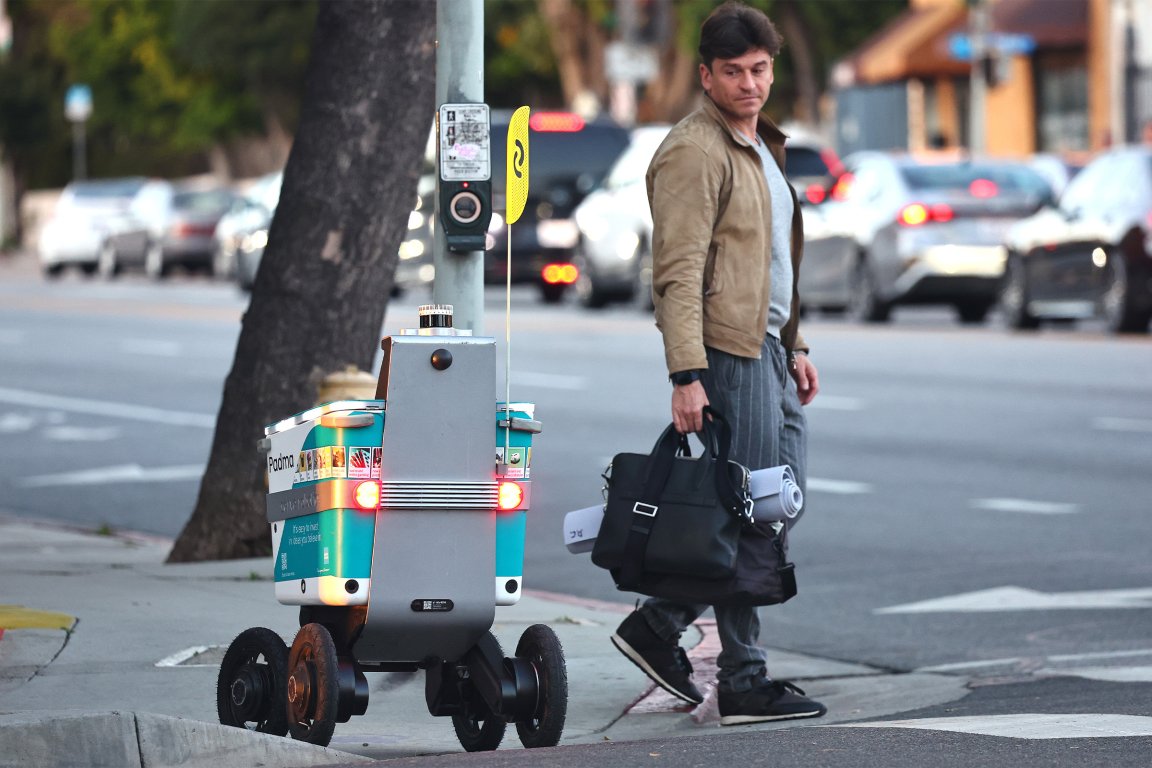
Gig delivery workers, already earning poverty wages, are now being undercut by robots that don’t need tips.
These days, one of the fastest growing new gigs in California is “robot wrangler”: workers paid to tend delivery robots behind the scenes as they trundle around the real world, the Los Angeles Times reports.
When delivery units operated by companies like Coco or Serve Robotics run into real-world obstacles — like a garden, for example — these robot wranglers spring into action, freeing them from potholes, helping them upright after a fall, and ferrying them back to headquarters for maintenance.
Much of the work happens behind the scenes, the LA Times notes. The robots need daily recharging and cleaning, plus constant maintenance for software updates and hardware malfunctions.
Still, a crucial component of the work happens in the streets, where the US’ notorious urban infrastructure can make life hell for a young robot. As the paper explains, it’s not uncommon for robot wranglers to have to come to the aid of their wards, helping them navigate crosswalks and physically drop off food to customers who refuse to come outside.
“They are the kind of jobs that scale with the robots,” Serve Robotics CEO told the LA Times. “If you build more robots, you’re going to still have people whose job is to operate the fleet.”
Be that as it may, delivery drivers in urban settings see the robots as a direct threat to their livelihoods by way of automation, as the new robot wrangler jobs make clear. In Los Angeles, for example, Coco is hiring “robot delivery specialists” to support its fleet of robots across the city, 24/7. “You’ll transport robots to merchant partners, perform basic maintenance, and even complete in-person deliveries when necessary,” the job listing reads.
Do you work as a robot wrangler? We want to hear from you. Email us at tips@futurism.com. We can keep you anonymous.
Wages for this illustrious work start at $21 an hour and top off at $23 — a yearly take-home hovering around $45,760. While that may be higher than what an average Los Angeles delivery driver earns, it’s still well below what’s required in California for a single adult with no children to care for themselves — $63,402, according to MIT’s Living Wage calculator.
And as robotics companies take over gig delivery jobs, they eliminate a low-barrier income source for workers who already have limited options. Of course, delivery work is far from an ideal safety net, but it nonetheless functions as an important financial stopgap for marginalized workers like migrants, single parents, the elderly, and people with disabilities.
If apps like Uber and DoorDash deskill drivers, robots complete the degradation — reducing workers to little more than remote babysitters. When a DoorDash driver closes the app, they presumably drop their obligation to fill orders for the company. Robot wranglers, contracted by the hour, have no such freedom.
Whatever long-term impact delivery robots will have on overall job numbers remains unclear. The business case for the tech is still relatively young, and municipal regulations may slow their rollout to a crawl. At this pivotal juncture, it’s worth asking: do delivery robots represent progress for all, or just Silicon Valley’s latest scheme to cut labor costs under the banner of innovation?
More on robots: Residents Rage Against Fleet of Delivery Robots Taking Over Chicago