

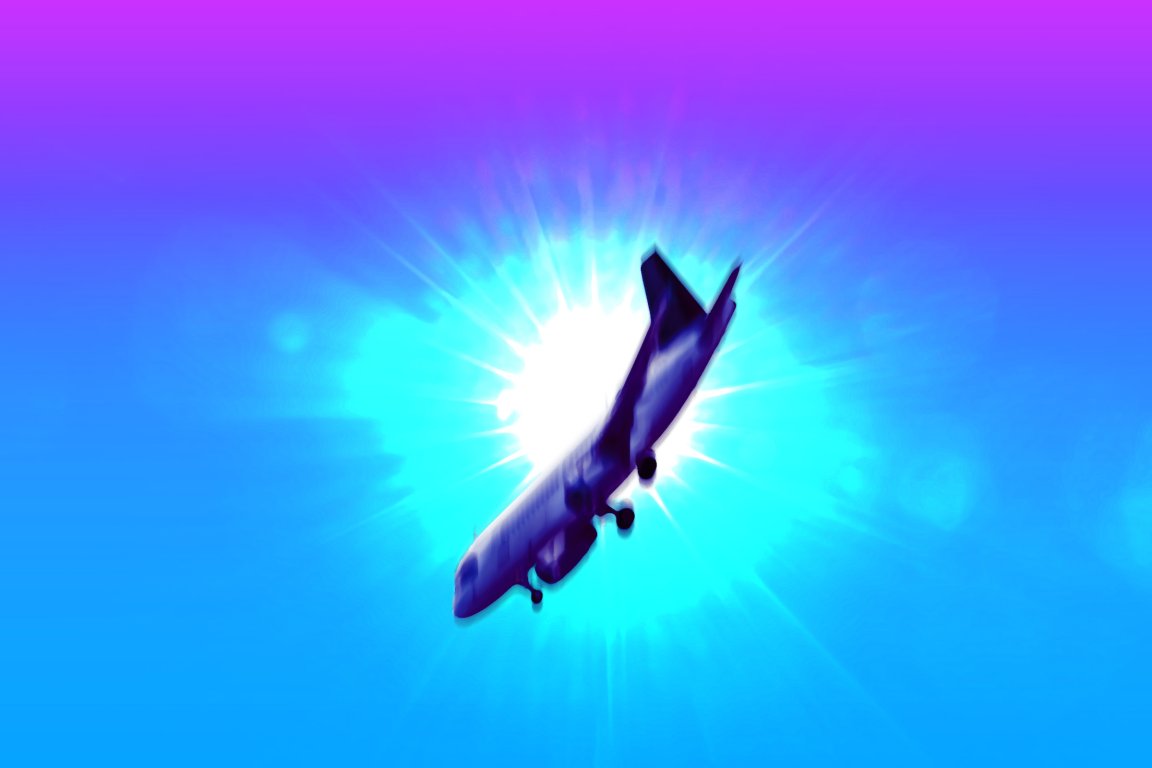
After taking off from Cancun, Mexico, on October 30, a packed JetBlue airliner seemed well on its way for just another uneventful flight. It had reached its cruising altitude of 35,000 feet, at which point the plane practically flies itself, and passengers begin to unwind, unbuckle their seatbelts, and bother their rear neighbors by reclining too far. Its destination: Newark, New Jersey.
Then it suddenly dropped in altitude.
The pilots regained control of the plane, an Airbus A320, but the plunge was so violent and abrupt that at least three passengers cut their heads open after smashing them on the ceiling. After making an emergency landing in Florida, 15 were taken to the hospital.
The cause wasn’t immediately clear. But after grounding more than 6,000 of its planes last week, Airbus finally shared the suspected culprit: cosmic rays from outer space messing up the aircraft’s computer systems.
It may sound like a dog-ate-my-homework type excuse, but it’s very much a real phenomenon. Scientists call these events — an actual nightmare for our art director, who bravely produced this story’s illustration in spite of his mortal fear of flying — a “single-event upset.”
In our everyday, solipsistic existence, we tend to think of the Earth as a hermetic little sanctuary isolated from the greater universe, but the reality is that it’s constantly being bombarded by zips of energy that originate from far beyond. Many of them are the emissions of a star that exploded in a distant supernova; our own Sun also produces weaker cosmic rays during outbursts like solar flares — just last month, it blasted the Earth with the largest solar storm in over two decades.
The rays are made of tiny subatomic particles traveling near the speed of light. When these strike a computer’s memory chip, they can inadvertently flip the value of a bit from 1 to 0, and vice versa. This is called a bit-flip. In the world of computers, they’re cosmic acts of divine intervention.
Sometimes the divine can be benign. A cosmic-ray induced bit-flip is widely believed to have allowed a Super Mario 64 speedrunner to shave a few seconds off their runtime by changing a value associated with the character’s jump height. But they can also wreak havoc on computers controlling more consequential systems, like when a bit-flip accidentally changed the number of votes a candidate received in a 2003 Belgian election.
In the case of the airliner, Airbus in a statement blamed “intense solar radiation” at the time of the incident, which may have corrupted “data critical to the functioning of flight controls.” According to the BBC’s reporting, the bit flip error occurred in the A320’s Elac system, which controls parts of the plane’s wings and tail.
Experts have been warning of cosmic rays’ potential to disrupt flight systems for years. Planes are now controlled by electronic computer systems rather than mechanical ones more than ever, exposing more systems to behaving unexpectedly after a bit-flip disruption.
As part of the grounding, which is one of the largest in aviation history, Airbus is updating its planes’ software to safeguard against bit flips with “rapid refreshing of the corrupted parameter so it has no time to have effect on the flight controls,” it said, per the BBC.
Though it officially blamed solar radiation, some experts are skeptical of the explanation. “On that particular day… there wasn’t anything special going on in terms of solar radiation,” Keith Ryden, professor of space engineering at the University of Surrey in the UK told the BBC. “That’s a little bit of a mystery from my point of view.”
If the Sun wasn’t the source, though, the disruptive rays could very well have come from deep space.
More on space: NASA Says Boeing’s Busted Starliner Spacecraft Won’t Be Allowed to Carry Astronauts on Next Mission