

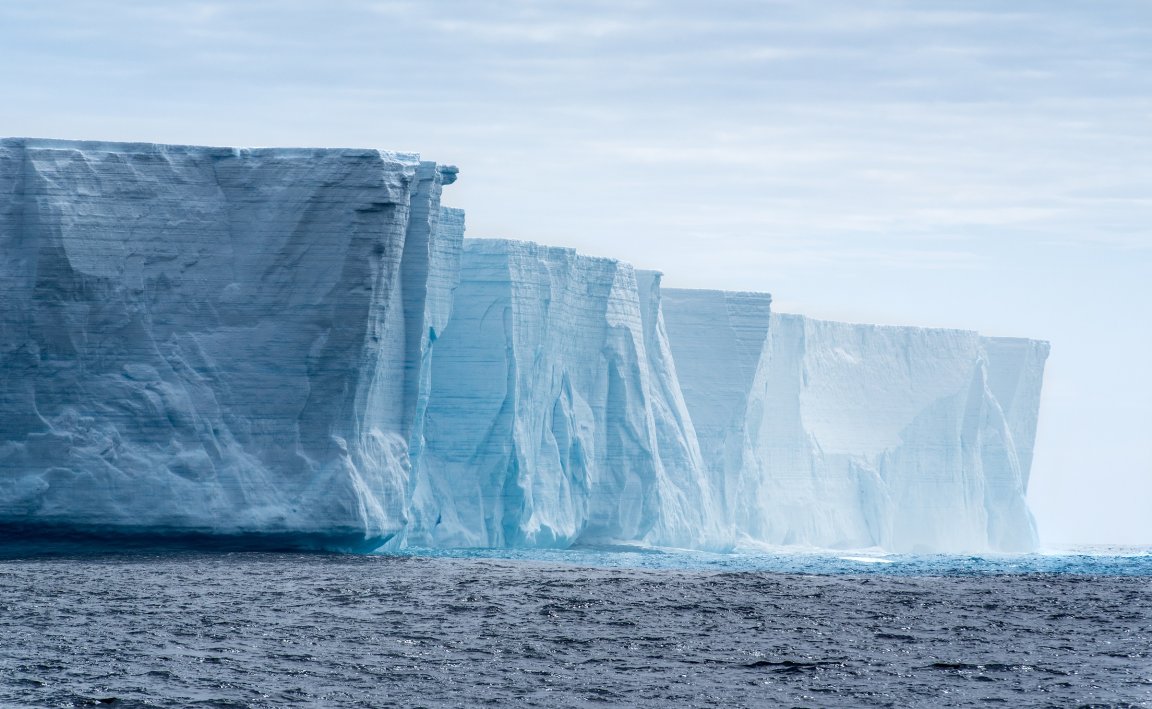
A team of scientists are staring climate change in the eye, the New York Times reports, setting sail for the infamous “Doomsday Glacier” in Antarctica in an attempt to study it up close.
The enormous Thwaites Glacier, at roughly the size of Florida, harbors enough water to raise sea levels across the globe by over two feet should it melt completely. Research has suggested that it’s already undergoing rapid melting — but its future, which holds the fate of our planet in the balance, is uncertain.
On Saturday, a crew of nearly 40 researchers left on a ship from a port in New Zealand to get more answers. A number of intriguing experiments are slated, but everyone’s going in knowing that all won’t go according to plan.
“There will be a Plan A through F,” Chris Pierce, a glaciologist at Montana State University whose team hopes to use airborne radar to effectively x-ray Thwaites’ ice, told the NYT.
There’s no doubt that Thwaites is melting quickly. How quickly, and what its melting could cause, however, are the questions that loom large.
Scientists fear that the glacier’s melting could trigger a collapse of the broader West Antarctic ice sheet. Over a mile thick in some portions, if the sheet collapsed, it could raise sea levels by up to a staggering 15 feet, practically drowning the planet over the course of several centuries. This is a worst case scenario, but the possibility is too severe to ignore, with some evidence suggesting that a similar event may have taken place around 120,000 years ago.
Recent research has suggested that Thwaites is more vulnerable to warming than once thought. Perhaps the most alarming discovery was that the glacier’s vast underbelly, once thought to be sealed off from warming because it hugged the seafloor, was being exposed to warm seawater which sneaks in as rising tides lift the glacier off the seafloor, causing “vigorous melting.”
“Thwaites has really broken up in front of our eyes,” Doug Benn, a glaciologist at the University of St. Andrews in Scotland, told the NYT.
One of the most intriguing experiments will rely on an unlikely source of help: seals. Rather than having robots collect data, the researchers will attach sensors to the blubbery mammals, collecting data on ocean temperature and salinity that’s transmitted to satellites.
The data the seals gather won’t be as random as you might think, Lars Boehme, an ecologist at the University of St. Andrews, told the NYT. The seals “go where the food is,” Boehme said. “And very often, that’s a place where, in terms of the environment and oceanography, things are happening.”
More on climate change: Rivers Turn Bright Orange in Alaska