

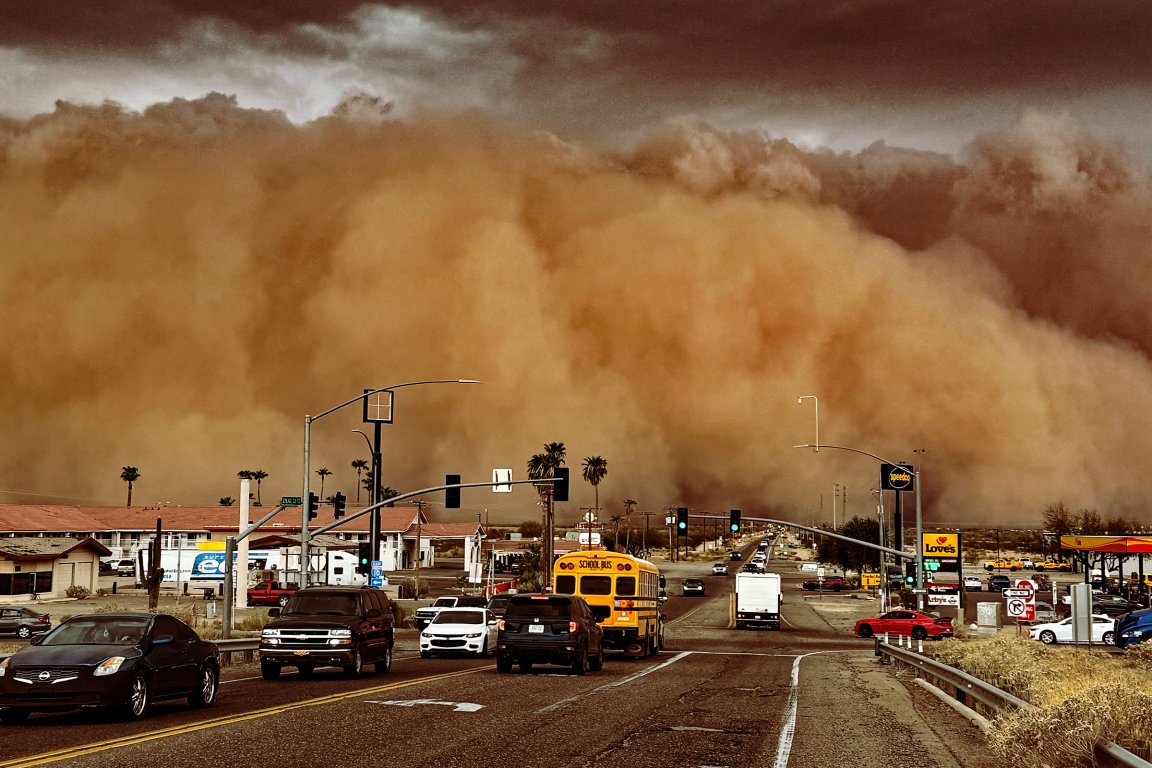
Dust storms are becoming increasingly common sights throughout much of the US, fueled by hot and arid conditions brought about by global warming. While there are the ever-present dusters in states like Arizona, those living in regions like the Midwest and Pacific Northwest are now learning what it means to be swallowed by these great walls of sand and dirt.
These dust storms are dangerous enough on their own, leading to spikes in emergency room visits and disrupting agricultural economies. But according to writing climate scientist Bill McGuire in the BBC’s Science Focus, dust storms are now becoming vectors for massive clouds of fungal spores, an event he calls “fungal storms.”
Far-out as that may sound, McGuire writes that fungus and bacteria traveling along with dust particles has been strongly correlated with outbreaks of bacterial meningitis across the Sahel region of Africa. In the continental US, they’re becoming increasingly tied to outbreaks of Valley Fever, a lung infection caused by the spores from the fungus Coccidioides.
One 2017 research paper published in Geophysical Research Letters noted that incidents of Valley Fever ballooned by over 800 percent from 2000 to 2011. In two geographical areas with high concentrations of the infection, dust storms where “found to better correlated with the disease than any other known controlling factor.”
Though some have argued the term “fungal storm” is more media hyperbole than a well-defined scientific phenomenon, further research has noted “abundant evidence” pointing to dust storms as a vector for pathogens like Valley Fever.
Whatever you call it, it’s clear the dangers of dust storms are growing right before our eyes.
As secretary general of the World Meteorological Organization Celeste Saulo told McGuire, “sand and dust storms do not just mean dirty windows and hazy skies. They harm the health and quality of life of millions of people and cost many millions of dollars through disruption to air and ground transport, on agriculture and on solar energy production.”
More on climate change: The Upcoming El Niño Is About to Unleash Devastation, Experts Warn