

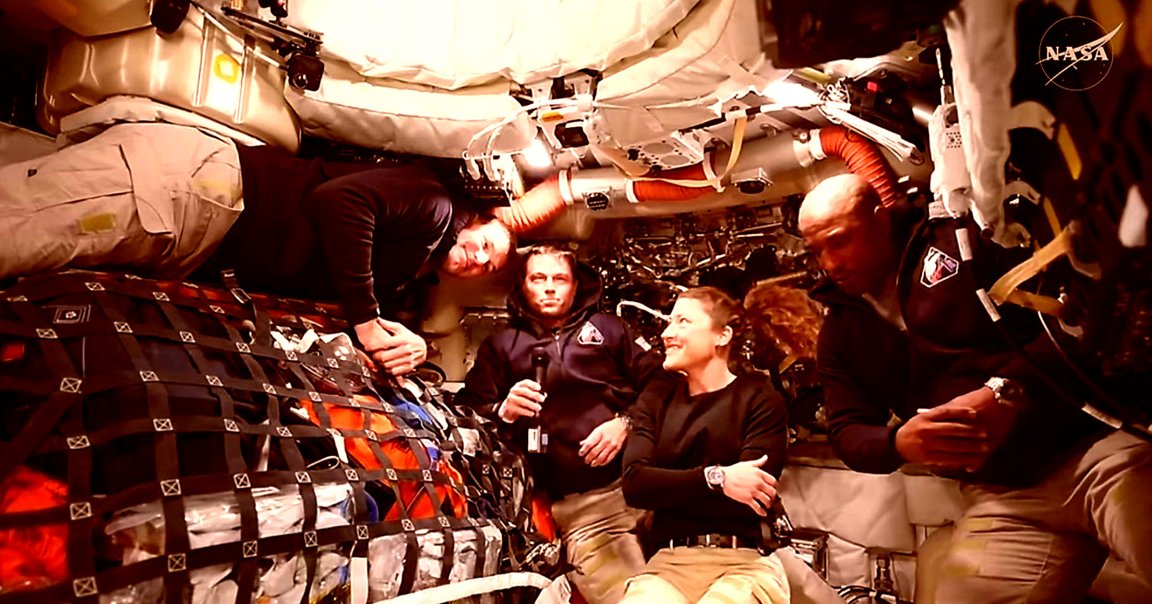
NASA’s historic Artemis 2 mission launched without a hitch last week, sending the first astronauts toward the Moon since 1972 — but their journey hasn’t been without hiccups.
Their space toilet, in particular — the space agency’s newfangled Universal Waste Management System (UWMS) — has turned out to be a considerable pain point.
Mere hours into their ten-day trip around the Moon, the toilet jammed, with NASA officials delivering the crew an unfortunate piece of news: it was only accepting solid waste.
While the issue was ultimately corrected when NASA astronaut Christina Koch realized the pump hadn’t been primed with enough liquid, the interplanetary commode broke down once again over the weekend.
This time, “it’s an issue with dumping the waste out of the toilet,” as flight director Judd Frieling told reporters on Saturday, as quoted by CNN. “And so it appears to me that we probably have some frozen urine in the vent line.”
And in the midst of it all, yet another issue with the toilet manifested itself in a way that’s particularly alarming in the closed confines of a spacecraft.
“For me, it was some sort of burning odor, and then it was definitely in the hygiene bay,” Canadian Space Agency astronaut and mission specialist Jeremy Hansen told reporters late Friday. “And when I opened up the hygiene bay, the rest of the crew could smell it pretty much immediately.”
The odor was like “when you turn on a heater that’s been sitting for a while and… you smell that burnt smell that comes from that,” Hansen explained. “And I do think it smells similar to that.”
Ground control suspects the odor was caused by insulation around the door of the toilet heating up.
The team’s space toilet is, at least potentially, a substantial upgrade over the chaotic free-for-all during the Apollo missions, which saw astronauts pooping into bags unassisted, which in one gross situation even led to pieces of fecal matter floating through their capsule.
It’s not a glamorous part of exploring space. The UWMS is designed to vent urine into the icy vacuum while a toilet seat and pump deposits fecal matter into a bag liner to be collected and brought back to Earth, closely resembling the one found on board the International Space Station.
NASA had planned for the possibility that the toilet could break down en route. For instance, the Collapsable Contingency Urinal (CCU), a long and slender device with a nozzle at one end, as seen in an image shared by NASA astronaut Donald Pettit, is designed to suck up urine, replacing the “need for about 25 pounds of diapers,” according to Pettit.
While the crew slept after identifying the frozen urine line, mission controllers pored over the broken down toilet and settled on a plan of attack by Saturday afternoon: the crew’s entire Orion capsule would rotate to expose the crystallized pee to the warming rays of the Sun to unclog it.
The plan worked, but only well enough to be “go” for “fecal use only,” according to Frieling.
Many hours later, ground control once again gave the crew the go ahead “for all types of use of the toilet,” according to capsule communicator Jacki Mahaffey.
“And the crew rejoices!” Koch replied.
More on the space toilet: NASA Spacecraft’s Toilet Fails Hours Into Ten-Day Journey to Moon