

With over 1,100 satellites currently in orbit and plans to complete a massive megaconstellation in the coming years, China has plenty of flashy experiments in orbital tech underway, from hatching a butterfly in zero gravity to hosting a sumptuous barbeque in orbit.
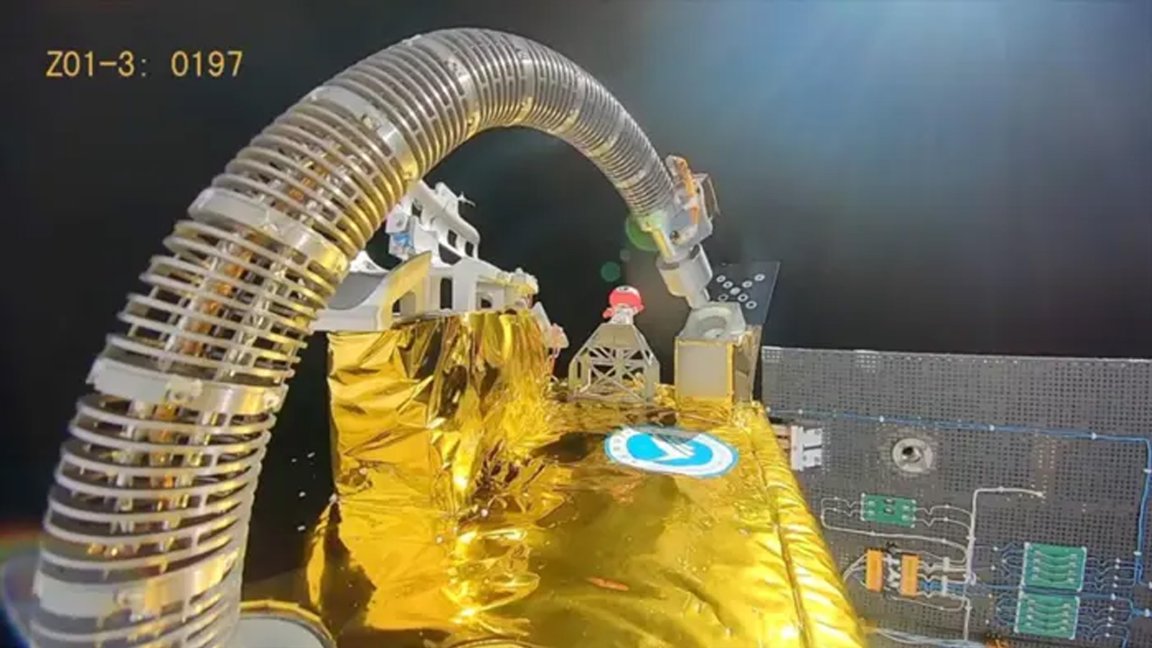
Another promising test is the Yuxing 3-06, also known as the Hukeda-2, a low earth orbit (LEO) satellite sporting a robotic “octopus tentacle” for pumping fellow spacecraft full of rocket fuel.
According to CCTV, the craft — which launched on March 16 — has now successfully completed a demonstration of its robotic appendage, which involved both a compliance control and refueling test. To complete the test, the robotic tentacle inserted a nozzled tip into its own dummy fuel port while flying around the planet at around 16,800 miles per hour, the South China Morning Post reported.
The arm is basically an assemblage of spring-laden tubes articulated via individually motorized cables, SCMP notes, designed to maneuver in the microgravity of LEO.
The demo is the first step toward establishing the Yuxing 3-06’s fuel-arm platform as a viable aerospace product, which could eventually lead to the world’s operational first “space refueling station.” If such a satellite could ever become technically and financially feasible, it could significantly extend the lifespan of LEO satellites.
The first successful demonstration of any LEO gas station came in 2007, when DARPA’s Orbital Express test successfully transferred fuel from one experimental craft to another. But the Orbital Express refueling system was purpose-built to explore the mechanics of LEO refueling, unlike the Yuxing 3-06, which is part of a stated large-scale commercial production.
Currently, satellites have a fixed lifespan, as they have a finite amount of fuel with which to maintain their positioning in LEO. When that fuel runs out, the craft can no longer fight against the friction of atmospheric gasses, which eventually drag them back down to Earth.
On top of creating literal tons of space junk, this situation is also a massive financial headache — when one satellite comes down, another must go up to replace it. At tens of millions of dollars to replenish a single satellite, the economics are brutal — meaning whoever solves the problem of orbital refueling could secure dominance over the skies for a fraction of the cost.
More on satellites: SpaceX’s One Million Orbital Data Centers Would Be Debilitating for Astronomy Research, Scientists Say