

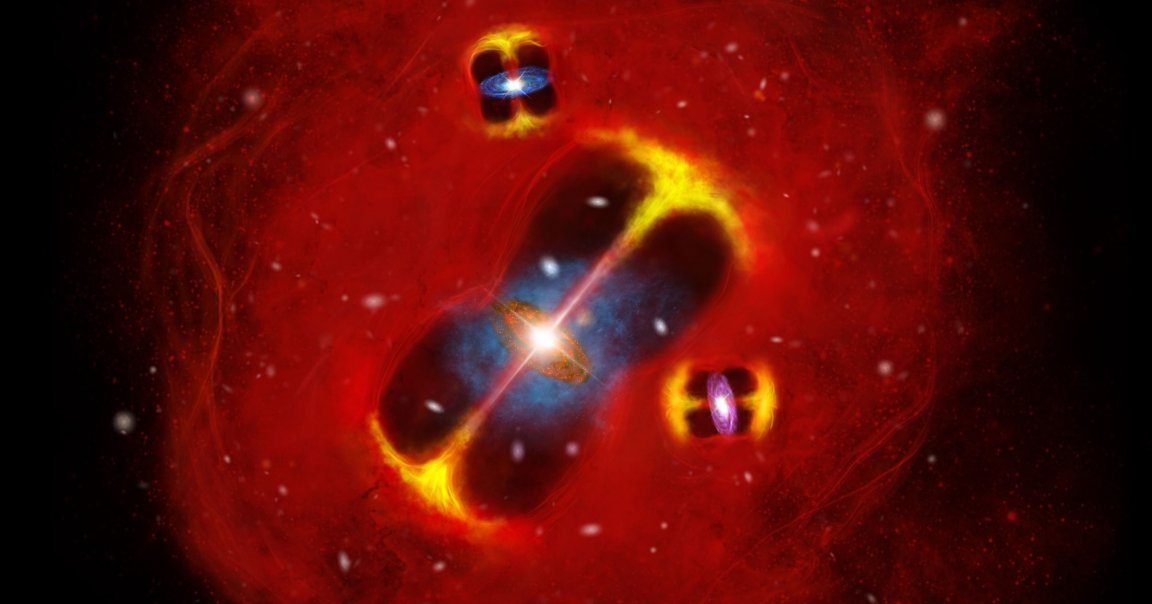
While peering into some of the oldest regions of the known universe — dating back to just 1.4 billion years after the Big Bang — an international team of astronomers made a puzzling discovery.
As detailed in a paper published the journal Nature, they discovered an extremely hot galaxy cluster that’s far hotter and older than current theories allow.
In other words, the discovered cluster is, under our current best understanding of cosmology, impossible — which could upend our current understanding of how the early universe evolved.
“We didn’t expect to see such a hot cluster atmosphere so early in cosmic history,” said lead author and University of British Columbia PhD candidate Dazhi Zhou in a statement about the finding.
“In fact, at first I was skeptical about the signal as it was too strong to be real,” he added. “But after months of verification, we’ve confirmed this gas is at least five times hotter than predicted, and even hotter and more energetic than what we find in many present-day clusters.”
The astronomers’ best theory is that the cluster somehow got a massive head start — previously unimaginable even to top thinkers — thanks to black holes lurking at its core.
“This tells us that something in the early universe, likely three recently discovered supermassive black holes in the cluster, were already pumping huge amounts of energy into the surroundings and shaping the young cluster,” added coauthor and Dalhousie University professor Scott Chapman, “much earlier and more strongly than we thought.”
Conventional theories suggest that galaxy clusters gain energy as the gases inside are pulled together and squeezed due to intensifying gravitational forces. The latest research, however, suggests there’s more to how these clusters evolve — perhaps even a separate source beyond these gravitational forces.
The team found the strange readings when they analyzed observations by the Atacama Large Millimeter/submillimeter Array (ALMA) in the Atacama desert in Chile that examined a “baby” galaxy cluster called SPT2349-56.
The cluster, which dates back to around 12 billion years, is huge: its core alone measures around half a million light-years across. That’s roughly the size of the halo that circles our own Milky Way galaxy, a vast region that contains globular clusters and older stars — yet it spawns stars more than 5,000 times faster.
The astronomers are hoping to figure out what allowed it to get so incredibly hot, a source of energy that defies our current models. The research suggests galaxy clusters evolve in a far more explosive manner than previously thought, aided by gravitational interactions between multiple supermassive black holes.
“We want to figure out how the intense star formation, the active black holes and this overheated atmosphere interact, and what it tells us about how present galaxy clusters were built,” Zhou explained in the statement. “How can all of this be happening at once in such a young, compact system?”
“Understanding galaxy clusters is the key to understanding the biggest galaxies in the universe,” Chapman said. “These massive galaxies mostly reside in clusters, and their evolution is heavily shaped by the very strong environment of the clusters as they form, including the intracluster medium.”
More on galaxy clusters: Scientists Intrigued by Bridge of Dark Matter Inside Huge Galaxy Cluster