

Earlier this year, it was widely reported that Immigration and Customs Enforcement was trying to get its hands on $20 million worth of electric shock gloves — discreet compliance devices designed to do exactly what it sounds like: electrocute anybody who gets in their way.
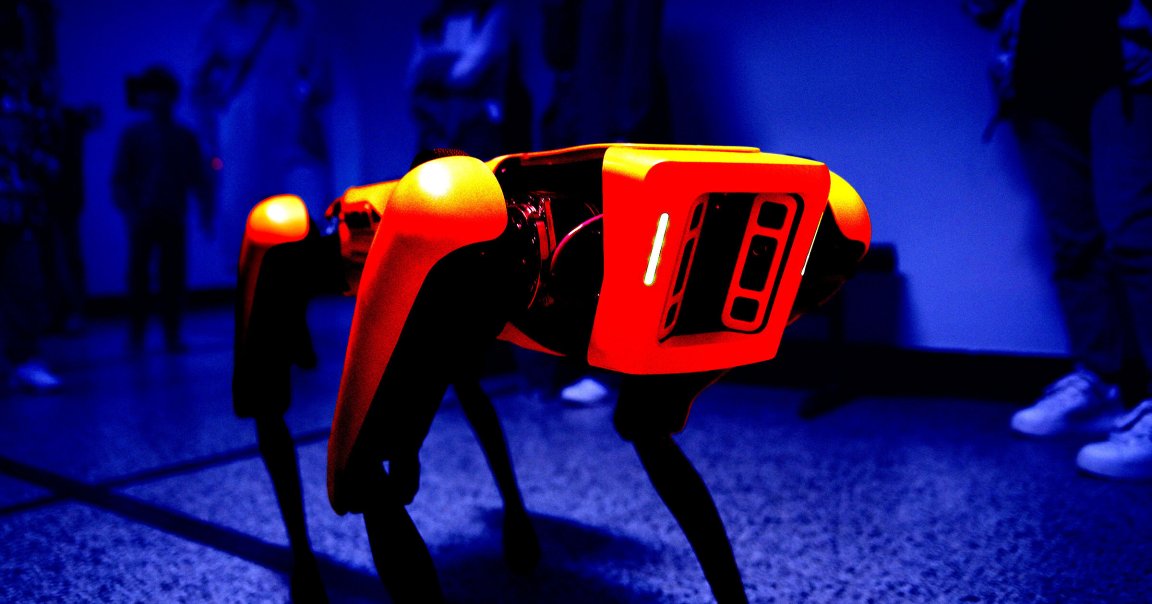
Now, it seems ICE is trying to add to the arsenal of dystopian techno-gadgetry, through the procurement of AI-integrated robot dogs.
That’s according to ABC News, which viewed a federal procurement notice showing ICE is planning to spend up to $2 million to procure a number of Spot robots from Boston Dynamics.
Equipped with extendable arms and 360-degree cameras, the mechanical canines will supposedly help “support public safety and law enforcement operations by providing a remotely operated robotic capability for inspection, situational awareness, and hazard assessment in environments that may pose risks to personnel,” per the filing.
After we first published this story, a Boston Dynamics spokesperson reached out to insist that the dogs “would not be used to hurt or intimidate people.”
“Under DHS, ICE has two distinct law enforcement divisions: Homeland Security Investigations (HSI) and Enforcement & Removal Operations (ERO),” the company said in a statement. “The Spot robots in question are being procured for the Homeland Security Investigations unit. HSI is the main criminal investigations arm of ICE, which investigates transnational crimes such as human trafficking, drug smuggling, child exploitation, money laundering, weapons trafficking, cybercrime, and export violations.”
“The robots are being outfitted with a specialized payload called a CBRNe kit, which has sensors that detect chemical, biological, radiological, nuclear, and explosive hazards,” the statement continued. “Spot applications for this kind of public safety work typically include things like hazardous gas detection, unexploded ordnance inspection, suspicious package investigation, search and rescue, subterranean or confined space exploration, and structural assessments following fires, disaster events, and other hazards. Spot provides situational awareness and improves safety for law enforcement officers, first responders, victims, suspects, and bystanders.”
If ICE misused the robot, the spokesperson said, Boston Dynamics “would take immediate action. That would include specific steps like voiding the warranty, refusing all future software updates, terminating their license, taking any appropriate legal action available to us, and likely never selling to that customer again. Fortunately, while those remedies exist, our clear communications with DHS and other customers have ensured that our robots are used in compliance with our terms and conditions of sale.”
With a price tag of around $120,000 for a single Spot unit complete with extendable arm, ICE’s budget would only secure it 16 total robodogs (the spokesperson said the total would be only five.) This is typical of federal agencies trying out new tech, which is tested in small batches in order to probe the long-term viability of a given toy.
For ICE, the dogs could also serve as the centerpiece of some blistering new propaganda. The agency’s publicity blitz has taken an extraordinarily dark turn since Donald Trump’s return to office, with overtly violent raids on civilians being filmed and edited into vertical video content.
Technology plays a key role in this propaganda: one quick-cut hype reel shared by the Department of Homeland Security shows high-tech police gadgets interstitched with ICE enforcement footage, including drones breaking car windows, aerial video of refugees on boats, an AI-targeting HUD, and for a split second, a robot dog ascending the stairs.
In this way, ICE’s high-tech surveillance toys pull double-duty — first as tools to conduct its violent raids on immigrant communities, and then as flashy fodder for the Trump admin’s content farms.
More on ICE: So Many Women Are Miscarrying in Detention Centers That ICE Has Lost Count