

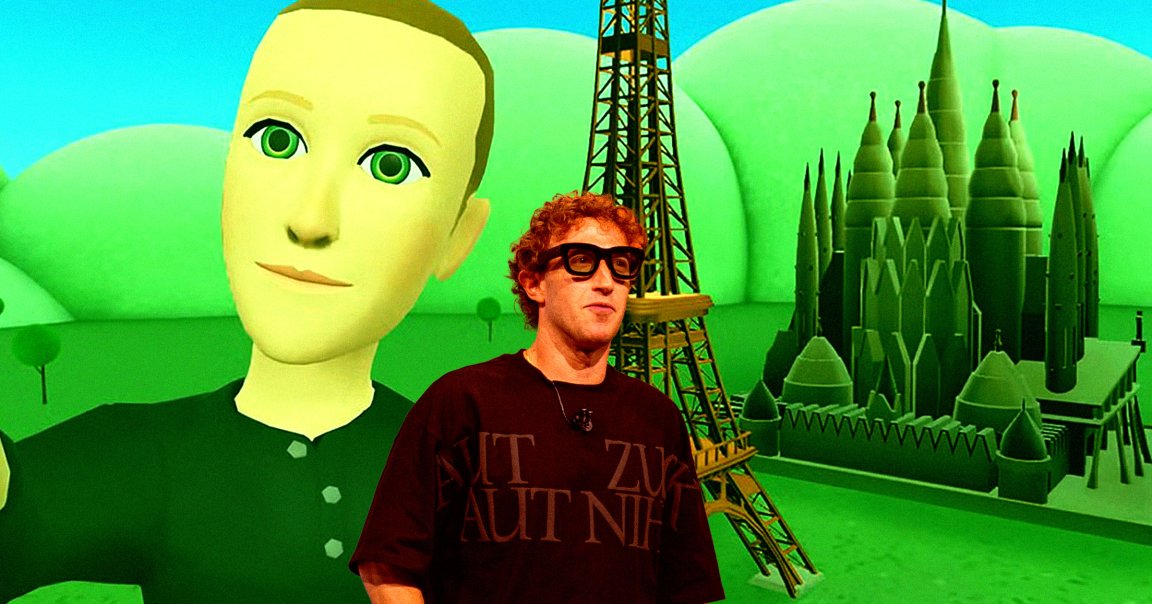
In October 2021, Facebook CEO Mark Zuckerberg revealed that his social media empire was officially rebranding itself as “Meta” as part of a sweeping company-wide doubling down on virtual reality tech.
The head-scratching pivot has been nothing short of a disaster ever since, from blocky “Horizon Worlds” online environments filled with screeching children to never-ending rounds of layoffs and exorbitant losses.
All told, the company has lost more than $70 billion since the beginning of 2021 on its enormous long-term VR bet, a staggering sum that has left investors itchy and unimpressed as Zuckerberg has failed to convince the public of the high-fidelity virtual spaces he long insisted we’d be choosing to spend most of our time in.
Now, as Bloomberg reports, the company’s executives are eying gigantic budget cuts, as high as 30 percent, for the teams responsible for its Meta Horizon Worlds product and Quest VR headset — another nail in the coffin for Zuckerberg’s obsession that has been a major thorn in the sides of investors for years now. Layoffs could start as soon as January, but final decisions have yet to be made.
In fact, following Bloomberg’s reporting, Meta’s stock jumped over four percent on Thursday, underscoring the degree to which shareholders have grown fed up with the company trying to make the metaverse happen.
“Smart move, just late,” Huber Research Partners analyst Craig Huber told Reuters. “This seems a major shift to align costs with a revenue outlook that surely is not as prosperous as management thought years ago.”
Besides, Meta and Zuckerberg have now found their next obsession: artificial intelligence. The company has committed to spending an astronomical $72 billion on AI this year — roughly as much as the company’s lost on the metaverse, coincidentally.
The cuts are part of a broader effort to rein in budgets by ten percent across the board, inside sources told Bloomberg — and, by all accounts, the changes could hit the company’s overarching Reality Labs division hard.
The cuts were reportedly born out of the realization that competition in the virtual reality space simply hasn’t taken off as expected.
They will also likely be a sight for sore eyes for investors, who have long accused the company’s metaverse of being an extremely expensive distraction and a drain on resources.
Could this really be the end of Zuckerberg’s dream of a metaverse? It’ll still exist in some form — but at this point, the writing is probably on the wall.
More on the metaverse: Mark Zuckerberg Allegedly Said Child Safety Was Less Important Than “Building the Metaverse”