

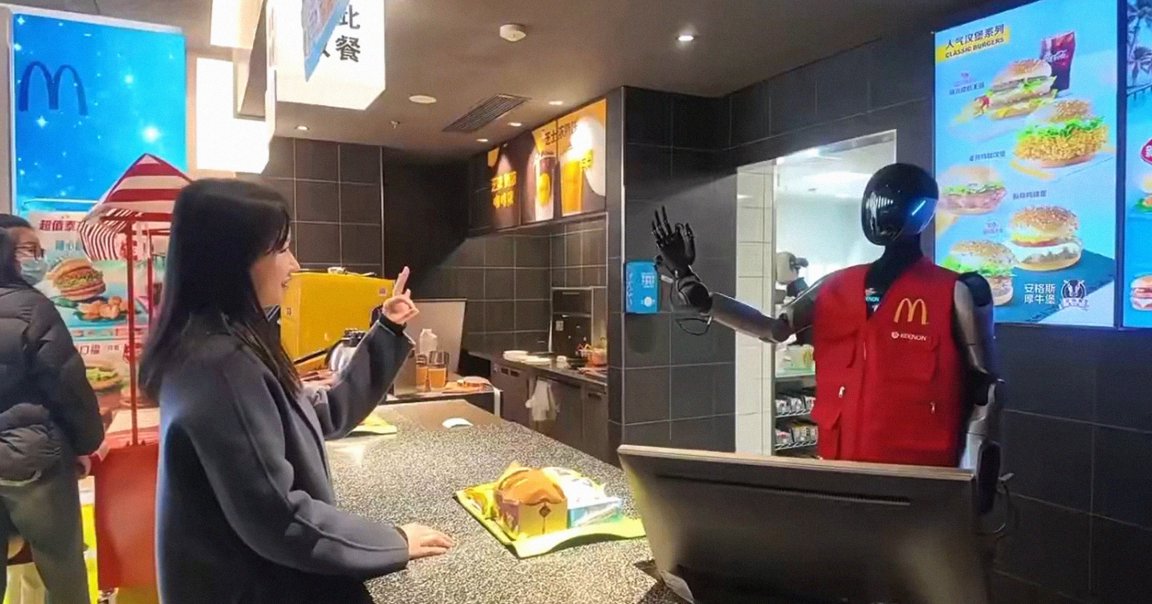
A video is making the rounds on social media, showing a uniformed robotic employee at a McDonald’s in Shanghai, China greeting a patron while seemingly taking their order.
The stunt was a joint collaboration between the fast food chain and Keenon Robotics, an international company specializing in service robots, like the serving trays on wheels that are becoming an increasingly common sight at restaurants around the world.
After the video went viral, it was immediately followed by breathless coverage in the media about humanoid robots being tested “on the front line.”
“McDonald’s experimenting with robot employees that look like humans — and even dress in uniform,” the New York Post wrote.
The reaction isn’t exactly surprising. After all, the topic of humanoid robots coming for our jobs has been front of mind as companies continue to make technological leaps, allowing them to become astonishingly agile and increasingly capable.
But the reality behind the stunt undercuts all that overheated coverage.
“Just to be clear — the robots were part of the grand opening of the Shanghai Science and Technology Museum restaurant,” McDonald’s global chief impact officer Jon Banner tweeted in response to the widely shared video. “The robots were requested by the museum to draw attention through a temporary greeting. Mission accomplished!”
Banner also denied that the fast food chain was replacing any human labor at its restaurants.
“The robots were not involved in any service or operational functions,” he added. “And if you didn’t visit prior to today, you missed them.”
Intentionally or not, the optics are messy. Why dress humanoid robots in human staffer uniforms if they’re not actually doing any work?
“Our Humanoid series are leading the squad and hitting the streets,” Keenon wrote in a Facebook post. “It’s a showcase of how service automation is becoming a seamless part of global dining, and how technology brings more smiles to every mealtime.”
It’s not the company’s first collaboration with a fast food brand. In a video on its homepage, the company quotes Burger King regional manager Riku-Matti Meuronen, who said that the company’s wheeled serving robots put a “smile” on children’s faces during a different event.
The confusion surrounding the publicity stunt highlights the public’s growing wariness of humanoid robots replacing human labor, a trend that’s already well underway at some companies.
Fast food chains have also resorted to other tech, like self-serve kiosks to speed up the ordering process and AI chatbots at drive-thru lanes — often with less than-stellar results.
More on humanoid robots: Trade Unions Alarmed by Robots Designed to Do Blue Collar Work