

In early November, Chinese astronauts on board the country’s Tiangong space station made a terrifying discovery. According to state news reports at the time, they found “tiny cracks” in their Shenzhou return spacecraft’s viewport window that were most likely the result of a collision with space debris.
The alarming finding forced China’s space agency to delay the affected crew’s return, triggering a convoluted game of musical chairs as the cracked spacecraft was deemed not safe enough for crewed flight. Fortunately, a replacement spacecraft that was sent to the station without a crew on board allowed the astronauts to safely return to the ground.
Now, new details about the incident have emerged, revealing that the situation was even more serious than initially reported, with some cracks penetrating the spacecraft’s window.
“My first thought was whether a small leaf had somehow stuck to the outside of the window,” said Shenzhou-20 crew member Chen Dong during a recent interview aired by China Central Television (CCTV), as quoted by Space.com. “But then I quickly realized that couldn’t happen because we were in space. How could there possibly be a fallen leaf there?”
The team used a “pen-shaped microscope” connected to a tablet to have a closer look.
“We could see very clearly the small cracks [with the microscope],” Chen recalled. “Several were relatively long, and one was shorter. We could also see that some of the cracks had penetrated through.”
Fellow crew member Wang Jie, who worked as an aerospace technician before becoming an astronaut, said he “wasn’t really nervous,” pointing out that the “outermost layer of the viewport is a protective layer, and inside it there are two pressure-bearing layers, and we are safe as long as the cabin pressure doesn’t change.”
To remedy the situation, the China National Space Administration said in a statement that it had launched a “porthole crack repair device” along with its emergency spacecraft. “Astronauts installed it inside the Shenzhou-20 capsule, effectively improving the spacecraft’s heat protection and sealing capabilities during reentry.”
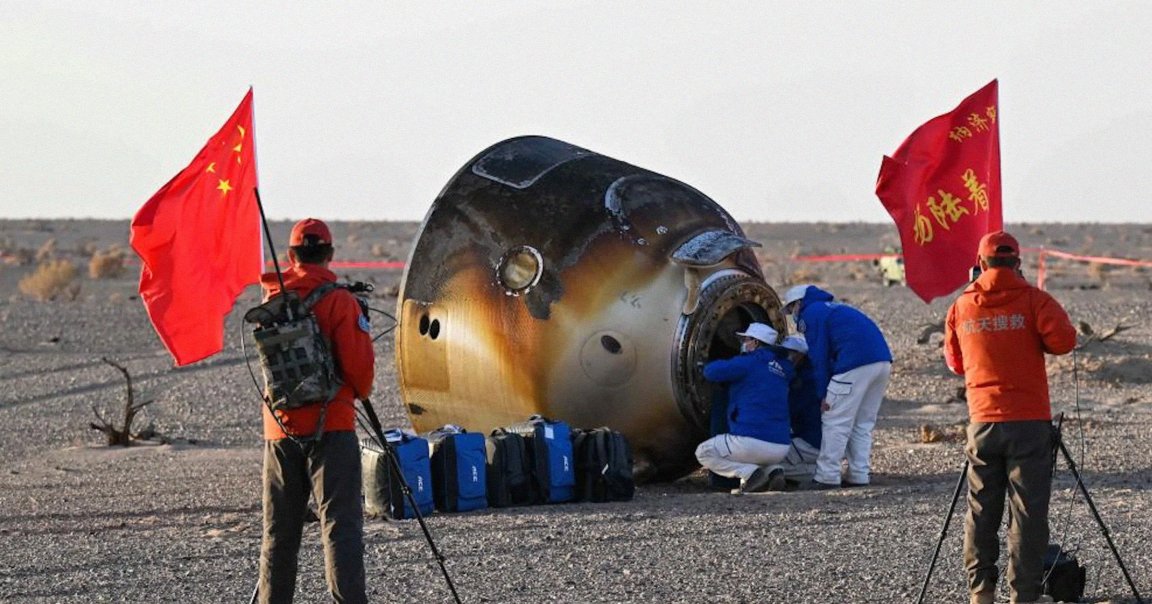
The space capsule with the cracked window ultimately landed without a crew on board in Mongolia on January 19, concluding the incident. But even the landing wasn’t exactly straightforward. Since no crew was able to separate the main parachute, teams on the ground were afraid the capsule would be dragged on the ground, so they had to act quickly, as officials explained during the recently televised interviews.
Fortunately, the capsule’s exterior post-reentry was “generally normal,” according to a CNSA statement at the time.
While no crew member appears to have been in any danger, the incident highlights how space junk continues to be a major problem for humanity’s presence in space. Especially as companies build out plans for enormous megaconstellations of satellites, we’re launching cargo to orbit at an unprecedented rate — which could risk cracking more than a viewport window in the near future as the Earth’s orbit is turned into a minefield.
More on the situation: Chinese Astronauts Clamber Outside Space Station to Inspect Damaged Spacecraft