

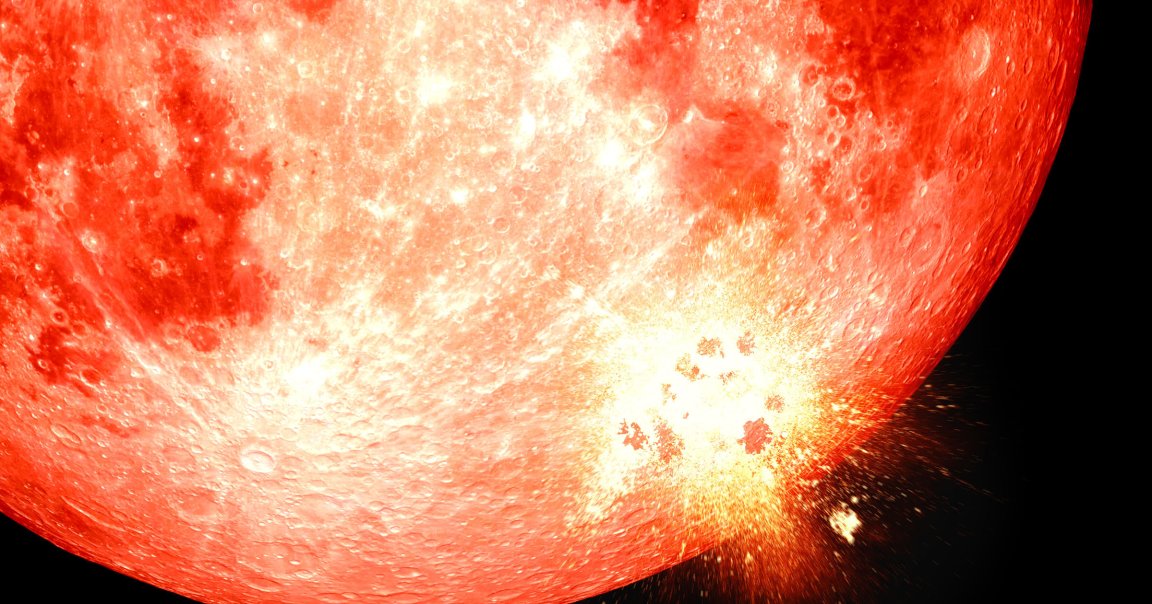
One of Elon Musk’s spacecraft will finally reach the lunar surface — but probably not in the way he envisioned.
According to a new report, the discarded upper stage of a SpaceX Falcon rocket will smash into the Moon this summer, potentially blasting open a new crater. While it may be of some minor scientific interest, it’s mainly an omen of how space junk may come back to haunt lunar missions in the future.
“It doesn’t present any danger to anyone, though it does highlight a certain carelessness about how leftover space hardware is disposed of,” report author Bill Gray, an astronomer who created the Project Pluto software used to track near-Earth objects, wrote in the report.
The report is yet to be peer reviewed, but Gray isn’t hedging his beats. He’s predicting, with high confidence, that the impact will occur at 2:44 AM EDT on August 5, striking near the Einstein crater on the near side of the Moon.
The 45-foot upper stage of a Falcon 9 rocket comes from a mission that brought two lunar landers, Firefly’s Blue Ghost and ispace’s Hakuto-R, to the Moon, which launched on January 15, 2025.
Since then, it’s kept orbiting the Earth in a path similar to the Moon’s, and several asteroid surveys have observed the spent rocket part more than 1,000 times over the past year, according to the report. Because the motion of these objects are “quite predictable,” it’s more than enough data to confidently project its trajectory.
“It simply moves under the influence of the gravity of the Earth, Moon, Sun, and planets,” Gray wrote. “We know those with immense precision.”
Solar radiation, however, can gently nudge objects with less predictable effects. “As an object tumbles, it may catch more or less sunlight, and may reflect some of it sideways,” he explained. “So sunlight is mostly pushing the object away from the Sun, but there’s a slight bit of pushing in other directions as well.”
But the Sun’s interference isn’t impactful enough to meaningfully throw off Gray’s predictions, it just means that we can’t achieve precision on the level of within a few meters and fractions of a second, he said.
When the Falcon 9 upper stage does hit, it’ll be traveling at 1.51 miles per second, which is seven times the speed of sound on Earth.
In 2022, Gray correctly predicted that another discarded rocket part would strike the Moon. Though scientists long believed it was also a Falcon 9 upper stage, it turned out to be the upper stage from China’s Chang’e 5-T1 lunar mission. The impact unexpectedly created a double crater, which scientists are still trying to explain.
These impacts should be a warning sign for future lunar ambitions. The Earth’s orbit will only continue to be more crowded with space junk, and as the US and China become more serious about establishing a human presence on the Moon, the danger posed by wayward human debris will rise with it. That’s not to mention how these could be contaminating the pristine lunar environment, which scientists are still trying to study.
More on the Moon: Video Shows NASA Astronaut Struggling to Walk After Journey Around the Moon