

Its rockets may have only reached orbit twice so far and its lunar lander is still many years out from getting anywhere near the Moon — but Amazon cofounder Jeff Bezos’ space company Blue Origin is already looking far into the future.
Last week, the company unveiled plans for a “Near-Earth Objects (NEO) Hunter mission concept for planetary defense,” a collaboration with NASA’s Jet Propulsion Lab. The idea is to test “multiple asteroid-deflection techniques, including ion-beam deflection and robust direct kinetic impact, helping protect Earth from potential threats.”
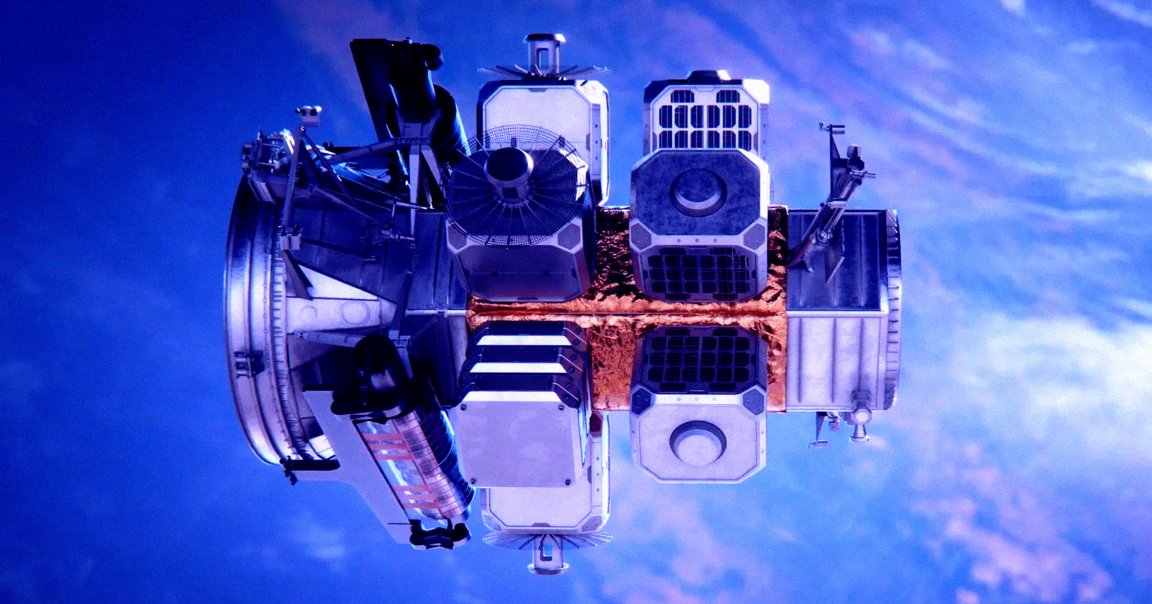
The company is hoping to leverage its Blue Ring, an in-development spacecraft platform designed to be capable of refueling, transporting, and hosting satellites, for the unusual endeavor.
The concept involves launching a fleet of small cubesats to thoroughly analyze any offending near-Earth object, including its density and mass, before deciding how to mitigate the threat.
Blue Origin suggests either using a concentrated beam of particles to change a threatening object’s orbit — or simply ramming the asteroid at high speeds, an approach dubbed “Robust Kinetic Disruption” that appears to be closely inspired by NASA’s successful Double Asteroid Redirection Test (DART) mission in 2022.
The mission successfully deflected an asteroid and moving it from its orbit, but scientists have since warned that the resulting game of cosmic billiards could result in setting off a powerful sequence of events that may end up backfiring.
When Blue Origin is hoping to turn its asteroid-busting spacecraft mission into reality remains unclear. Blue Origin’s Blue Ring platform recently underwent structural load testing at NASA’s Marshall Space Flight Center, as NASASpaceflight reports.
A prototype for Blue Ring was launched on board the company’s inaugural flight of its 300-foot New Glenn rocket in early 2025.
Meanwhile, NASA continues to work on its own Near-Earth Object Surveyor mission, per the agency, the “first space telescope specifically designed to detect asteroids and comets that may be potential hazards to Earth.”
The spacecraft’s infrared detectors are designed to “track the most elusive near-Earth objects,” which “don’t reflect much visible light,” but “glow in the infrared spectrum as they’re heated by sunlight.”
The NEO Surveyor mission is slated to launch aboard a SpaceX Falcon 9 sometime in 2027.
Blue Origin’s first official Blue Ring mission is scheduled to lift off some time this year, but the company has yet to propose a launch date for its asteroid hunting mission.
More on planetary defense: Remember That Asteroid NASA Deflected in a Test of Saving Earth? We Have Bad News