

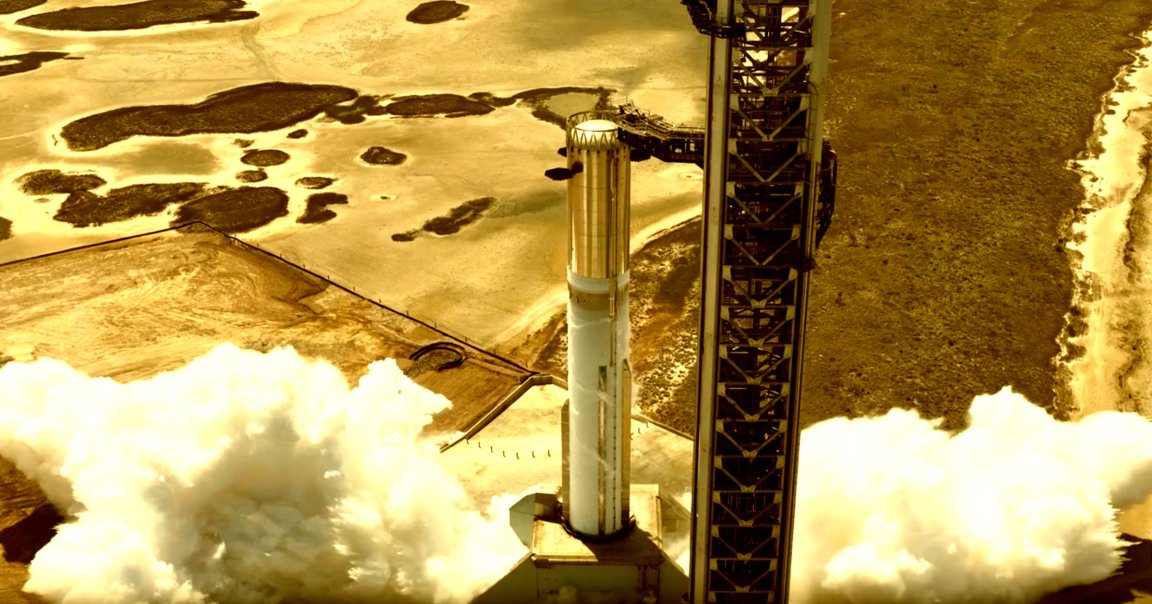
During its inaugural launch of its first Starship rocket prototype just over three years ago, SpaceX decided not to reinforce the launch pad itself, resulting in catastrophic damage as the monster rocket’s Super Heavy booster tore the concrete structure into pieces and punched a hole deep into the ground below. It was a careless mistake that resulted in massive clouds of dust and grime engulfing a nearby town.
The Elon Musk-led firm has learned plenty more hard lessons over its subsequent ten test launches, which have included the construction of a reinforced steel plate and a massive water deluge system designed to shoot water upward to fight the flames during launch — another element the company skipped entirely during its disastrous first test launch.
But over the weekend, a test of this system appeared to have resulted in an explosion, in yet another potential setback in the development of the world’s most powerful rocket system. A livestream by NASASpaceflight shows a massive plume of what appears to be water vapor shooting up from the pad during testing.
“During a deluge test today, what seems to be an explosive event was observed in the deluge farm followed by the deluge shutting down,” the publication wrote in the caption.
While it’s not the kind of enormous fireball we’ve come accustomed to seeing during the company’s operations, it’s unclear whether the explosive event will force SpaceX to delay its 12th test launch, which according to road closure advisories is currently scheduled for sometime next week.
However, drone footage suggests that the damage appears to be minimal.
“Bit of an issue with the deluge yesterday in SpaceX’s testing, but nothing that seems to have caused too much damage,” space enthusiast and YouTuber Marcus House noted. “Gas unit here looked to have popped it’s top. Huge pressures needed to drive that water, that’s for sure.”
According to a 24-minute mini documentary SpaceX shared last month, its latest rocket prototype, dubbed “Version 3,” will be tested on a “new pad and new test site.” However, during two static fires of its B19 Starship booster, both the steel plate and water deluge system triggered an automatic abort.
The booster is set to launch Starship prototype Ship 39 during the upcoming, 12th test flight.
It’s yet another illustration of SpaceX’s not-always-successful approach to iterative rocket design philosophy, and could easily presage future delays.
That doesn’t bode well, considering NASA is still hoping to test Starship next year in low-Earth orbit in anticipation of the first lunar landing attempt in over half a century, which is tentatively scheduled for 2028.
More on Starship: NASA Cancels Artemis 3 Moon Landing