

Just over a year ago, SpaceX CEO Elon Musk made it abundantly clear he was not interested in visiting the Moon.
In January 2025, the height of his bromance with president Donald Trump, he tweeted that the “Moon is a distraction,” asserting instead that “we’re going straight to Mars.”
He has lambasted NASA’s efforts to return to the lunar surface, accusing its Artemis program of being “extremely inefficient as it is a jobs-maximizing program, not a results-maximizing program.”
For many years now, Musk has made it his number one goal to establish a city on Mars, using 1,000 of the company’s Starship rockets in an interstellar colonization effort that was supposed to kick off back in 2024.
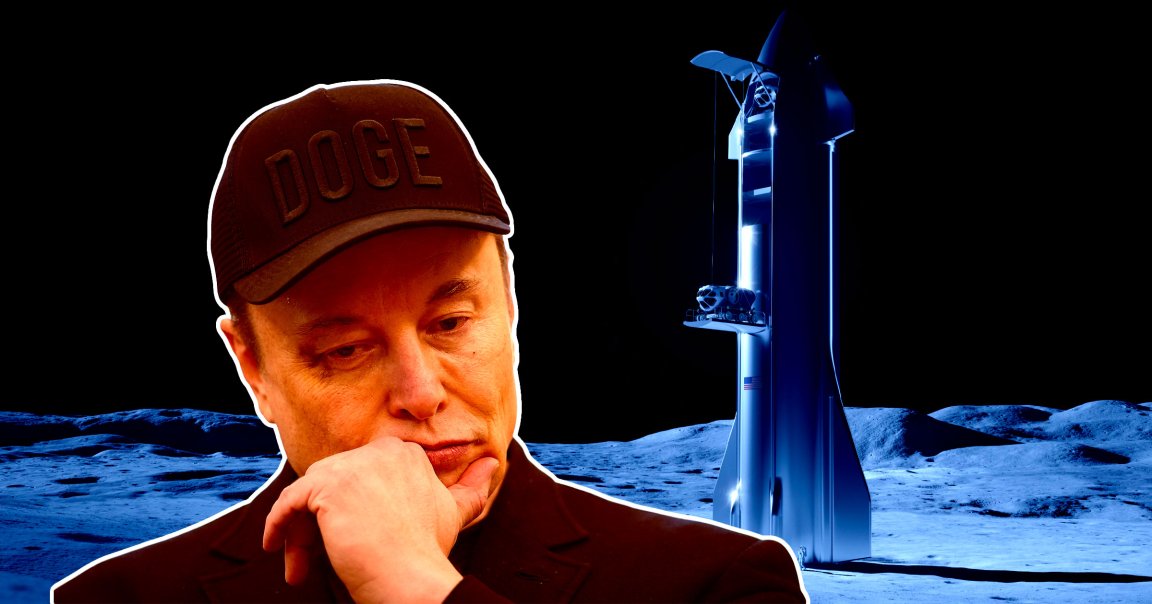
Having completely missed that goal, the mercurial entrepreneur appears to have had a major change of heart, contradicting his earlier statements by arguing that the plan is now to go to the Moon and build a city there after all.
As it turns out, the Moon is far easier to settle than Mars, a plan that will likely prove a much easier pill to swallow for his investors — yet another instance of Musk significantly moving the goalposts after years of bluster and hype.
“For those unaware, SpaceX has already shifted focus to building a self-growing city on the Moon, as we can potentially achieve that in less than ten years, whereas Mars would take 20+ years,” he tweeted on Sunday.
The richest man in the world’s colony on the Moon has become priority number one, since the “overriding priority” is to secure the “future of civilization” — and getting to the Moon, which is many orders of magnitude closer to us than Mars, is “faster.”
The timing of the admission is particularly noteworthy. Following the space company acquiring Musk’s CSAM-distributing AI startup xAI earlier this month, the goal is to go public at an eye-watering and record-breaking valuation of $1.25 trillion.
It’s unclear whether Musk’s abrupt reversal was in any way related to potential investor pressure ahead of the IPO, but given his enormous personal interest in going all-in on Mars — the Moon be damned — it’s a tectonic shift in priorities.
SpaceX’s role in NASA’s return to the surface of the Moon remains unclear. The space agency initially tapped Musk’s company’s Starship to deliver astronauts to the lunar South Pole from orbit. In October, however, NASA officials suggested the agency may opt for SpaceX’s competitor, Blue Origin instead, given ongoing technical issues hampering Starship’s development.
NASA’s Artemis 3 mission, the first planned crewed Moon landing in over half a century, is currently scheduled for 2028, but whether SpaceX can get Starship functional by then remains unknown.
The company has yet to successfully launch the mammoth rocket to space and then successfully land, let alone demonstrate in-orbit refueling capabilities, which will be critical for Starship to visit the Moon and eventually Mars.
In his latest tweet, Musk said that SpaceX hadn’t given up on Mars, but won’t start work on plans for a city there for another “five to seven years.”
Even on his social media platform X, which largely functions as an echo chamber of his most vocal supporters, his latest missive fell on flat ears.
“You could actually use some of those obscene billions of dollars of money to improve life here on Earth,” reads one reply, which received over 200 likes. “You know, reclaim desserts [sic] since you seem to love inhabitable places so much.”
More on SpaceX: SpaceX Just Bought Elon Musk’s CSAM Company