

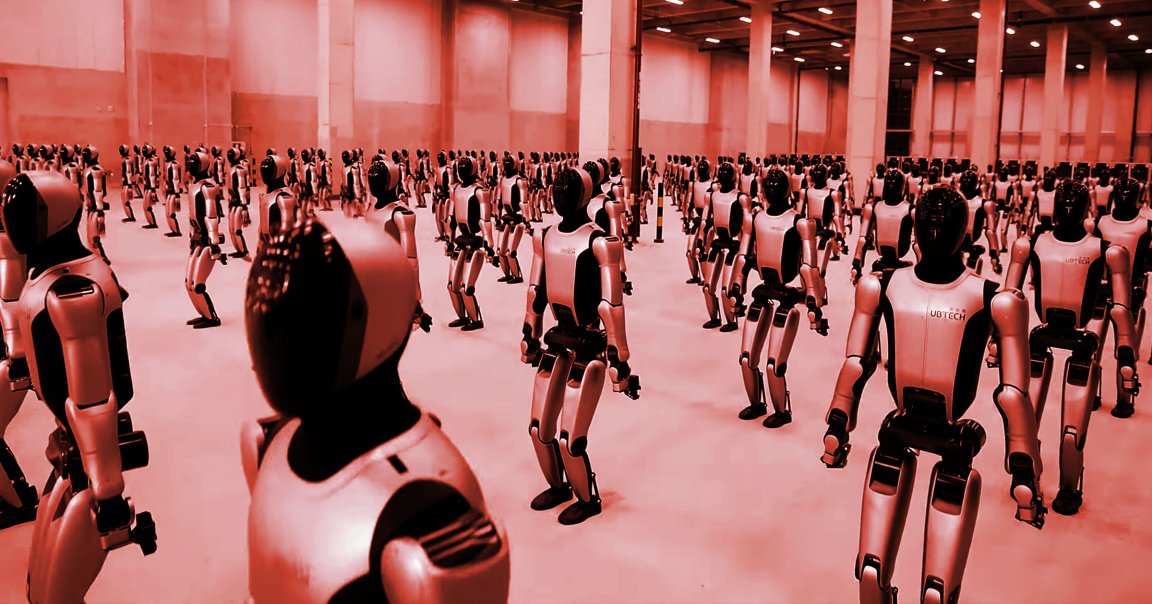
Chinese officials are warning that the country’s humanoid robotics industry could be forming a massive bubble.
As Bloomberg reports, strategists from the National Development and Reform Commission (NDRC), which serves as the country’s state-run macroeconomic management agency, say that extreme levels of investment could be drowning out other markets and research initiatives.
It’s a notable shift in tone as the humanoid robot industry continues to attract billions of dollars in investment. Aided by advancements in artificial intelligence opening up new use cases — and plenty of unbridled enthusiasm — for the tech, investors are pouring untold sums into over 150 humanoid robot companies in China alone, according to the NDRC.
Many of those companies are producing robots that are extremely similar to each other, overspending that could overwhelm the market. Bike-sharing apps, for instance, flooded the market in China in 2017 and 2018, with dozens of them crowding each other out at the same time. The outcome: streets littered with unused bikes.
“Frontier industries have long grappled with the challenge of balancing the speed of growth against the risk of bubbles — an issue now confronting the humanoid robot sector as well,” NDRC spokeswoman Li Chao told reporters last week, as quoted by Bloomberg.
China has established itself as a clear global leader in the space, with Morgan Stanley predicting the humanoid robot market could surpass a whopping $5 trillion by 2050. Citigroup is even more optimistic, expecting the market to hit $7 trillion by that point.
New offerings by companies like Unitree have made bipedal robots far more affordable and advanced than ever before. Unitree’s G1 robot, in particular, has garnered tons of attention for its flashy abilities to throw punches in the ring or play basketball.
A burgeoning industry of far smaller Chinese competitors has cropped up as well, fueling even more investment — as well as concern from policymakers that the industry could be growing too fast.
Last month, Chinese robotics company UBTECH claimed it had rolled out the “world’s first mass delivery” of industrial humanoid robots. Startup AgiBot’s A2 also set a Guinness World Record for the longest distance ever walked by a humanoid robot, with its A2 covering over 66 miles while live-swapping its battery over and over.
Despite plenty of enthusiasm, turning humanoid robots into a viable and affordable product with a clear-cut use case remains a major challenge. Case in point, the current crop of androids still struggles significantly with completing household tasks, particularly without the help of a nearby human teleoperator.
To speed up the process of finding real-world applications, the NDRC is hoping to spread industrial resources across the country, while also accelerating research and development for “core technologies.”
The risks of a bubble are certainly there. Without consolidation, China’s market could soon be flooded with armies of largely identical humanoid robots — which is either a terrifying prospect, considering the possibility of them putting us all out of work, or risks a market crash if it turns out they’re not particularly good at real work.
More on humanoid robots: Whistleblower Says He Was Fired for Warning Execs That New Robot Could Crush Human Skull