

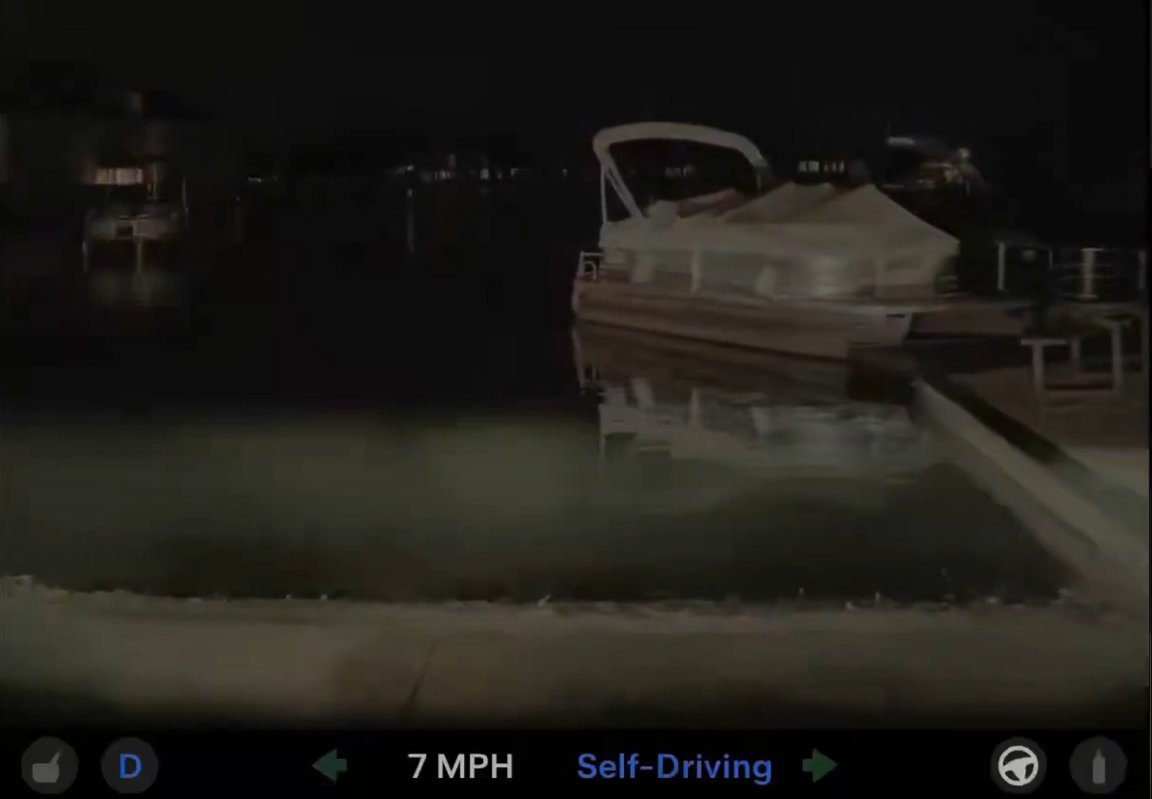
Tesla CEO Elon Musk once boasted that the Cybertruck could double as a boat. Perhaps the AI behind his cars’ Full Self-Driving software took Musk at his word and hallucinated that this applied to all Teslas, because one of them just attempted to steer a guy’s ride straight into a lake.
Footage of this lacustrine impulse was shared Sunday by Daniel Milligan, a Tesla owner and former SpaceX engineer. It begins innocently enough: at night, on a quiet road. The car then gently turns right onto what turns out to be a boat ramp, and instead of slowing down, accelerates towards what would’ve been its watery grave, had the driver not hit the brakes.
“I had to intervene,” Milligan wrote. “I’d like to see what it would’ve done, but at the speed it was going, it definitely felt like it was going to go for a swim.”
Milligan explained his intended destination was a driveway about fifty feet away. He suspected the error had to do with the lighting conditions.
“Just tried it again during the day (same direction and destination) and it completely skipped the boat ramp,” Milligan later reported. “My guess is that it could actually see the driveway up ahead in the daytime or could more clearly see the lake.”
The footage is merely the latest among countless examples of self-driving cars struggling to safely, or evenly convincingly, navigate public roads. Tesla’s FSD in particular has generated loads of controversies, which is no doubt a consequence of Musk’s incredible decision to make it available to millions of Tesla owners, despite the software being both unfinished and not actually fully self-driving. While its name suggests otherwise, it is classified as a driving assistance feature, requiring drivers be prepared to intervene at any moment.
Its track record, therefore, is worrisome. On top of a documented habit of driving straight into the path of oncoming trains, FSD and its predecessor Autopilot have also been involved in numerous deadly accidents, including the latter being found partially responsible for the death of a 22-year-old woman who was struck by one of the cars.
These concerns rarely deter Tesla owners. Milligan, for example, still thinks FSD is a “game changer,” but admits it “needs more work before it’s fully autonomous.”
Of course, maybe we should consider that FSD has a daring sense of humor: it nearly re-enacted a famous scene from “The Office,” in which Michael Scott submerges his car after taking his GPS’s guidance too literally.
“The machine knows where it’s going. The machines knows!” he screams.
More on self-driving cars: It Turns Out That When Waymos Are Stumped, They Get Intervention From Workers in the Philippines