

We’ve seen plenty of robot appendages designed to decrease exertion, from futuristic exoskeletons that can allow you to climb thousands of steps without breaking a sweat to arm braces that can take the load off at the car factory when working overhead.
Now, a team of engineers in Shenzhen, China, has taken a dramatically different approach — by taking inspiration from a creature in Greek mythology with the body of a horse and the torso of a human. Or possibly from an unflattering Cory Doctorow metaphor building on the same folklore.
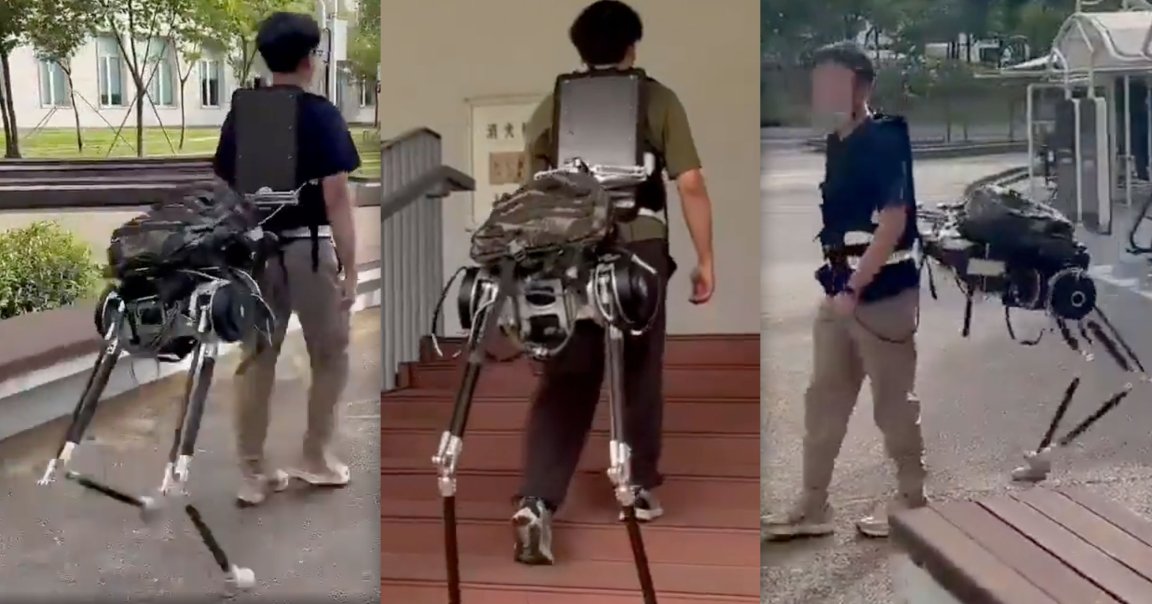
In video demonstrations released alongside a paper published in the International Journal of Robotics Research last month, an engineer can be seen walking around a university campus with a two-legged, centaur-inspired appendage striding along behind him.
The robot’s two spindly legs appear to struggle to keep up with the marching human at the front. But as soon as the wearer climbs some stairs, the approach’s key advantage over, say, a pair of wheels, becomes apparent.
“Experimental evaluation results demonstrate that the Centaur robot effectively adapts to varying human walking directions and speeds while seamlessly collaborating with the human to traverse diverse terrains,” the researchers from the Southern University of Science and Technology in Shenzhen, China wrote in their paper.
The team found that their approach allowed a wearer to save plenty of energy, or “metabolic cost,” compared to wearing a regular backpack that weighed 44 pounds, similar to the centaur robot.
The researchers argued that while autonomous robots such as robodogs are “being actively explored as load-transport solutions without direct human involvement,” the approach comes with some drawbacks, like the need to “navigate reliably in complex environments where a prior map is unavailable.” Payload capacity is also limited, and could greatly cut into battery power.
“Under current limitations in autonomous navigation, endurance, and payload capacity, autonomous robots still face challenges in fully performing load-carriage tasks,” they wrote.
Their centaur approach, however, could effectively take the load off without compromising too much on navigation and payload capacity, they argue.
“The proposed human-Centaur system can optimize the load distribution to reduce the load pressure on the human,” the paper reads.
It could even give its human wearer a push.
“Additionally, the Centaur robot can be controlled to interact with the human at the human-robot interface, generating horizontal interaction force in the sagittal plane to provide forward assistance during human walking,” the researchers wrote.
However, not everybody was convinced their approach made sense.
On Reddit, armchair engineers outright mocked the idea.
“I feel like a shopping cart would almost always be a better solution,” one user wrote. “The next time I’m carrying a light sacrifice to a dormant volcano that has frequent charging stations in good weather this might be handy.”
“Imaging running with that thing carrying a load and then tripping and breaking your back as it collapses on to you with force,” another user argued. “It’s like driving a car from the hood.”
Others pointed out that gadgets to help carry heavy loads while walking has a long, storied history already, effectively making the researchers’ robot an attempt to reinvent the wheel.
“Have you guys heard of the rickshaw?” one user inquired.
More on exoskeletons: Nike’s New Sneaker Contains an Exoskeleton to Boost Your Leg Performance