

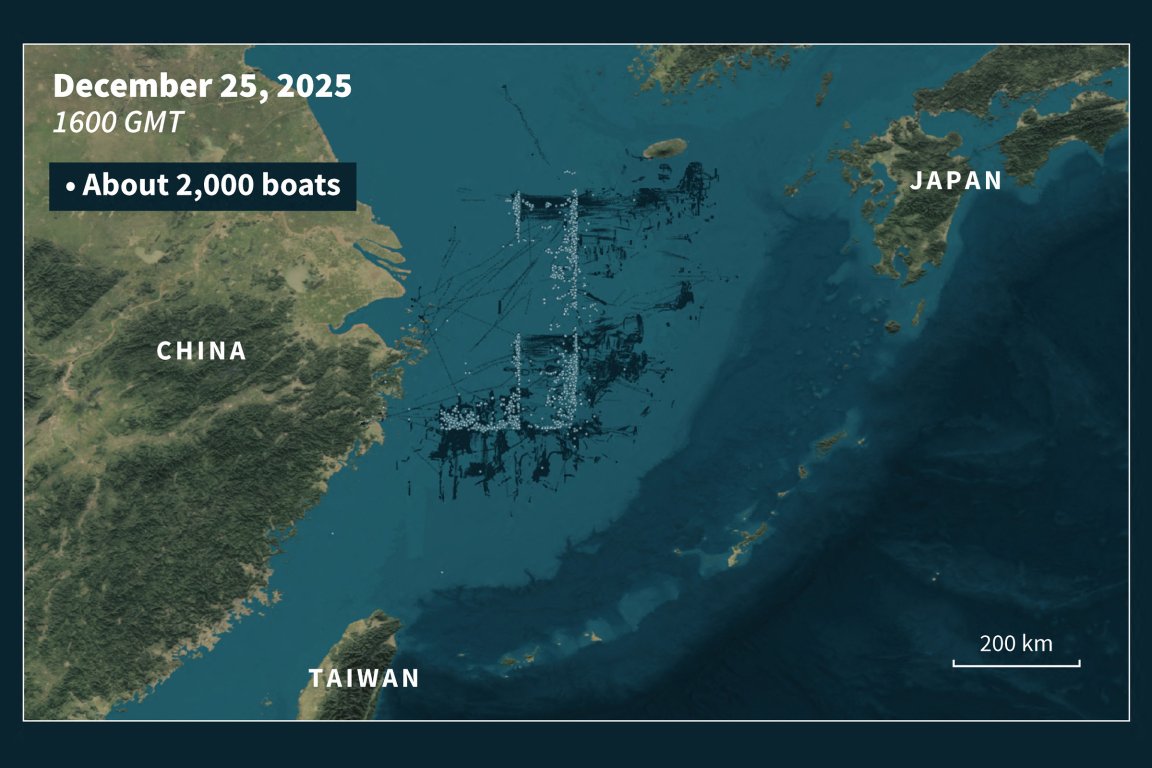
Is an ancient leviathan stirring from the Pacific depths, ready to scrub humanity off the Earth once and for all? Is the lost city of Atlantis clawing back to the surface from the bottom of the East China Sea? Nah — thousands of commercial fishing boats lining up in an impossibly vast naval formation.
The bizarre constellations were first sighted in December, where more than 2,000 small ships formed up to create two inverted-L arrangements off the coast of Shanghai.
The boats came together a again just a few weeks later in January, where some 1,000 fishing vessels formed a rectangle stretching around 240 nautical miles. That wall of boats was so dense that some incoming cargo ships were forced to take unorthodox maneuvers to zig-zag through the maze, the New York Times reported.
Coordinated activity simmered down in February, only to resurface last week, when around 1,200 commercial fishing vessels joined together yet again to form two parallel lines.
No matter where you’re looking, fishing boat activity tends to be chaotic, resulting in GPS profiles that look like more like scatter plots than tidy line graphs. This goes doubly so in the East China Sea, which is traveled by around 1.5 million ships each year. To see thousands of vessels come together in such an organized display, in other words, is pretty wild.
“Something didn’t look right to me because in nature very rarely do you see straight lines,” Jason Wang, chief operating officer at satellite analytics firm ingeniSpace told Agence France–Presse. “We’ve seen like two, 300, up to a thousand [Chinese fishing boats congregate], but anything exceeding a thousand I thought was unusual.”
The strange formations have raised the eyebrows of plenty of China hawks in the US, who argue that the People’s Republic is running de-facto naval drills with civilian vessels — likely in preparation for a confrontation with Chinese Taipei, otherwise known as Taiwan.
“The sight of that many vessels operating in concert is staggering,” Mark Douglas, an analyst at Maritime Intelligence firm Starboard told the NYT. “The level of coordination to get that many vessels into a formation like this is significant.”
More on China: Chinese Robots Can Now Run Up Walls