

SpaceX has radically reduced the cost of reaching space thanks to its reusable rockets, a revolutionary capability that has greatly set it apart from its competitors.
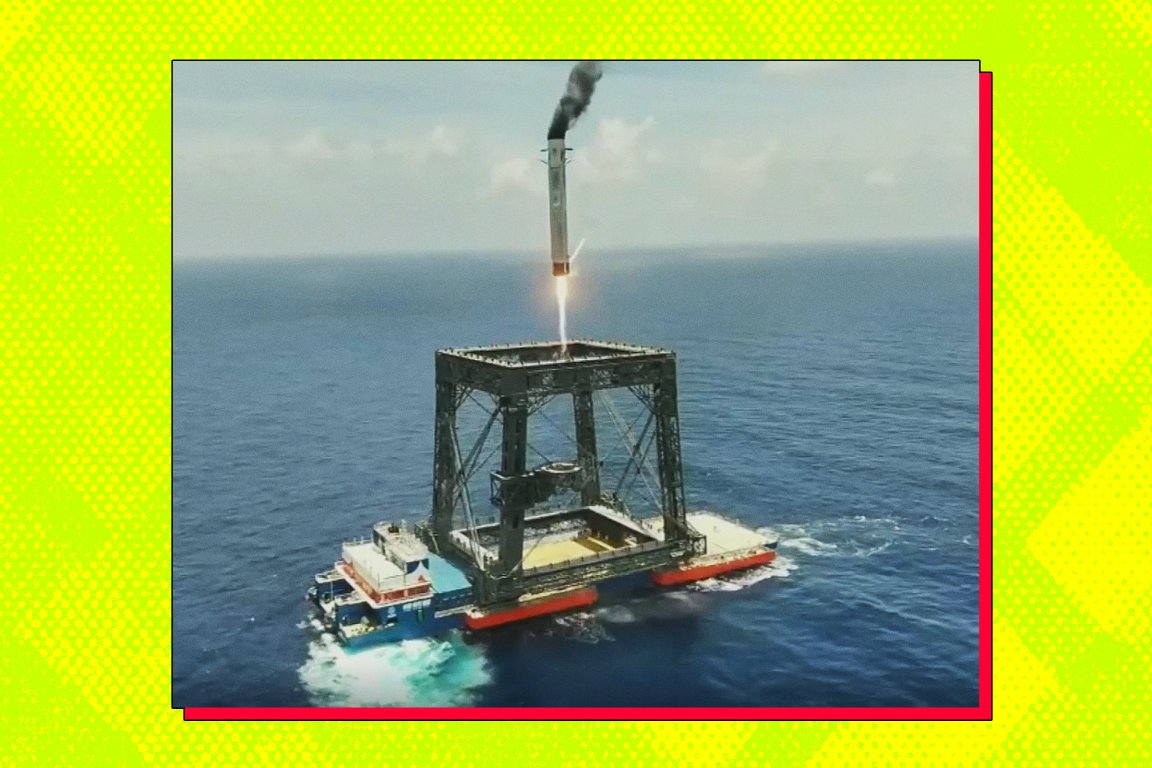
But its dominance in the domain is seriously being challenged by China. Footage shared by the Chinese state-run CCTV shows a Long March 10B rocket booster being caught by an offshore recovery platform. Engineers can be heard cheering on the slowly descending rocket as it confidently sets down.

As Engadget reports, that makes China only the second country to have pulled off such a feat, following the United States — a “historic breakthrough” that could have major implications not just for SpaceX, but for the space industry as a whole.
The rocket was developed by the China Academy of Launch Vehicle Technology (CALT), a subsidiary of the state-owned Chinese space program contractor China Aerospace Science and Technology Corporation (CASC).
The rocket has a payload capacity of 16 tons to low-Earth orbit, not far off from SpaceX’s workhorse Falcon 9, which can carry 22 tons. However, unlike the Falcon 9, which lands autonomously with the help of four deployable landing legs, CALT’s recovery platform picks the descending rocket out of the air with “landing hooks.”
Previous attempts have resulted in descending rockets missing the launch pad. Chinese competitor LandSpace is trying an even more SpaceX-like approach using a leg system. In December, the company successfully sent its Zhuque-3 rocket into orbit, but it ended up blowing up in a fireball while trying to land.
CALT is envisioning it as a new platform to launch Starlink-like internet broadband satellites and other larger commercial satellites.
By reusing the first stage, the company is hoping to dramatically reduce launch costs, much like SpaceX.
The Elon Musk-led company first successfully landed a Falcon 9 rocket following orbital flight in December 2015. Jeff Bezos’ Blue Origin became the second company to have pulled off such a feat in November, with its New Glenn booster gently touching back down in November, just under a decade later.
While CALT’s latest feat is undoubtedly a major sign of progress, China has its work cut out to reach SpaceX’s unparalleled launch cadence. The rocket company came close to launching a rocket every other day in 2025, completing an astonishing 165 orbital flights — almost twice as many as China’s entire space program.
More on China’s space program: New Report Finds That China’s Space Program Is Rapidly Outstripping NASA