

The United States Space Force has been testing its top-secret Boeing X-37B space plane for over a decade. Two versions of the unusual spacecraft have completed seven orbital missions over the last 15 years, spending a combined thousands of days in space.
Despite its extensive experience of being launched atop a rocket and slowing its descent on its own during reentry, much like NASA’s Space Shuttle, we still have no idea what it’s doing in space, beyond the military vaguely pointing towards testing new spaceflight hardware and space-based capabilities.
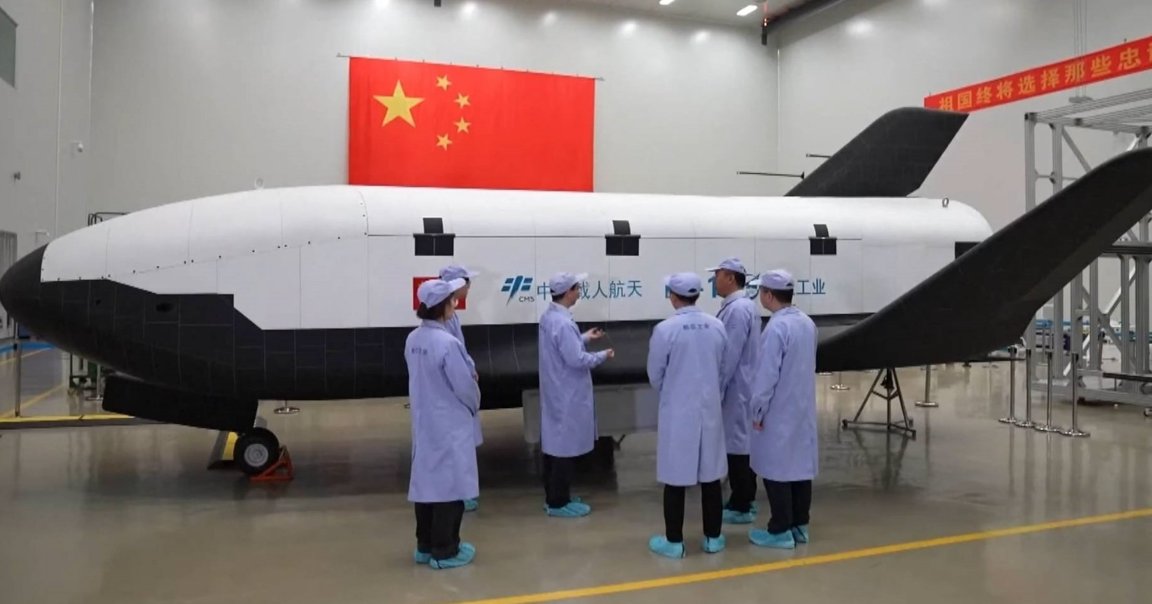
And China isn’t far behind. Its own secretive space plane, dubbed Shendong, or “Divine Dragon,” launched for the fourth time on February 7 from the Jiuquan Satellite Launch Center.
Its purpose similarly remains under tight wrap. According to state-run news network Xinhua, the space plane “will conduct technological verification for reusable spacecraft, providing technical support for the peaceful use of space.”
The plane’s third trip to space concluded in September 2024 after spending 267 days in orbit. The “success of the experiment demonstrates the growing maturity of China’s reusable spacecraft technologies, which will pave the way for more convenient and affordable round-trip methods for the peaceful use of space in the future,” a statement read at the time.
Most intriguingly, previous test flights have involved Shendong releasing small mysterious objects — likely satellites — while in orbit, which have been tracked by the US Space Force and even amateur astronomers.
There’s far more that we don’t know about the space plane than what we do. As SpaceNews points out, given the payload capacity of its Long March 2F rocket, which launched the spacecraft earlier this month, it could be similar in size to the Space Force’s X-37B.
Some believe China may be testing the close approach of other objects, or “rendezvous proximity operations” (RPOs) after being found to have conducted close maneuvers with its deployed satellites.
“I think that tracks along with other things that they’re doing — you know, conducting RPOs in [low-Earth] and [geostationary orbit],” nonprofit Secure World Foundation chief director of space security and stability Victoria Samson told Space.com. “This is a skill set that they’re obviously interested in, as is Russia, as is the United States.”
But for now, all we can do is speculate about the purpose of either space plane — top-secret experiments that could be a sign the two biggest world powers are actively vying for superiority in orbit.
More on the spaceplane: Chinese Spaceplane Releases Six Mysterious Objects That Are Emitting Signals