

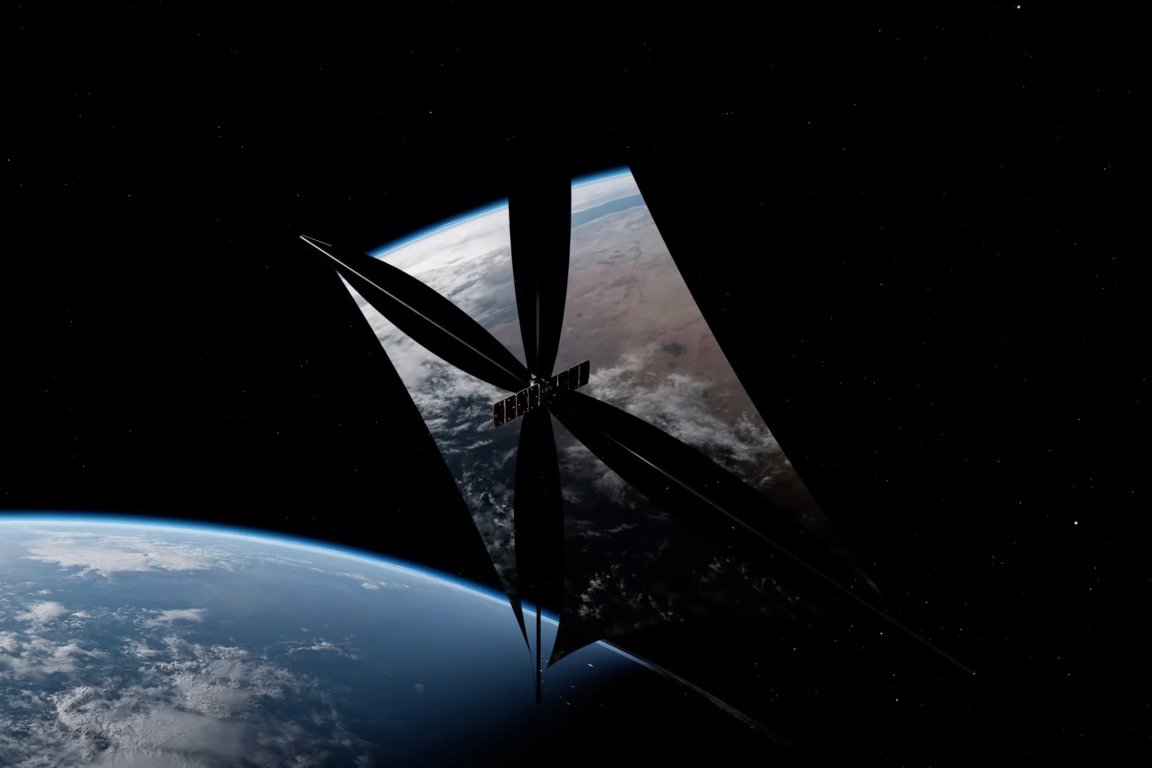
There’s light pollution — and then there are giant orbital space mirrors that blot out the night sky.
On July 9, the US Federal Communications Commission approved the construction and launch of a mirror satellite that would bend our star’s illuminating rays to our will from low Earth orbit. The company behind the ambitious venture, Reflect Orbital, claims that its prototype could be used to reflect sunlight down onto dark patches of the Earth, allowing huge solar panel installations to continue generating electricity after nightfall and provide illumination during emergencies.
“We’re trying to build something that could replace fossil fuels and really power everything,” CEO Ben Nowack told The New York Times in March as the company was still seeking approval.
The proposal has outraged astronomers, who feel their profession is already being threatened by massive satellite constellations from companies like SpaceX that interfere with deep space observations. While the FCC reviewed Reflect Orbital’s application, it received nearly 2,000 public comments criticizing the proposal, Wired reported, including from leading astronomical organizations.
Betty Kioko, institutional affairs officer for the European Southern Observatory, called it an “existential threat” for optical astronomy, per Wired. Robert Massey, deputy executive director at the Royal Astronomical Society, told Space.com last October that it would be “catastrophic.” Many are skeptical that even thousands of Reflect Orbital’s satellites working in tandem would be able to reflect a meaningful fraction of the midday Sun, let alone provide enough engilding rays to power solar plants.
Biologists were also concerned, warning that playing god with sunlight could disrupt the circadian rhythms of humans and wildlife, confuse migratory patterns, and even affect phytoplankton, the tiny aquatic organisms that are the planet’s most important photosynthesizers.
Their pleas, however, fell on deaf ears. With the FCC approval, Reflect Orbital plans to launch a prototype named Eärendil-1 later this year. With its 60 foot mirror, the company claims that it will be capable of reflecting as much light as a full Moon over a roughly nine square mile area, according to Time Magazine, for about five minutes at a time.
Those are just the beginning of its ambitions. Reflect Orbital envisions operating an epic constellation of 50,000 mirror satellites by 2035, with 1,000 launched by the end of 2028 — to researchers, a disaster in the making.
More on space: SpaceX Stock Plunges to All-Time Low After Competitor Makes Major Leap