

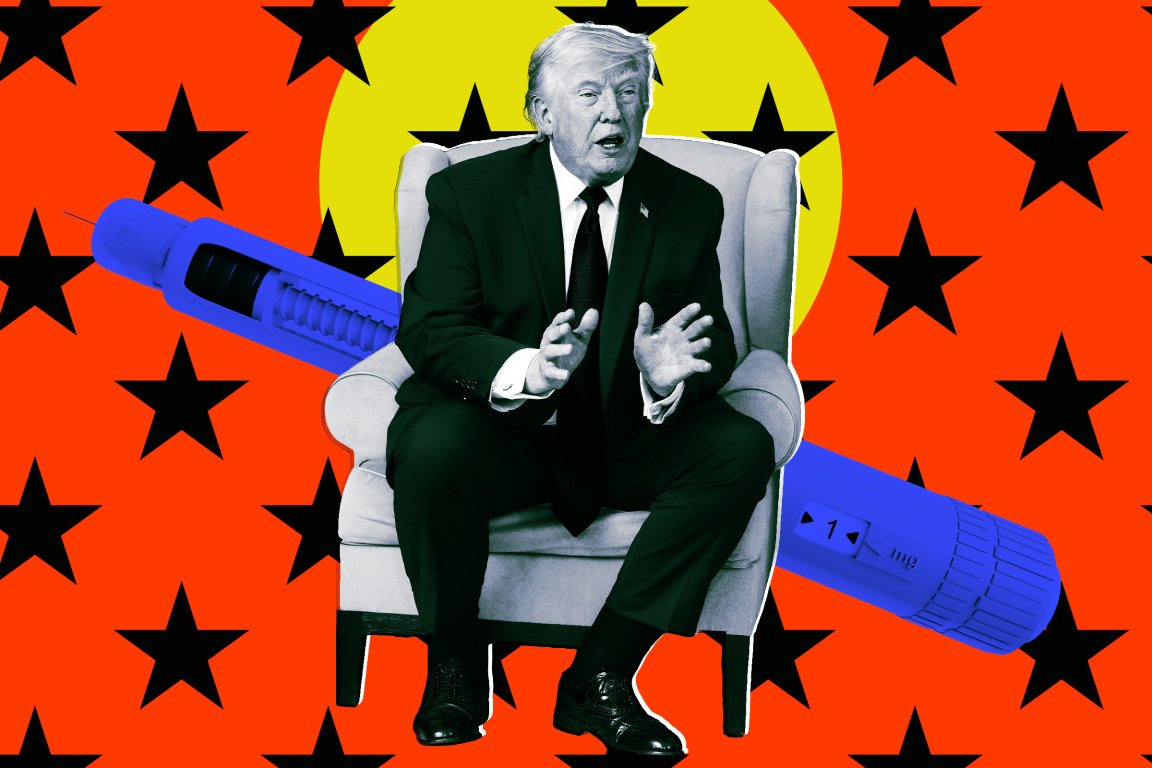
According to president Donald Trump’s annual medical exam, results of which were released last month, the 80-year-old’s body mass index is close to the threshold for clinical obesity. His doctor has also recommended more exercise and wean off his daily aspirin intake.
The president’s health has long been a source of rampant speculation, from theories that he had suffered a stroke earlier this year to mysterious bruising on both of his hands, which the White House dismissed as being the result of “shaking hands all day every day.”
Trump also is known to have a strong preference for fast food and has an “absurd” 2,430-calorie McDonald’s order.
Now, Stat is reporting that a single unidentified man, who was 79 years old back in April, gained access to a still-unapproved weight loss drug called retatrutide before anybody else — and while the publication was unable to confirm his actual identity, circumstantial evidence makes it hard to ignore the possibility that it could have been president Trump, who turned 80 on June 14.
According to Stat’s sources, the case “drew the interest of top health officials, suggesting the person receiving the drug was well connected.”
The patient gained access to the drug through the FDA’s “compassionate use” program, which is usually reserved for patients with serious and life-threatening medical issues, per Stat.
Adding to the intrigue, the White House’s Health and Human Services department was strangely vague and never outright denied the theory when Stat reached out. After the story came out, though, White House spokesperson Kush Desai stridently refuted the suggestion, writing that “this application was not for the President.”
Retatrutide, which was developed by drugmaker Eli Lilly, is being touted as the “next generation in the GLP-1 craze.” Glucagon-like peptide-1 receptor agonists (GLP-1) are a class of medications that include semaglutide (sold as Ozempic) and tirzepatide (sold as Zepbound). The treatments have been shown to not only treat Type 2 diabetes, but effectively promote weight loss as well, along with a constellation of other health benefits.
Retatrutide has yet to be deemed safe and effective by the FDA, despite being for sale on the internet through sketchy online vendors.
However, Eli Lilly released promising trial results in March, claiming patients lost an average 28 percent of their weight over 80 weeks while on the drug, approaching the effectiveness of far more invasive bariatric surgery.
According to Stat, the mysterious recipient of the drug had previously been treated with tirzepatide for at least a year, but experienced “only moderate weight loss.”
While we don’t have confirmation of the mystery patient being the president, there is precedent: Trump previously was one of the first to receive an antibody treatment from a company called Regeneron after contracting the virus that causes COVID-19.
Adding further credence to the theory, Eli Lilly CEO David Ricks has a comfortable relationship with Trump and attended a glitzy dinner at the president’s Mar-a-Lago residence. In January, Politico reported that Ricks was “putting on a masterclass” in trying to get on Trump’s good side, with the president gushing that Ricks is an “unbelievable executive, an unbelievable guy, one of the most successful companies.”
Experts were surprised Eli Lilly had approved usage of the drug through FDA’s compassionate use program for a single patient. Usually, a much larger cohort of patients is part of such a program.
“If you really were trying to treat obesity in people who can’t use the products that are out there, why would you go the single patient route?” New York University health ethicist Alison Bateman-House told Stat. “It’s like saying we have all these people who need to get from New York to DC, and rather than chartering a bus,we’re going to tell everyone that they need to drive their own car.”
Updated to include a response from a White House spokesperson.
More on GLP-1s: GLP-1 Drugs Appear to Prevent Cancer, New Research Finds