

In 2022, Australian biotech startup Cortical Labs made a big splash after announcing that it had taught “mini-brains” consisting of 800,000 to one million living human brain cells in a petri dish how to play the video game “Pong.”
“The amazing aspect is how quickly it learns, in five minutes, in real time,” Cortical Labs chief scientific officer Brett Kagan told New Scientist at the time. “That’s really an amazing thing that biology can do.”
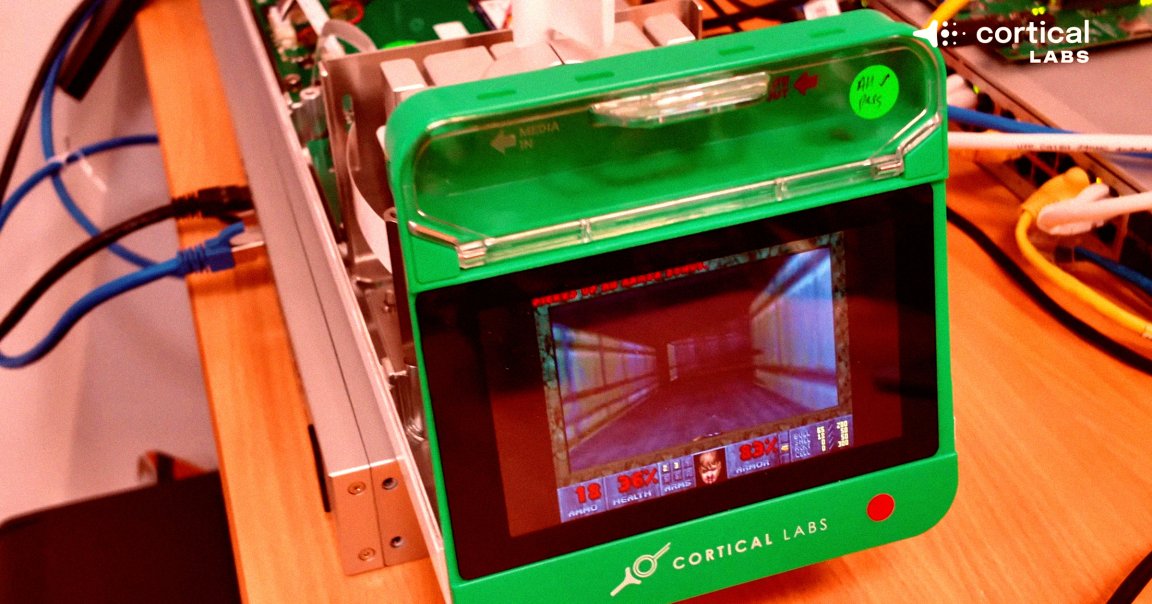
Just under a year since the startup launched the CL1, the “world’s first code deployable biological computer,” the company is upping the ante considerably. In a YouTube announcement, the company claims to have taught living human brain cells how to play the seminal video game “Doom” — a far more complex, three-dimensional game environment from “Pong” — to showcase how far the tech has come over the last four years.
It’s the natural evolution of a well-established meme. We’ve seen the game being run on a satellite in space, on cells of E. coli bacteria, inside a candy bar, and even inside another copy of “Doom.”
“So we showed that biological neurons could play the game Pong,” Kagan explained in the video. “This was a massive milestone because it demonstrated adaptive, real-time, goal-directed learning. But it took us 18 months with our original hardware and software to get this to work. And Pong was much simpler.”
“Doom was much more complex,” he added. “It’s 3D. It has enemies. It needs to explore, its an environment, and it’s hard.”

To adapt the 33-year-old video game and allow the CL1 to run it, the company had to “translate the digital world of Doom into the biological language of neurons, which is electricity,” Kagan explained.
By mapping the video feed from the game into “patterns of electrical stimulation,” the computer stimulated various areas of the neural culture, which reacted to that stimulation, appearing as spikes in the device’s activity monitor.
“If the neurons fire in a specific pattern, the Doom guy shoots,” Cortical Labs CTO David Hogan said in the video. “If they fire in another pattern, he moves right, and so on.”
Independent developer and collaborator Sean Cole then used Cortical Labs’ cloud platform to essentially teach the neurons how to play the game through the company’s Application Programming Interface (API) in “less than a week,” per Hogan.
However, Kagan admitted that the neurons aren’t exactly very good at the game just yet.
“Right now, the cells play a lot like a beginner who’s never seen a computer,” he said. “And in all fairness, they haven’t. But they show evidence that they can seek out enemies, they can shoot, they can spin.”
How much of a breakthrough the demo represents isn’t as straightforward as you might think, since computer chips don’t really compare to human brains.
“Yes, it’s alive, and yes, it’s biological, but really what it is being used as is a material that can process information in very special ways that we can’t recreate in silicon,” Kagan told New Scientist.
University of Manchester computer science professor Steve Furber added that we still don’t fully understand how the neurons are playing the game and how they know what’s being expected of them.
Nonetheless, it’s an exciting demonstration that could eventually open more doors, like controlling complex robotic arms.
In his company’s video announcement, Kagan said that the company is now looking to have its neurons to “really begin to excel at [Doom] and then take on even more complicated tasks.”
Gamers, meanwhile, were taken aback by the demo.
“I know this is a technical achievement far greater than anything I will ever achieve, but I gotta admit… Something about this feels very wrong to me,” one Reddit user wrote.
Others made light of the matter.
“What’s the big deal, my brain cells play Doom as well,” another user mused.
More on Cortical Labs: Weird New Computer Runs AI on Captive Human Brain Cells