

Tesla CEO and billionaire Elon Musk has long garnered a reputation for being massively wrong in his promises and predictions about the future.
In 2024, for instance, he said that AI would become “smarter than the smartest human” by 2025. He said his company’s SpaceX Starship rocket, which is still exploding during test flights, will land on Mars this year. Like clockwork, he’s predicted that self-driving cars will become a reality “next year” every year for well over a decade now. He promised robotaxis without human safety monitors by mid-2025, which the company still has yet to accomplish.
We could go on and on. In short, it’d be far easier to count the occasions on which he’s been right than when he’s been wrong.
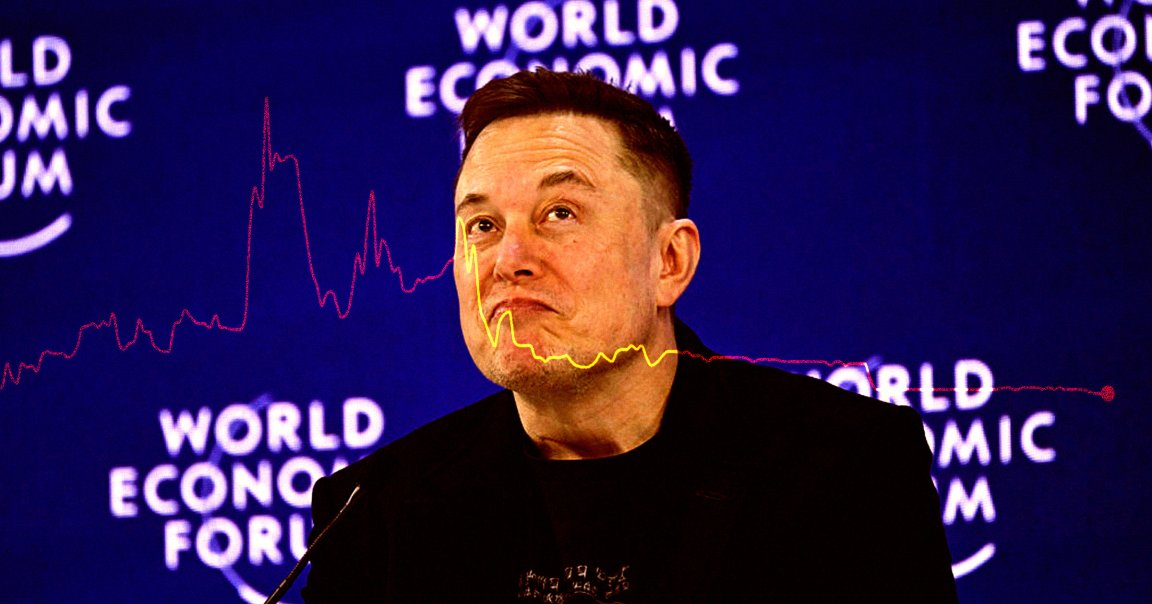
Now, as NBC News reports, users on online prediction markets like Kalshi and Polymarket are making big bucks off of Musk’s astonishing track record for being wrong about the future. Case in point, Polymarket user David Bensoussan made a ten percent return after betting $10,000 that Musk wouldn’t follow through on his threat of forming a new political party following his falling out with president Donald Trump.
He also successfully bet against Musk’s prediction that Tesla would launch an “unsupervised” version of its erroneously-named “Full Self-Driving” software by the end of 2025.
To Bensoussan, it’s a matter of principle.
“He does have a solid fan base, and so if I can help separate them from some of their money, I’m always happy to do that,” he told NBC. “He has a habit of exaggerating timelines, and of saying he’s going to do these amazing things and attaching more immediacy than what his intent may necessarily be.”
It’s an ironic inversion of the ethos of many of Musk’s investors, who have long warned to never bet against the mercurial CEO.
In total, Bensoussan’s ploy to bet against Musk’s wildly optimistic predictions has paid off, garnering him over $36,000.
Online prediction markets have surged in popularity in recent years. While benefitting from a largely unfettered regulatory vacuum, sites like Polymarket and Kalshi have also become embroiled in major insider trading controversies. Case in point, earlier this year, an anonymous bettor netted a cool $410,000 after accurately predicting the Trump administration’s attacks on Venezuela mere hours before Trump issued orders authorizing the strikes.
Even Musk himself has frequently voiced his support for prediction markets. His AI company, xAI, has deep integrations of both Kalshi and Polymarket.
But as it turns out, actively betting against his many attempts to reassure investors that a major technological revolution is just around the corner — a gambit that has largely worked out for him in the past — could be pretty lucrative.
As for current predictions, the online platforms aren’t exactly eager to stand behind his latest prophecies. For instance, only 13 percent of Kalshi users believe Musk will make good on his recent threat to buy airline Ryanair by the end of this year. The airline’s CEO, Michael O’Leary, had questioned the economics of adding SpaceX Starlink internet to airliners, resulting in petty name-calling.
As NBC points out, Musk also tried to manipulate prediction markets by calling a bet on Polymarket that Tesla will launch a robotaxi service before July 2025 a “money-making opportunity.”
Markets expectedly rose, with odds tripling to about 40 percent.
However, as the rules stipulated, a robotaxi service would only count if it was open to the general public — something that only materialized well after July 2025 — leading to plenty of users getting “burned.”
More on Musk’s predictions: Elon Musk Lost a Bet That COVID Would Quickly Fade, and What He Did Next Says a Lot About Him as a Person