

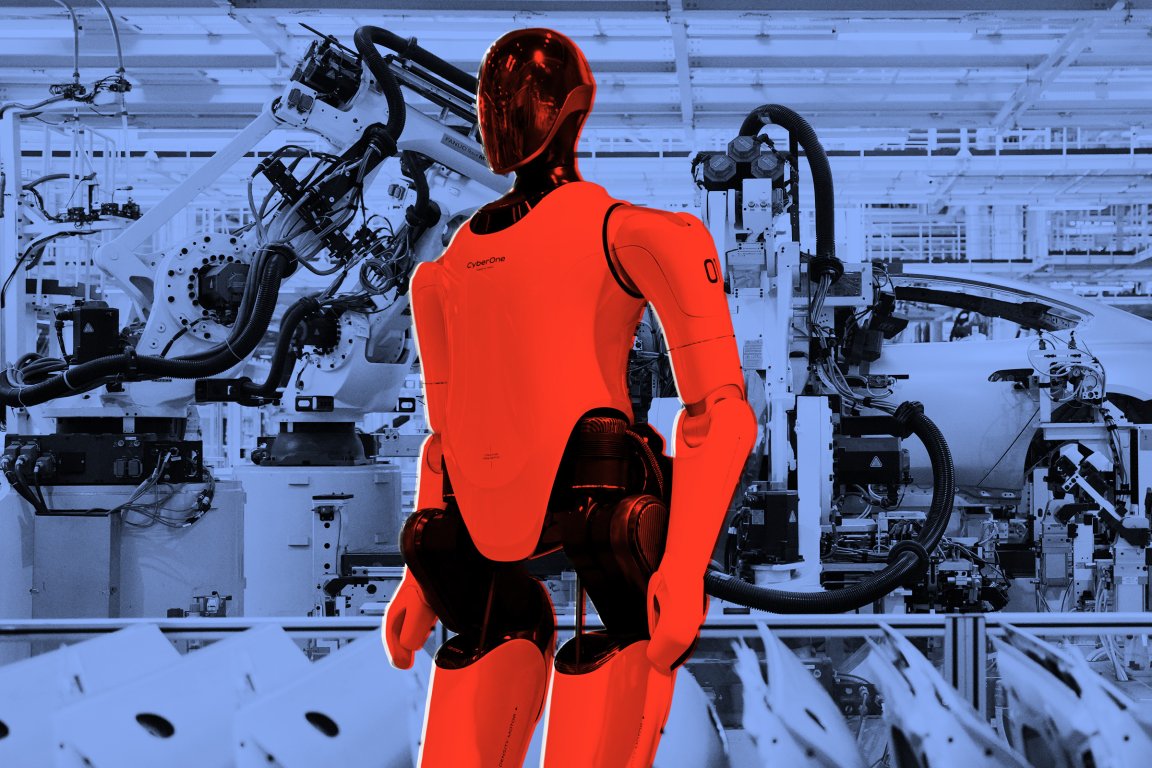
There’s a new “intern” on the assembly line, and it won’t be pausing every hour to take a bathroom break.
The Chinese consumer electronic giant Xiaomi recently announced a trial run for a couple of humanoid robot workers at its electric vehicle factory in Beijing. In an interview with CNBC, Xiaomi president Lu Weibing said the company’s bots successfully completed 90.2 percent of the work over a three hour period.
A PR video shared by the company shows the two bots, straddling opposite ends of the assembly line, gingerly applying lugnuts to a vehicle chassis.
At a cycle time of 76 seconds, it appears to be pretty slow going — a pair of humans could undoubtedly perform the task faster — but is nonetheless one of the first looks at humanoid robots successfully integrating into an industrial production setting. According to Lu, the robots are fast enough to keep up with the pace of the rest of the factory.
“To integrate robots into our production lines, the biggest challenge is for them to keep up with the pace,” Lu told CNBC. “In Xiaomi’s car factory, every 76 seconds, a new car gets off the assembly line. The two humanoid robots are able to keep up our pace.”
Despite the successful trial, Lu keeps his expectations tempered.
“The robots in our production lines weren’t doing an official job, more like the interns,” he told the broadcaster.
That said, it’s still a remarkable accomplishment for Xiaomi and China, the latter of which has already deployed more industrial robots than any country in human history.
While Xiaomi might be the latest to introduce bipedal robots to the assembly line, it’s not the first. In February, UK-based firm Humanoid completed a similar pilot, boasting a success rate of over 90 percent in a tote-stacking task, per Humanoids Daily.
The tasks differ: the Humanoid bots presumably dealt with a smaller degree of precision but a larger object, while the Xiaomi robots had to place much smaller parts with pinpoint accuracy. There’s also a question of what counts as “humanoid” — where the Xiaomi bots were truly bipedal, completing the tasks on two legs, the Humanoid-produced robots were affixed to a stable base.
It remains to be seen who — if anyone — will be the first to deploy bipedal robots in an industrial setting full-time, but the fact that a growing number of companies could is astonishing.
More on humanoid robots: Chinese Robots Can Now Run Up Walls