

In July, researchers using the NASA-funded Asteroid Terrestrial-impact Last Alert System survey telescope in Chile made an exceedingly rare discovery: a mysterious object passing through the solar system at far too high a speed to be bound by the Sun’s gravity.
The object, which has since been dubbed 3I/ATLAS — the third interstellar object ever found passing through our solar system — has fascinated the astronomy community ever since. And despite a wealth of data suggesting it’s a natural comet with an icy core or nucleus and a bright cloud of gas and dust, or coma, Harvard astronomer Avi Loeb has maintained that there’s a chance we could be looking at an alien artefact sent by an extraterrestrial civilization.
While Loeb himself has admitted that the probability of 3I/ATLAS being technological nature is getting lower the more we learn, scientists are still probing the mysterious object for any signs of life.
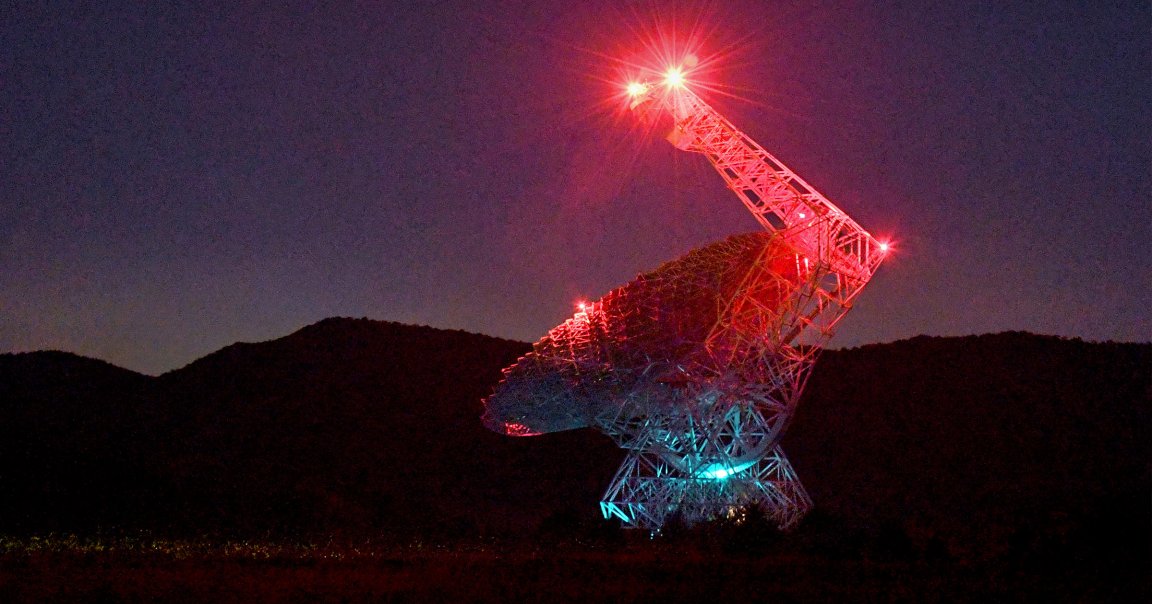
As the visitor made its closest approach to Earth, coming within just 167 million miles on December 19, an international team of researchers from the alien-hunting astronomy project Breakthrough Listen pointed the Green Bank Telescope — the largest single-dish radio telescope in the world — at 3I/ATLAS.
In a yet-to-be-peer-reviewed paper, they revealed sobering — albeit probably expected — results: the telescope failed to detect any “candidate signals” emanating from 3I/ATLAS on the day before it made its closest approach to Earth.
“No artificial radio emission localized to 3I/ATLAS was detected” by the Green Bank Telescope, as the Search for Extraterrestrial Intelligence Institute (SETI) noted on its website.
“In summary, 3I/ATLAS continues to behave as expected from natural astrophysical processes,” it goes on. “That said, it remains an extremely interesting target for observation given the overall rarity of interstellar objects.”
The Breakthrough Listen researchers concluded in their paper that “3I/ATLAS exhibits mostly typical cometary characteristics, including a coma and an unelongated nucleus.”
“There is currently no evidence to suggest that [interstellar objects] are anything other than natural astrophysical objects,” the paper reads. “However, given the small number of such objects known (only three to date), and the plausibility of interstellar probes as a technosignature, thorough study is warranted.”
For his part, Loeb continues to painstakingly document “anomalies” displayed by the rare visitor, from its unusually large suspected size to its strangely fine-tuned trajectory that brought and will bring it within just tens of millions of miles from Mars, Venus, and Jupiter.
But considering the wealth of data suggesting 3I/ATLAS is nothing more than a massive snowball largely composed of carbon dioxide and water ice, the chances that we’re looking at an alien probe sent to us from a different star system are clearly starting to dwindle.
Wouldn’t it be in an extraterrestrial civilization’s best interest to reach out to us during its probe’s closest approach? Earth certainly is giving up its fair share of radio transmissions, making our planet stand out like a sore thumb in an otherwise lifeless expanse, at least as far as we know it today.
Loeb, for one, has come up with his own “Loeb scale” to quantify how likely it is for an interstellar object to be alien in nature, where zero denotes a natural icy rock, and ten denotes a confirmed piece of alien tech.
As of shortly after it was first discovered, Loeb ranked 3I/ATLAS as a four on his scale. He has since declined to update the ranking until “new data from the period bracketing its closest approach to Earth is publicly released and analyzed” — a process that could drag on for months.
More on 3I/ATLAS: Scientists Say They’ve Found Another Anomaly About 3I/ATLAS