

As mysterious interstellar visitor 3I/ATLAS screams through our solar system, astronomers are racing to get a closer look.
The object, which is widely believed to be a comet, is expected to make its closest approach to the Earth in December and Jupiter in March of next year. And despite plenty of direct observations by ground and space-based telescopes, plenty of questions remain about the object: what exactly is it made of? How big is it? How did it even get here?
Last month, the European Space Agency used five of the science instruments attached to its Jupiter Icy Moons Explorer (JUICE) to get a better sense of its composition and behavior. JUICE completed a flyby of Venus in August to gain speed for its decade-long journey to Jupiter’s icy moons.
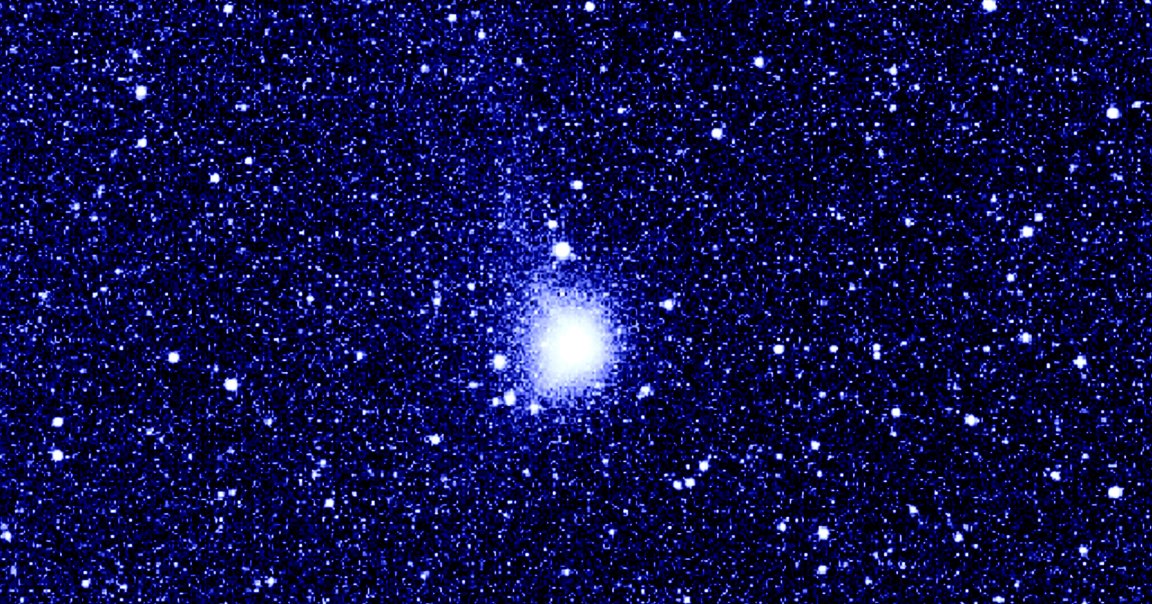
As ESA scientists await the data, the spacecraft’s NavCam snapped a preliminary picture of the extremely rare visitor on November 2. That’s just two days before the probe’s closest approach of 3I/ATLAS, coming within just 41 million miles, and three days after the object reached its perihelion, or the closest point to the Sun. The scientists were “surprised” to find it “surrounded by signs of activity” as it was being heated up by the Sun, according to a statement.
“Though the data from the science instruments won’t arrive on Earth until February 2026, our JUICE team couldn’t wait that long,” the ESA wrote.
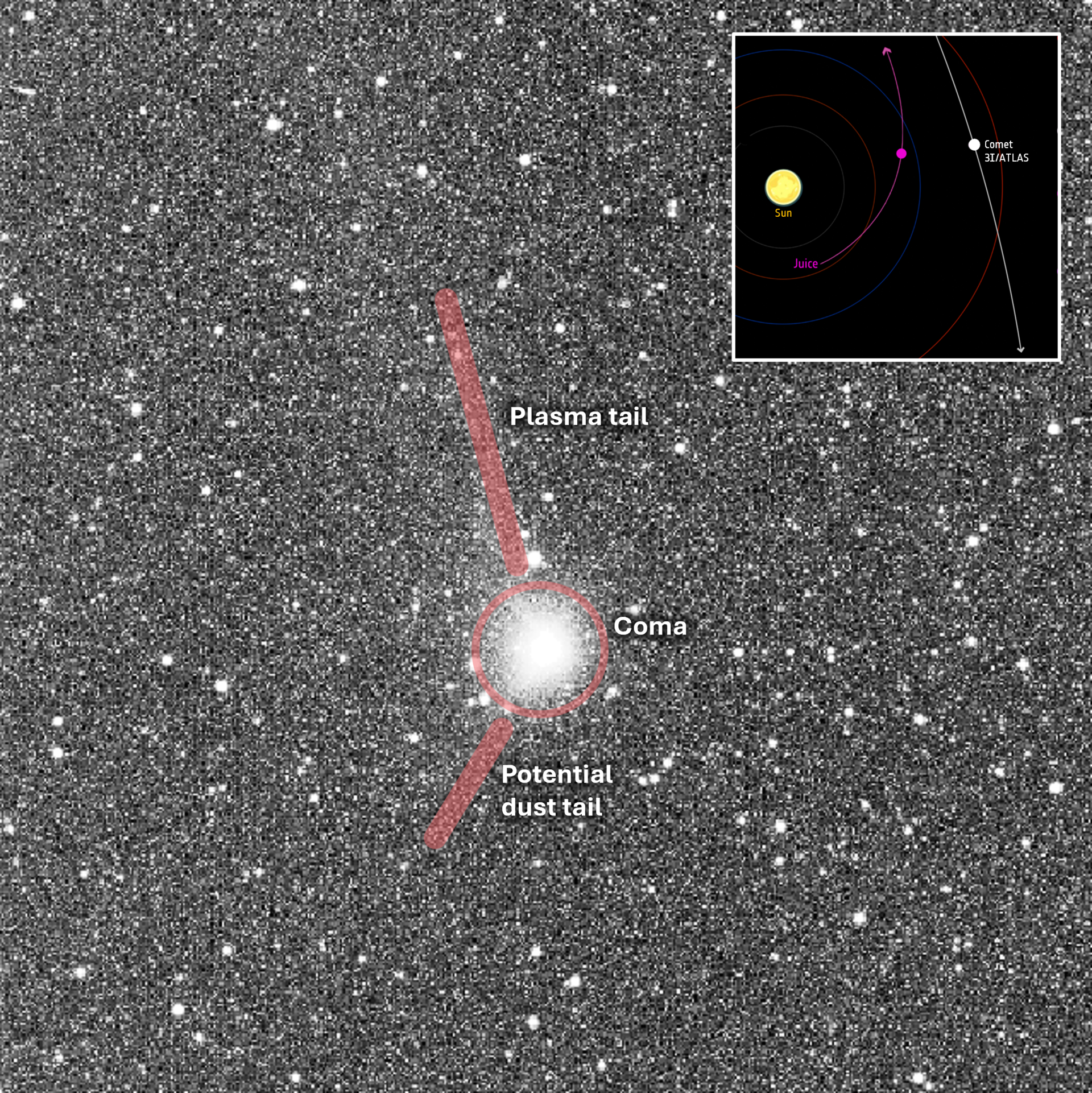
The NavCam is technically not designed to capture high-resolution pictures of the cosmos, and is meant to help JUICE navigate Jupiter’s icy moons in 2031, as its name suggests. But even with just a quarter of a single image’s data downloaded, the team could clearly observe 3I/ATLAS’ coma, its glowing halo of gas and dust that surrounds its nucleus.
The image also showed a “hint of two tails,” according to the ESA: a “plasma tail” that’s made up of electrically charged gas, and a harder-to-spot “dust tail,” that in the case of a solar system comet would be made up of tiny specks the size of smoke particles. The former tends to point away from the Sun, while the latter curves into the comet’s path.
As 3I/ATLAS approached its perihelion, or its closest point to the Sun, in October, astronomers observed the more visible former tail growing considerably. That’s largely to be expected for a natural comet as it’s exposed to much larger amounts of solar radiation, which causes ices to sublimate and leave a trail behind it.
In the case of 3I/ATLAS, it’s an exceedingly rare opportunity to study interstellar space, as it’s only the third object from a different star system ever spotted passing through our solar system.
Fortunately, with the help of existing spacecraft, we could soon get a better sense of its nature. The five instruments attached to JUICE, for instance, will include high-resolution multispectral and hyperspectral images, ultraviolet and submillimeter wave data, and particle spectrometer readings.
But scientists will have to be patient, as the data is expected to arrive in late February, a delay caused by JUICE “using its main high-gain antenna as a heat shield to protect it from the Sun, leaving its smaller medium-gain antenna to send data back to Earth at a much lower rate,” according to the ESA.
More on 3I/ATLAS: Someone Used AI to Make a Fake Avi Loeb on YouTube