

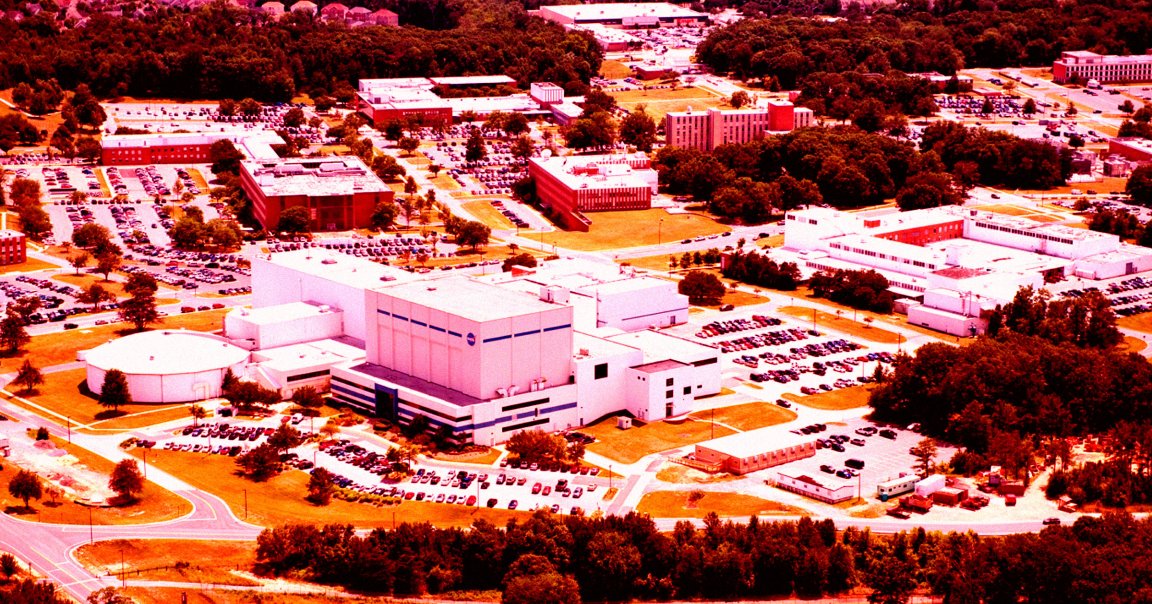
Last week, news emerged that NASA’s largest library at its iconic Goddard Space Flight Center (GFSC) in Maryland was being shut down.
The optics — especially considering the wider context of the Trump administration’s nakedly anti-science vision for the future of the agency and the shuttering of over a dozen buildings at the center — were bad, to say the least.
At least 13 buildings at Goddard, as well as more than 100 labs, are set to have been shut by March of this year, a major downscaling effort that highlights the Trump administration’s desire to slash NASA’s science budget by more than half in its proposed 2026 fiscal year budget. (The exact budget is still being actively debated, despite already being three months into NASA’s fiscal year.)
NASA insiders are dismayed at the situation playing out at GSFC, arguing that the library was an extremely important resource that’s being unjustifiably wiped out.
“I have a hard time imagining a research center of the high quality that Goddard is, or any center at NASA, how they will operate without a library, without a central collection,” planetary scientist David Williams, who has curated space mission data for NASA’s archives, told NBC News.
“It’s not like we’re so much smarter now than we were in the past,” he told the NYT. “It’s the same people, and they make the same kind of human errors. If you lose that history, you are going to make the same mistakes again.”
In some ways, others have pointed out, it’s business as usual for a large government bureaucracy.
“NASA has been closing its libraries for a long time,” Keith Cowing, a former NASA astrobiologist who now blogs about the agency at NASA Watch, wrote in a recent post. “Budgetary and building issues are usually the prime reason. Usually, stuff gets moved around and put in storage for years until the storage costs mount and then a portion ends up in someone’s library — somewhere — and the rest gets shipped to some generic [General Services Administration] warehouse — or thrown.”
But the process is agonizing, and important records can be lost through carelessness or error.
“Now it is GSFC’s turn to go through this painful process,” he added.
Officials have cried foul, arguing that plans for shutting the GSFC library existed long before Trump took office last year.
Recently sworn-in NASA administrator Jared Isaacman, for instance, insisted on a thread on X-formerly-Twitter that the move was “part of a long-planned facilities consolidation approved in 2022 under the previous administration.” And NASA press secretary Bethany Stevens described it as a “consolidation, not a closure.”
Isaacman also took issue with the New York Times’ framing of the story, accusing the newspaper that its reporting on the matter did not “fully reflect the context NASA shared,” arguing that “at no point is NASA ‘tossing out’ important scientific or historical materials, and that framing has led to several other misleading headlines.”
He also pointed out that “NASA researchers will continue to have access to the scientific information and resources they need to do their work.”
However, as a NASA spokesperson claimed in a statement to the NYT — which Isaacman quoted himself on X — “some material would be stored in a government warehouse while the rest would be tossed away” following a careful 60-day review.
Isaacman later admitted that he doesn’t “dispute that, after a deliberate review, some materials with no historical or technical value may not be retained” following an “evaluation by an on-site NASA team over a 60-day period.”
In short, there’s clearly some nuance to NASA’s plans — but given the broader political context, the shocked reactions by current and former NASA staffers shouldn’t come as much of a surprise. The Trump administration has indicated that it’s looking to shut down dozens of important science missions as part of its planned 2026 budget, the agency’s biggest budget cut in its 66-year history, if it were to pass.
The administration has also slashed budgets for other important and lifesaving scientific research as part of what’s being characterized as a broader “war on science.”
The Trump administration’s motivations for shutting down over a dozen buildings at the GSFC are a little murky. The 2022 master plan Isaacman was referring to lists “meet affordability goals” as one of its three top long-term priorities, while maintaining “mission capability” and creating a “vision” for “GSFC campuses of the future.”
Futurism has reached out to NASA for a more detailed budget breakdown and how much the agency is hoping to save through its “consolidation” efforts.
Isaacman argued that the public discourse surrounding the plans was “unfortunate at a time when the world should be energized by a plan to send NASA astronauts farther into space than ever before, return us to the lunar environment with a commitment to stay, alongside historic investments in an orbital economy and a renewed pursuit of science and discovery.”
But insiders aren’t nearly as optimistic, arguing that shutting the GSFC library would be an immense loss and could make the lives of researchers needlessly difficult.
“We want to restore the data so that it can be used, and in order to restore the data, we need to know, like I said, how the instruments worked, how they were calibrated,” Williams told NBC. “And that information is all over the place and you have to gather it. And, really, the library is one of the main resources for me and people in the future.”
While responding to Isaacman on X, spaceflight engineering expert Dennis Wingo, who has advised NASA as a subject matter expert for decades, argued that the risks of losing important historical records are immense.
“As one who has personally saved and restored NASA data, there is much more to this than you are being told,” Wingo tweeted.
“While what you are saying is the party line, that is not how it works in actuality,” he added, referencing the closing of the NASA Marshall Space Flight Center-funded Redstone Science and Information Center in 2019.
After Isaacman once again doubled down in response to Wingo, taking “exception” to “the mischaracterization of this process and its politicization to suggest the current administration is engaging in some sort of book burning,” Wingo remained unconvinced.
“Libraries and archives around the world are being ‘consolidated’ out of existence,” he wrote. “I can tell you for an absolute fact that many of the people making the determinations on what is historically valuable or not are not qualified to do so.”
“I have personally seen this happen multiple times over the past 35 years,” Wingo added.
In the early 2000s, Wingo and NASA Watch’s Cowing discovered tapes in a remote warehouse of NASA’s Lunar Orbiter spacecraft missions in the late 1960s, which, per Cowing, NASA “wanted to get rid of.”
“We drove the tapes up to NASA Ames in two large rental trucks and assembled a team of retirees and college kids to bring the data back from the past at resolutions simply impossible to achieve back in the day,” Cowing recalled in his latest blog post.
“I urge you to not allow the dumpsterization of our scientific history,” Wingo concluded in his plea to Isaacman.
More on the story: NASA Reportedly Shutting Down Its Largest Library, Throwing Materials Away