

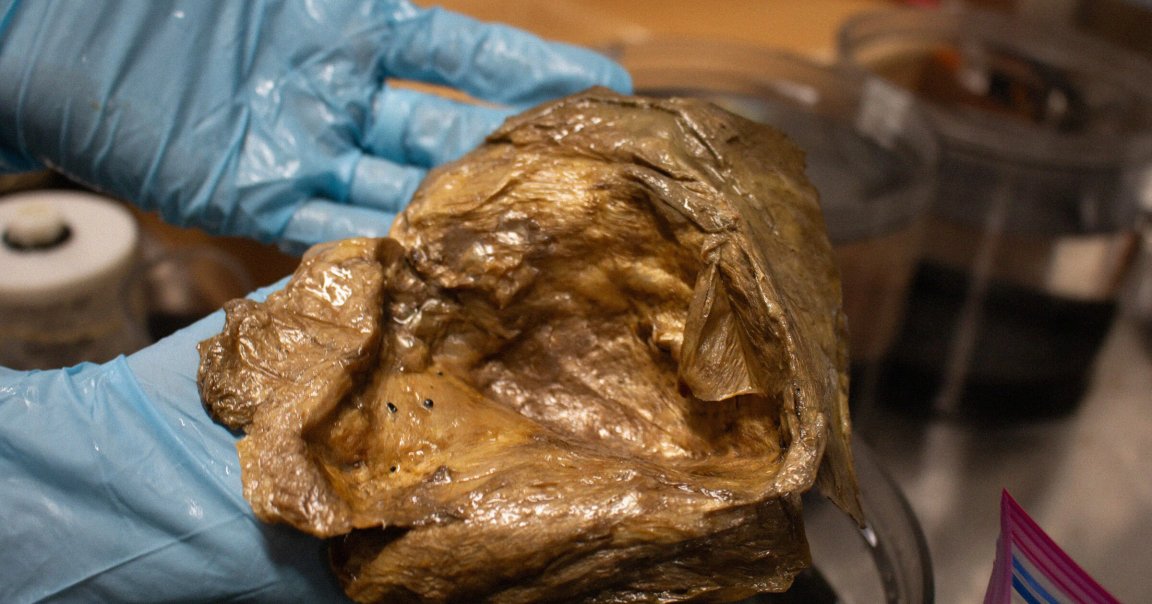
After spending two and half years pondering a “golden orb” found at the bottom of the ocean, scientists have finally figured out what in the thundering typhoons it actually is.
The aureate object looked like some sort of alien relic when it was first discovered clinging to a rock over two miles underwater in the Gulf of Alaska, before collapsing into a blob resembling molten leafs of gold when it was recovered.
Now, scientists at the National Oceanic and Atmospheric Administration and the Smithsonian Institution reveal that the baffling object is a remnant of what was once a giant anemone — though it took considerable detective work to reach that conclusion.
“This turned into a special case that required focused efforts and expertise of several different individuals,” said Allen Collins, a zoologist and director of NOAA Fisheries’ National Systematics Laboratory, in a statement. “This was a complex mystery that required morphological, genetic, deep-sea and bioinformatics expertise to solve.”
While the orb attracted a great deal of public interest, scientists regularly encounter strange organisms they can’t immediately explain when exploring the deep ocean.
“We see weird stuff every dive,” NOAA physical scientist Sam Candio said in an interview with Futurism after the discovery. The orb “wasn’t even the most interesting thing that jumped out at us at that time.”
But the golden object proved to be more of an enigma than expected. It was discovered during an expedition on the NOAA Ship Okeanos Explorer, and at the time, the expedition team could only conclude it was biological in nature. Its smooth surface was marked with a noticeable hole, which was interpreted as a clue that something either crawled into or out of it. Early theories suggested it was some sort of dead sponge or egg case.
To get to the bottom of the mystery, NOAA and Smithsonian scientists physically examined the orb-turned-lump and analyzed its genetic makeup. Starting with the physical examination, they found that though its anatomy was unusual for an animal, it contained fibrous cells called spirocysts which are a hallmark of aquatic invertebrates called cnidarians. This finding was repeated in a similar specimen discovered in an earlier expedition.
Whole genome sequencing then sealed the deal. It confirmed that the specimen shared genetic material with a giant deep sea anemone, and sequencing its mitochondrial genomes narrowed the species down. It was almost an exact match for Relicanthus daphneae, a cnidarian that was only described as an anemone in 2006 despite being discovered thirty years earlier. The species may be identified, but it still remains a source of fascination.
“So often in deep ocean exploration, we find these captivating mysteries, like the ‘golden orb,'” said William Mowitt, acting director of NOAA Ocean Exploration, in the statement. “With advanced techniques like DNA sequencing, we are able to solve more and more of them.”
More on the ocean: Man Creates Tiny Submarine for His Parakeet to Experience Life Underwater