

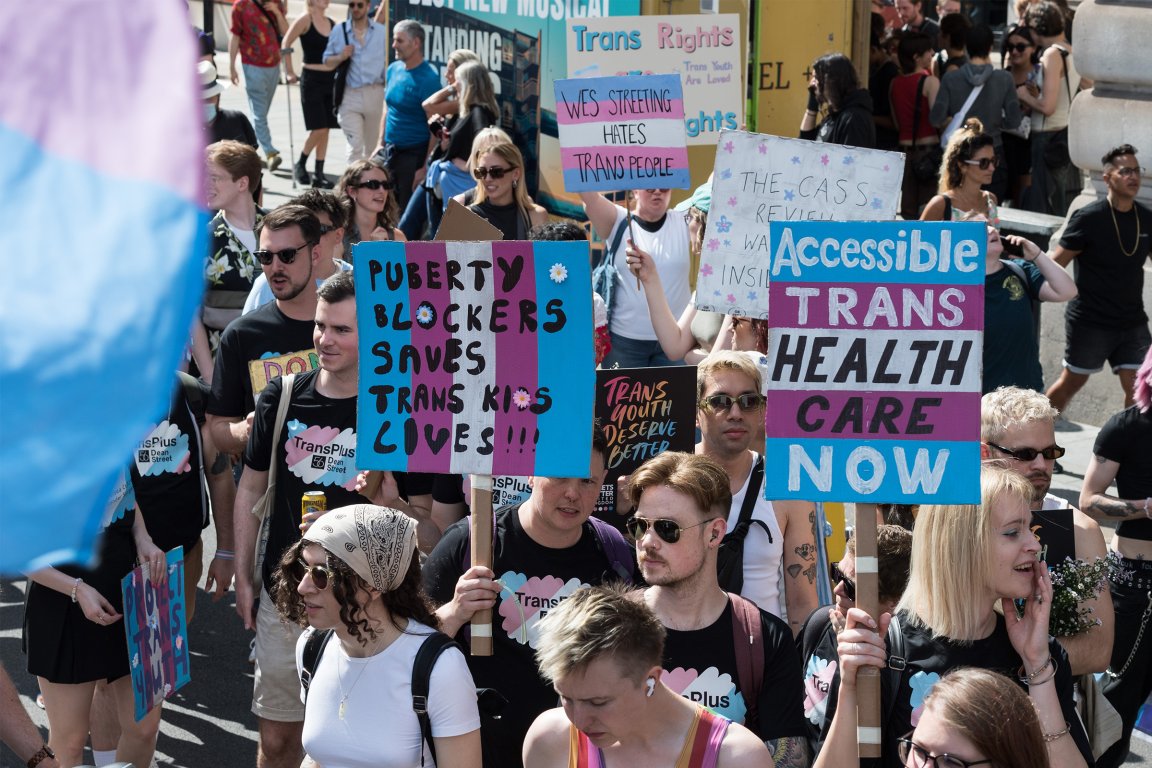
From the US’ eighteenth amendment to Australia’s sin taxes, history shows us that prohibition rarely curbs demand, but instead simply drives it underground.
That’s exactly what’s happening in the UK, after the Tavistock gender clinic — the country’s only dedicated gender identity clinic for young people — shut its doors in 2022 at the behest of the NHS. When it did, it became far more difficult to get ahold of hormonal medications used in hormone replacement therapy, London-based newspaper The Times reports.
That seems to be the goal for conservative policy makers, who cite concerns over the safety protocols at Tavistock, and the long-term safety of puberty blockers and hormone meds more broadly as their reason to cut youth off from these health services. But with Tavistock out of the picture, transgender teens seeking gender affirming treatment have turned to a robust black market which has sprouted in its wake.
According to The Times, young people have begun exploring a variety of alternate sources for gender-affirming care, none of them ideal. Some get their goods from online sources based in Russia or India. Others use the same drug dealers who supply party drugs like ketamine and MDMA, while a few have even turned to home brewing.
One of the three hospitals running the NHS’ substantially scaled down gender clinics after Tavistock closed shared with The Times that 12 percent of trans teens admitted they were self-medicating with unofficial hormones. As the data is self-reported, that’s likely an understatement.
“I’m seeing a surge of the older adolescents — the 15, 16, 17-year-olds — just skipping all medical supervision entirely, which I’m really worried about,” Anna Hutchinson, a private clinical psychologist in London, told the paper.
By Hutchinson’s count, 40 percent of trans-identifying young people admitted to self-medicating.
“A lot of them are on testosterone and estrogen, and usually not with parental approval or any medical oversight,” she said. “Some have told us they are getting them from illegal websites that sell anabolic steroids to weightlifters. Others say they get them from their drug dealers along with their ketamine.”
Of course, it’s exactly what anyone would expect. By quashing the public option, the NHS has essentially driven those seeking care to face either of two extremes: the high-cost private market, or the ultra-low cost black market.
The moves come amidst broader crackdowns against gender affirming care throughout the UK. In April, the supreme court unanimously ruled that “sex” as defined in the Equality Act of 2010 only refers to “biological sex,” a condition which Human Rights Watch says opens the door for discrimination and segregation of trans people.
In a rush to protect young people from the perceived medical risks of hormone medications and puberty blockers, the NHS has inadvertently engineered a far more dangerous reality: a system that trades supervised care for black market deals. The ultimate irony of the prohibition isn’t its just failure as a policy measure — but that it will only harm the young people it’s purported to protect.
More on gender: Meta’s Platforms Have Become a Cesspool of Hatred Against Queer People