

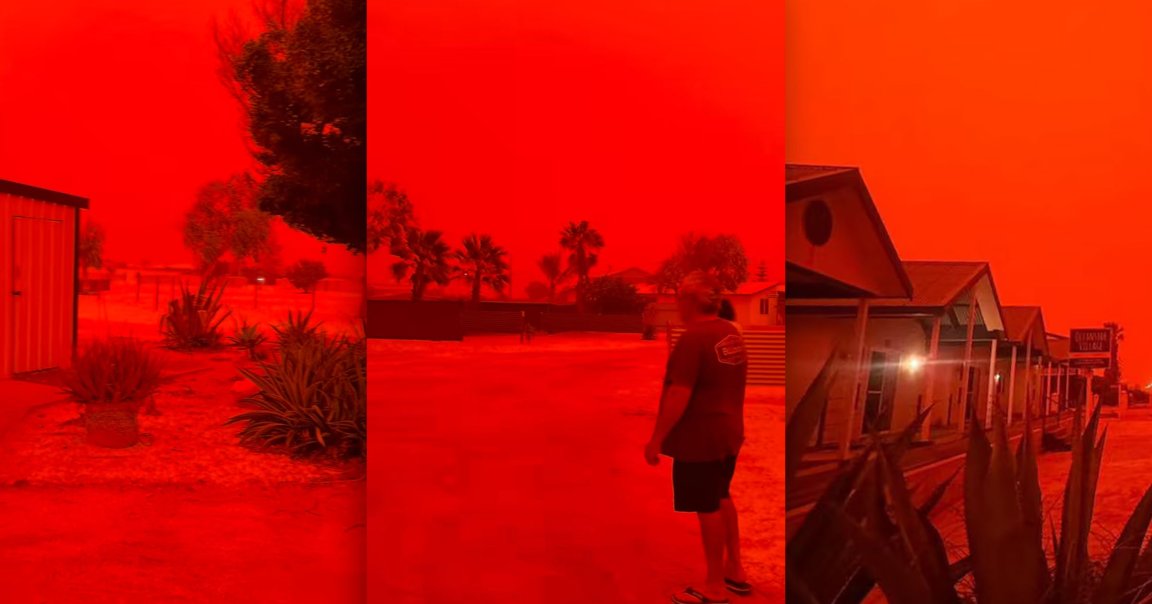
Tropical cyclone Narelle made history last week by becoming the first storm in over 20 years to make landfall in three Australian states and territories, battering more than 3,400 miles of the continent’s northern coast with gale-force winds and heavy rain.
It also announced itself in an extremely eerie way. Just before it made landfall on Friday, it turned the sky into an apocalyptic shade of bright red — an even deeper and more crimson shade than the deep orange skies we’ve witnessed in North America due to widespread wildfires.
Videos circulating online show the effect in full force, with residents staring at the spectacle in near disbelief.
“The skies just kept getting more and more orange as the afternoon went on and then, at about 3:30 pm, we went outside and it was that color,” resident Kerrie Shepherd told Australian broadcaster ABC News. “It was red all the way along, everywhere we looked.”
“No, that’s not a filter!” AccuWeather wrote in a Facebook post, preempting claims that the footage was doctored. “The sky turned an eerie shade of red in Western Australia as dust filled the air ahead of Tropical Cyclone Narelle.”
So what could’ve been behind the natural phenomenon if it wasn’t wildfires? As the NOAA’s National Environmental Satellite, Data and Information Service explains, iron-rich rocks in northwestern Australia oxidize — or rust — in the dry heat to gain their iconic reddish hue.
“As the rust expands, it weakens the rock and helps break it apart,” the agency writes.
“It’s a very red part of the country, it’s got that rusty hue, so you get that color getting whipped up with the strong winds… both locally and from northern [Western Australia] as a whole,” Bureau of Meteorology senior forecaster Angus Hines told ABC News.
Heavy cloud cover emphasized the effect, turning it into an even more apocalyptic scene.
“It’s a pretty dry part of the country, so any time you get those strong winds, you are whipping up that dust into the atmosphere,” Hines added. “But [direct sunlight] would usually penetrate through whatever is in the atmosphere a bit more effectively and make it not look so dark red.”
“It feels like the light is evenly illuminating the ground, like a panel of lighting as opposed to one bright spotlight,” he explained.
Meanwhile, residents at the local Shark Bay Caravan Park thought better than to risk breathing in the rusty air.
“It’s an inside day for us that’s for sure,” the park wrote in a Facebook post.
More on dark skies: Toxic Sludge Raining Down on Iran After Bombing of Oil Facilities