
In the wake of the deadly attack on Venezuela and kidnapping of president Nicolás Maduro by the United States, netizens looking to manufacture support for the strikes have found a friend in generative AI.
Since the kidnapping, people in the West have been fiercely debating who should control the narrative about the military action. By many accounts, those most impacted by the attacks — Venezuelans living and working in Venezuela — are resolutely opposed to the strikes, with thousands mobilizing in numerous Venezuelan cities in protest. (The death toll from the US strikes currently stands at 80 soldiers and civilians, a figure which will likely go up as the dust settles.)
Though the attacks are still too recent to get accurate polling data of the country’s sentiments, a November survey found that 86 percent of Venezuelans preferred for Maduro to remain head of state to resolve the country’s economic woes. Only 8 percent favored the far-right opposition party, which has support from US president Donald Trump. Even many Venezuelans who oppose Maduro are also opposed to the United States’ incursion to oust him.
Yet if you ask American Trump supporters, Venezuelans are actually thrilled about the invasion. Their evidence: good ol’ AI slop.
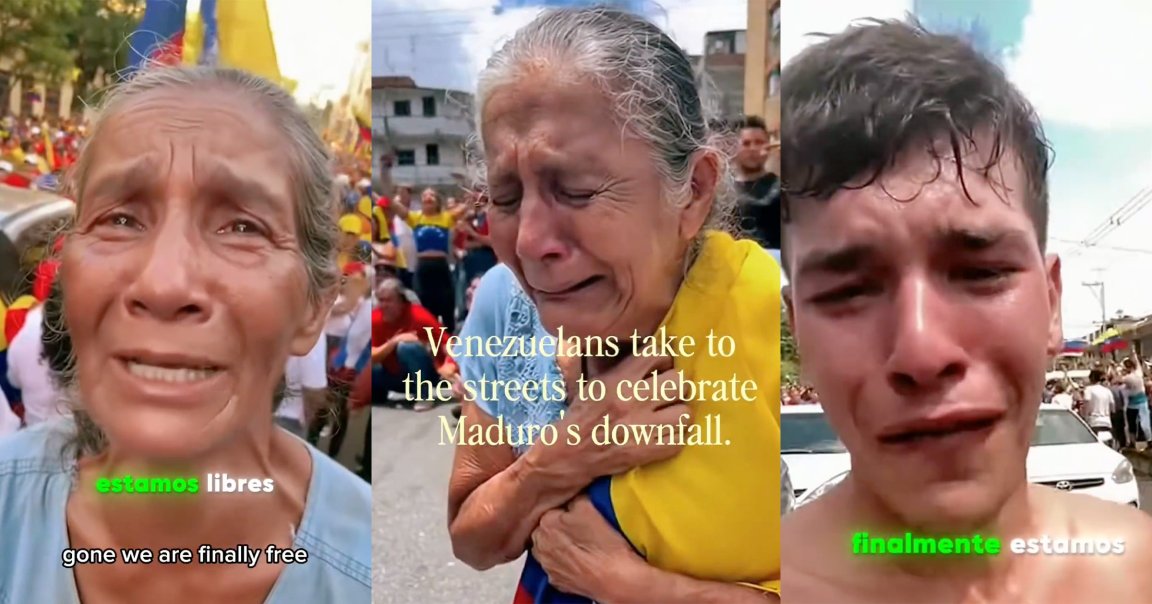
In a post with over five million views on X-formerly-Twitter, the account Wall Street Apes shared a minute-long video of what are supposed to be Venezuelan citizens crying tears of joy over the attacks. Of course, as anyone versed in the visual language of gen AI will quickly notice, the video is a compilation of low-quality AI clips.
“The people cry for their freedom, thanks to the United States for freeing us,” the video’s AI narrator exclaims. “The hero, thank you Donald Trump.”
“I’m so jealous,” a US-run account with nearly 140,000 followers replied under the clip. “I want the same freedom and the same joy for Iran and the Iranian people.”
Shooting back at the mega-viral post, critics warned that the AI slop augurs a frightening new era of misinformation.
“The US empire’s war propaganda is getting much more sophisticated,” wrote geopolitical analyst Ben Norton. “You can bet the US government will use AI to try to justify its many more imperialist wars of aggression.”
Sure enough, plenty more AI generated misinformation has surfaced following the attacks, spread by conservative politicians like Vince Lago, mayor of Coral Gables, Florida. In some cases, AI generated images of Maduro in various US custody centers began to circulate in the hours immediately after his kidnapping — and well before authentic images were released by the Trump administration.
As Mexican political journalist José Luis Granados Ceja observed, the AI slop follows decades of efforts by the US government and media to manufacture consent among the western masses for intervention in the oil-rich South American state.
“In 2002, Venezuelan President Hugo Chávez was briefly ousted in what came to be called the ‘world’s first media coup’ where the lies said on TV paved the road,” Ceja wrote in response to the AI propaganda. “It shouldn’t be a surprise then that in 2025 new tech and fake AI videos are being used toward similar ends.”
More on misinformation: Racists Are Using AI to Spread Diabolical Anti-Immigrant Slop