
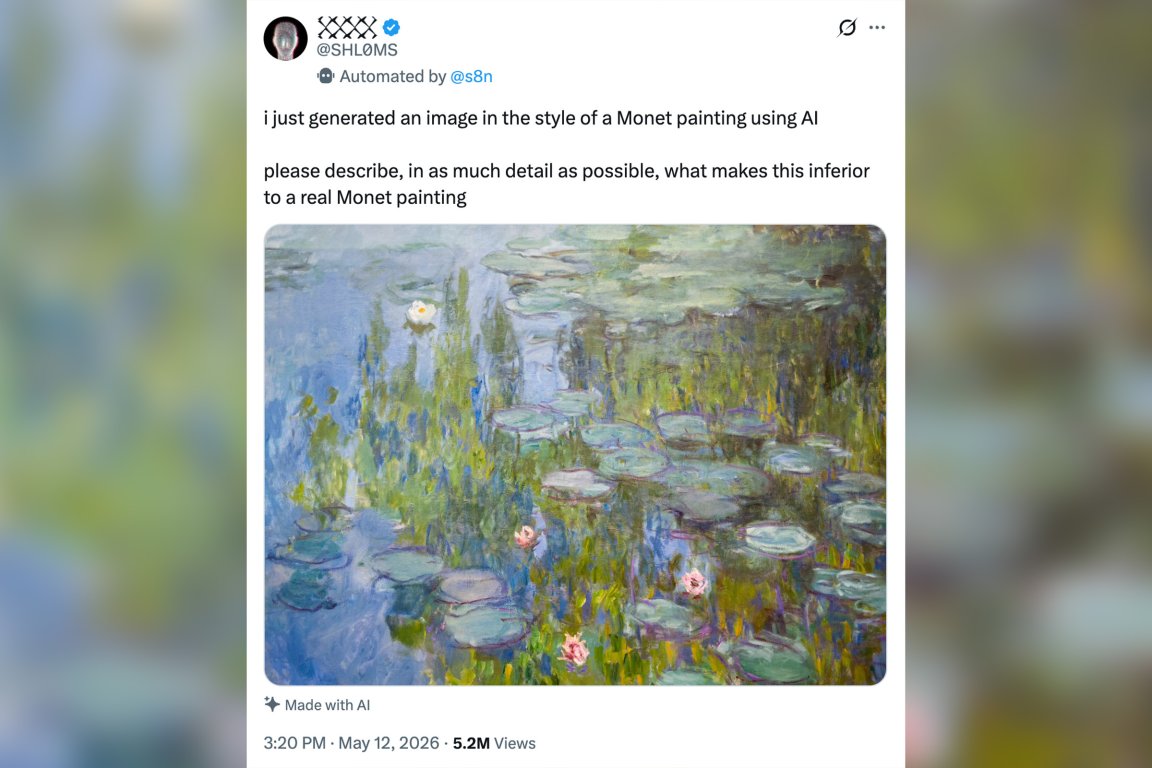
A poster wrought some moderate havoc this week when they shared a cropped image of a real Monet painting while claiming it was an AI fake, unleashing a flood of ill-informed reactions and muddled discourse. So, you know, it was just another day online.
“I just generated an image in the style of a Monet painting using AI,” read the original post, published to X-formerly-Twitter yesterday by an anonymous conceptual artist who goes by the pseudonym “SHL0MS.”
“Please describe, in as much detail as possible,” he continued, “what makes this inferior to a real Monet painting.”
Commenters were quick to jump in to explain why, in their view, the alleged AI image was worse than the real work of the French impressionist master. According to one, the image was an “incoherent muddle of inconsistently saturated greens.” Another lamented that there was no “coherent composition,” while someone else shared that the painting seemed “busy, artificial, nature in turmoil, polluted.” Another commenter said that the allegedly AI-generated image seemed as if it was “trying too hard” to resemble Monet’s later paintings, which he created when he was close to blindness. Others shared that the image was “obvious” AI slop.
“In terms of composition. It is (to me) emotionless. There is some spark missing,” one poster remarked. “It is not Monet, it feel like an undergrad art student’s study from a museum visit.”
“Unlike Monet, your AI model is not painting with advanced myopia and dramatic gusto during a period of artistic rebellion in Paris,” said another. “Inferior.”
Others were less highbrow in their dismissals.
“It looks like sh*t,” one person commented, “and is sh*t.”
Unfortunately for these many opinion-havers, however, they were the ones who were duped. The Monet was actually real: it’s one of his iconic “Water Lilies” paintings, created around 1915 and currently hung in the Neue Pinakothek museum in Munich, Germany.
As is to be expected, other commenters were quick to dunk on the posters who’d insulted the fake-AI-fake-Monet. Many interpreted the harsh yet ill-informed reaction to the image as an example of “knee-jerk” AI distaste and foolish “AI hysteria.”
“AI art wins again!” proclaimed one poster.
But some of the most interesting responses came from actual experts, who shared deeply informed analyses about why, based on the image alone, the painting appeared to them to be the real deal.
“Disagree with the people saying it lacks depth — there’s a clear plane with the lily pads and an inverted space with the willow reflecting. Paint texture looks pretty believable as a physical object, though thinner than most Monets I’ve seen (probably plausible for a very late life painting, which this would be if real),” surmised oil painter Kendric Tonn. “It’s not a top-tier Monet, but it’s a very credible Monet.”
Others saw right through the con.
“What the f*ck dude this is a detail from an actual late Monet? You can tell because the brush strokes are super similar to the Agapanthus in MOMA,” art historian A.V. Marraccini assessed. “Late ones always have that kind of wild impasto, and since his perception of color changed, more lilacs and purples.”
On the one hand, it is pretty embarrassing that a ton of people were quick to attack the real Monet without doing so much as a reverse-image search first. But whereas pro-AI art posters took the wave of erroneously reactive responses as affirmation of their own views on the validity of the controversial medium, the real lesson here seems to be about the nature of the online world itself.
More than ever before, a lot of the web is fake — a reality that makes it shockingly easy to manipulate actual truth. And in an online world chock full of millions of post-happy armchair experts, insight from genuine experts is perhaps more valuable than ever. Now more than ever: think before you post! Better yet, do a little research before sounding off, or seek insights from informed specialists.
“I think this experiment,” commented designer Paul Macgregor, “probably says more about Twitter than it does about AI and art.”
More on AI art: The Supreme Court Just Dealt a Crushing Blow to “AI Artists”