

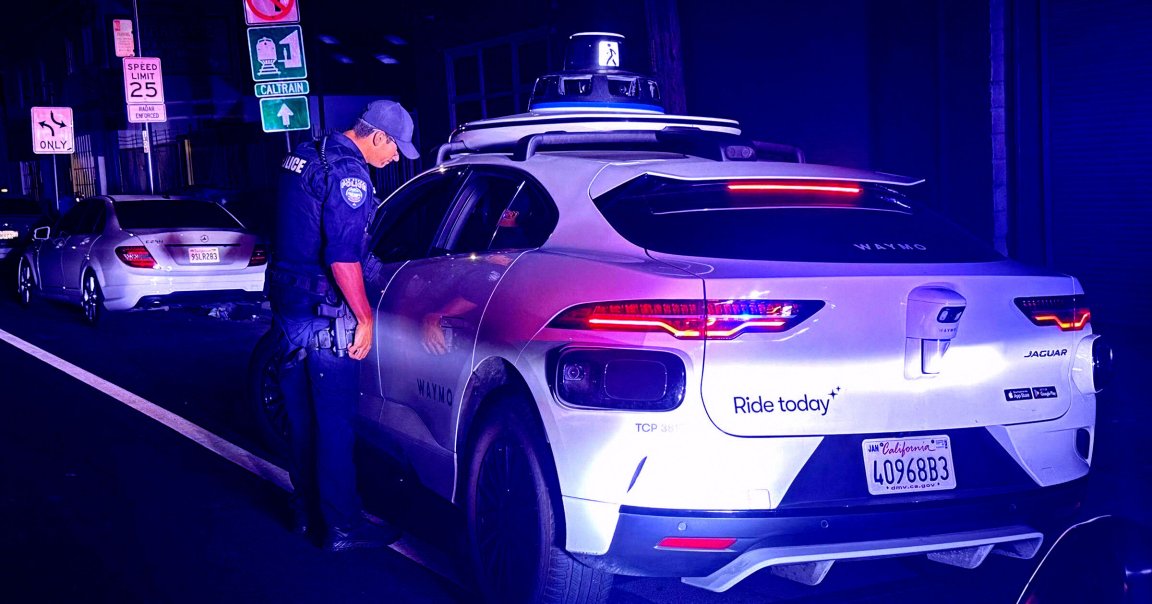
Autonomous vehicles have an accountability problem. Because there’s no driver, there’s nobody to hold liable when the car misbehaves. This means that when a Waymo blocks an ambulance on its way to an emergency, or a Tesla robotaxi speeds past a stopped school bus, traffic authorities have no recourse to impose a penalty.
For years, this created a bifurcated system where for-profit companies could break traffic laws that would land individuals in hot water, though that may not be the case much longer. In California, at least, the Department of Motor Vehicles has now ruled that AVs are no longer exempt from traffic citations, which could have huge implications for the companies pumping city streets full of self-driving cars.
Per the San Francisco Standard, the first-of-its-kind regulation likewise mandates that AVs comply with emergency personnel within 30 seconds of being given an instruction, under penalty of having their permits suspended.
Ideally, regulators hope the new directive will prevent AVs from draining public resources and clogging urban roadways, like Waymo did during a city-wide power outage in San Francisco last December.
“California continues to lead the nation in the development and adoption of AV technology, and these updates regulations further demonstrate the state’s commitment to public safety,” California DMV director Steve Gordon said in a press release on Tuesday.
Given the trouble AV companies have had with bike lanes, train crossings, and roadside emergencies, it’ll be fascinating to see whether their self-driving cars can rise to the challenge — or else be relegated back to the proving grounds.
More on autonomous vehicles: Self-Driving Taxis Poised for Vicious Backlash