

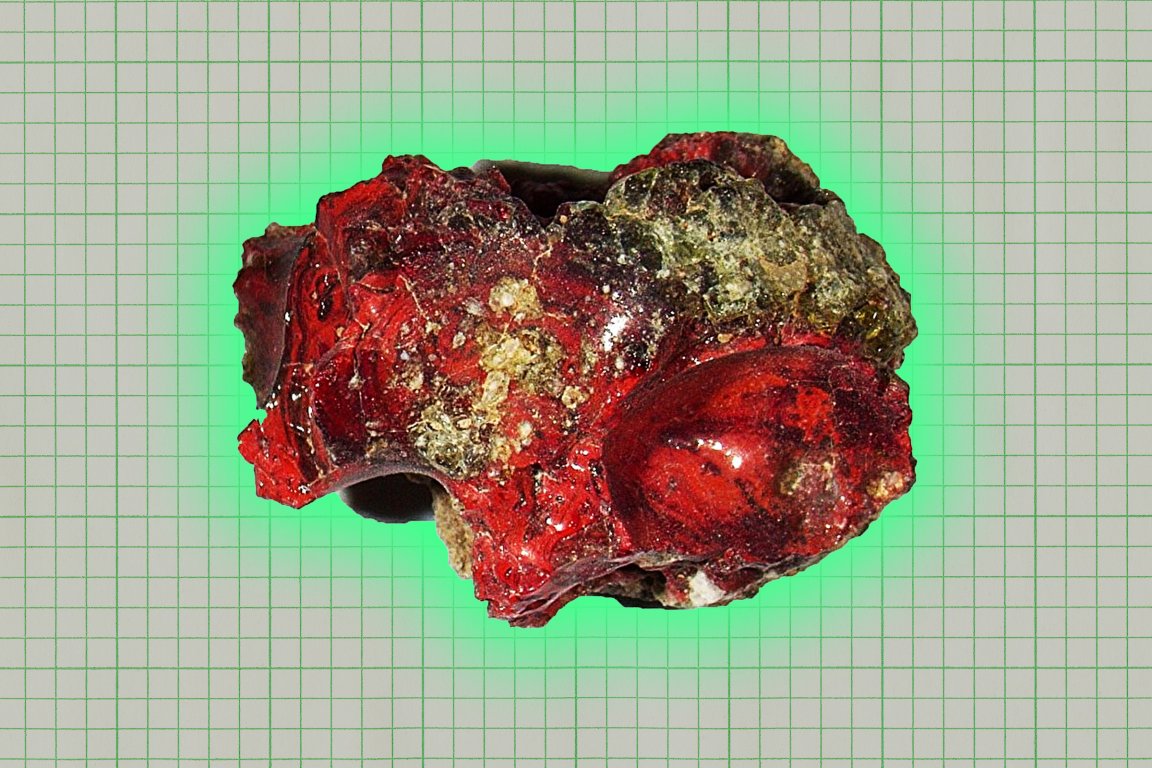
The US Army’s Trinity test in 1945, the first-ever demonstration of a nuclear weapon, was a grim inflection point in human history: the prelude to the deadly attacks on Hiroshima and Nagasaki, and a remaking of the global order, the apocalyptic shadow of which we all now live beneath.
In the irradiated crater it left behind, scientists discovered a glassy remnant later dubbed trinitite, a byproduct of New Mexico desert sand and leftover test site like a tower and coaxial cables, fused together and transformed by the unimaginable heat and force of the blast. Most of the stuff is a greyish-green material, but a rare variation, which takes the form of a red crystal, has long been a source of fascination due to its nightmarish visage, which features bulbous protrusions vaguely evoking the horror of exposed flesh.
Now, a new study published in Proceedings of the National Academy of Sciences used CT and X-ray scans to probe the composition of the mysterious crystal. In the process, they found something bizarre: a material called a clathrate, which traps atoms inside its lattice and which had never previously been observed in the natural world or even the wreckage of a nuclear explosion.
“It’s a completely new kind of clathrate crystal — something never seen before in nature or in the products of a nuclear explosion,” University of Florence geologist Luca Bindi, who co-authored the new paper, told Scientific American.
The research underscores the radioactive nightmare of nuclear warfare, which creates conditions so extreme that they defy comprehension even after nearly a century.
And if you were thinking of heading out to the New Mexico desert to find some for yourself, tread carefully — it’s illegal to gather the stuff.
More on nuclear projects: The Trump Administration Is Doing Something Horrifying to Workers at Nuclear Facilities