

A growing contingent of the scientific community has become skeptical about the body of research finding that microplastics have infiltrated almost every aspect of nature, from the remotest regions of Earth to inside our bodies.
As The Guardian reported earlier this year, scientists have started warned that some of these studies may be based on errors due bad methodology, inadequate efforts to limit plastic contamination, and lack of validation.
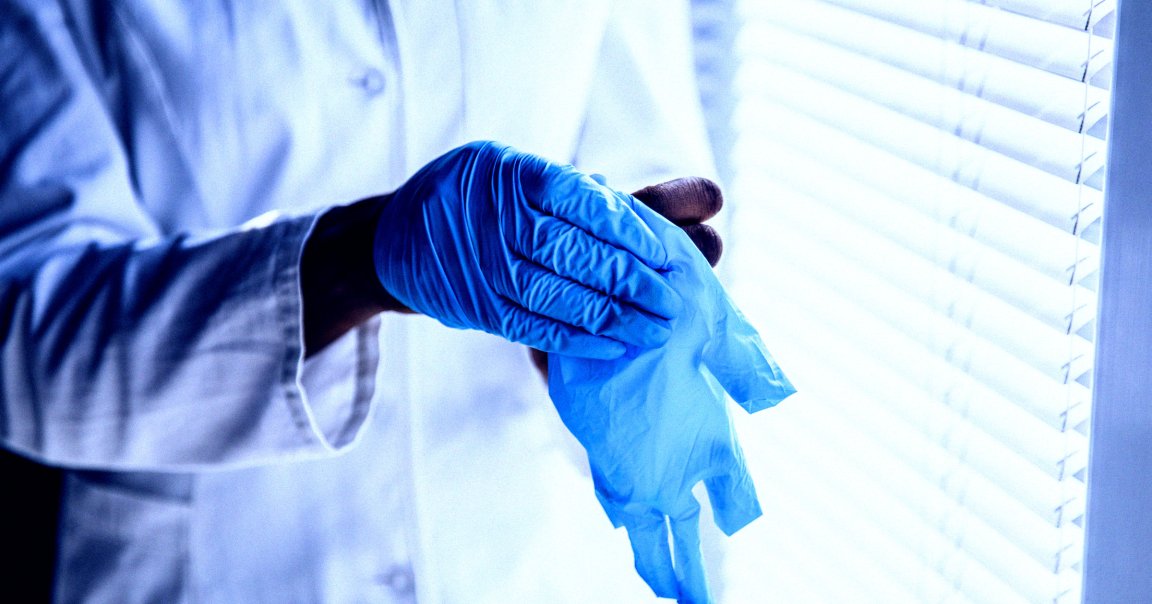
Now, researchers from the University of Michigan have found that the special coating on commonly used nitrile and latex gloves worn by scientists could be causing measured levels of microplastics to shoot through the roof, even though the coating isn’t technically made of microplastics itself.
As detailed in a recent paper published in the journal Analytical Methods, special substances added to disposable gloves to make them separate from molds more easily, called stearates, are chemically very similar to microplastics, making them almost impossible to distinguish in the lab.
However, the research team led by recent University of Michigan doctoral graduate Madeline Clough stressed that the findings aren’t the last word on the question.
“As microplastic researchers looking for microplastics in the environment, we’re searching for the needle in the haystack, but there really shouldn’t be a needle to begin with,” she said in a statement.
For a preceding project exploring airborne microplastics, Clough used special air samplers to collect environmental samples and analyzed them using light-based spectroscopy. The air samplers themselves feature metal surfaces that collect any chemicals present in the air.
While preparing these metal surfaces, Clough wore nitrile gloves, as is standard practice. But when she analyzed the results, she found the number of microplastics was orders of magnitude higher than she expected, inspiring their latest paper.
“It led to a wild goose chase of trying to figure out where this contamination could possibly have come from, because we just knew this number was far too high to be correct,” she said in the statement. “Throughout the process of figuring it out — was it a plastic squirt bottle, was it particles in the atmosphere of the lab where I was preparing the substrates — we finally traced it down to gloves.”
Beyond nitrile gloves, the team tested seven other types of gloves as well for their latest paper, and found that cleanroom varieties — which do not come coated in stearates — performed significantly better than others, resulting in fewer particles getting caught in the air samplers.
“The type of contact we tried to mimic touches upon all varieties of microplastics research,” Clough explained. “If you are contacting a sample with a gloved hand, you’re likely imparting these stearates that could overestimate your results.”
Under an electron microscope, the researchers struggled to tell apart polyethylene, an extremely commonly used plastic, from stearate particles.
But while the results suggest previous studies could be painting a highly skewed picture of microplastics contamination in the world around us, Clough suggested it’s not too late.
“For microplastics researchers who have these impacted datasets, there’s still hope to recover them and find a true quantity of microplastics,” she said in the statement.
“By using this approach in conjunction with our included spectral libraries of stearate standards, researchers can address glove-based contamination in environmental datasets and provide more accurate estimates of environmental microplastic abundance,” the researchers conclude in their paper.
In short, it could take quite some time until we know for sure just how pervasive the small pieces of plastic are in the environment, let alone their effects on our health.
“This field is very challenging to work in because there’s plastic everywhere,” senior author and University of Michigan chemistry professor Anne McNeil added. “But that’s why we need chemists and people who understand chemical structure to be working in this field.”
“We may be overestimating microplastics, but there should be none,” McNeil concluded. “There’s still a lot out there, and that’s the problem.”
More on microplastics: Wait… All Those Studies May Have “Detected” Microplastics in the Human Body Because of a Severe Error