

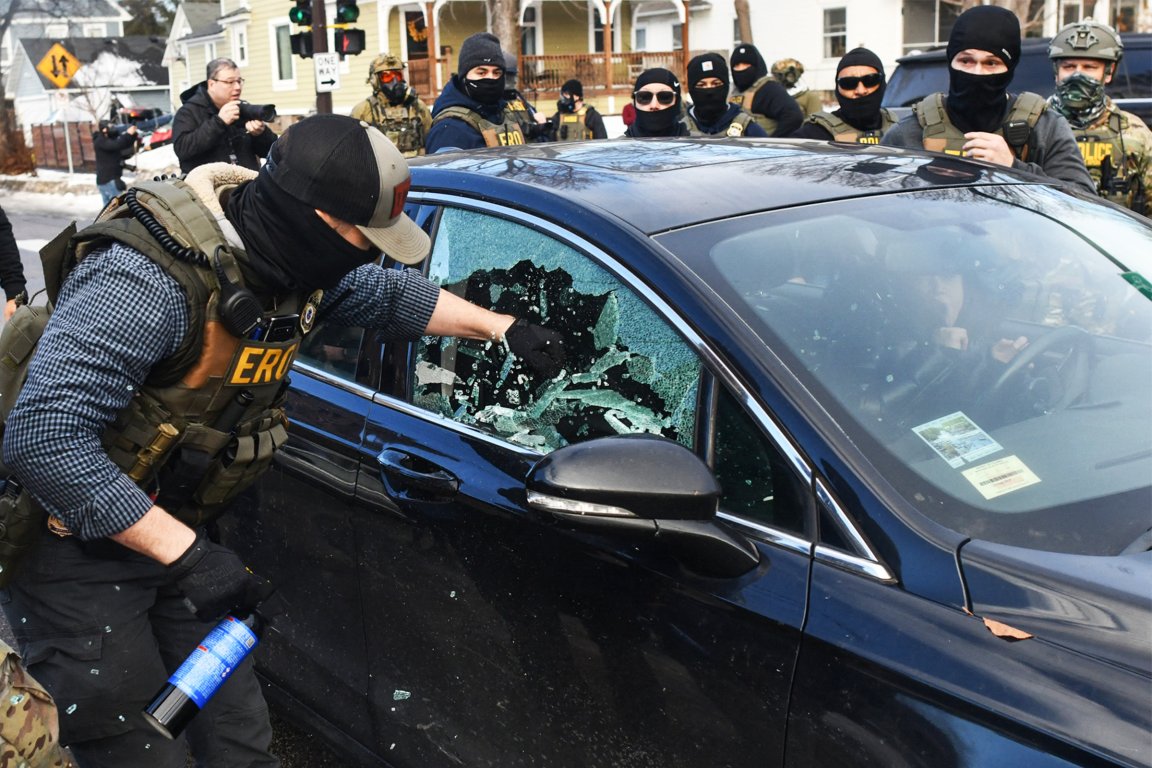
What’s the most surefire way to achieve Civil War 2.0 in the United States? According to one wild simulation, it’s exactly what’s happening right now in Minneapolis.
In October 2024, researchers at the Center for Ethics and the Rule of Law (CERL) at the University of Pennsylvania conducted an experiment in which a president ordered a widely condemned federal law enforcement operation in the city of brotherly love.
To carry out the operation, the simulated president tried to federalize the Pennsylvania national guard, which the governor resisted. National guard troops who sided with the state followed suit, prompting the fictional president to order acting US military troops to march on Philly.
According to CERL director Claire Finkelstein’s breakdown of the simulation, newly published in the Guardian, the experiment culminated in a “violent confrontation” between state and federal forces in a major US metropolis.
Finkelstein notes that the war gaming exercise included actual government officials and former senior military leaders, none of whom “considered the scenario unrealistic.” The results were based off the assumption that during a rapidly evolving civil emergency like this, courts would be largely ineffective at stopping federal overreach.
Though the early stages of the Philadelphia simulation closely match the brutal events citizens in Minneapolis have experienced at the hands of US Immigration and Customs Enforcement agents, the model diverges from reality in one key way: municipal and state officials don’t seem interested in attacking ICE agents anytime soon.
Though things definitely look hairy in Minnesota, a significant gulf remains between non-cooperation and armed resistance from municipal and state service members. Under a 2025 municipal ordinance, for example, Minneapolis police are prohibited from cooperating with ICE agents, though they’re also not authorized to interfere in federal enforcement activities.
Minnesota governor Tim Walz has likewise urged protestors not to engage in acts of civil disobedience as he moved to mobilize the Minnesota National Guard. Though some saw the move as a preparation to forcibly expel ICE from Minneapolis, there’s no evidence that this was ever the case; as a national guard official told one local news channel, if state troops do get deployed to Minneapolis, it’ll be to direct traffic, keep protests peaceful, and protect private property.
All in all, the prospect of official resistance currently remains the stuff of simulations. In reality, state power remains pointed in the same place since the start of the ICE crackdown: at protesters, not at the federal agents brutalizing their communities.
More on ICE: ICE’s AI Tool Has Been a Complete Disaster