

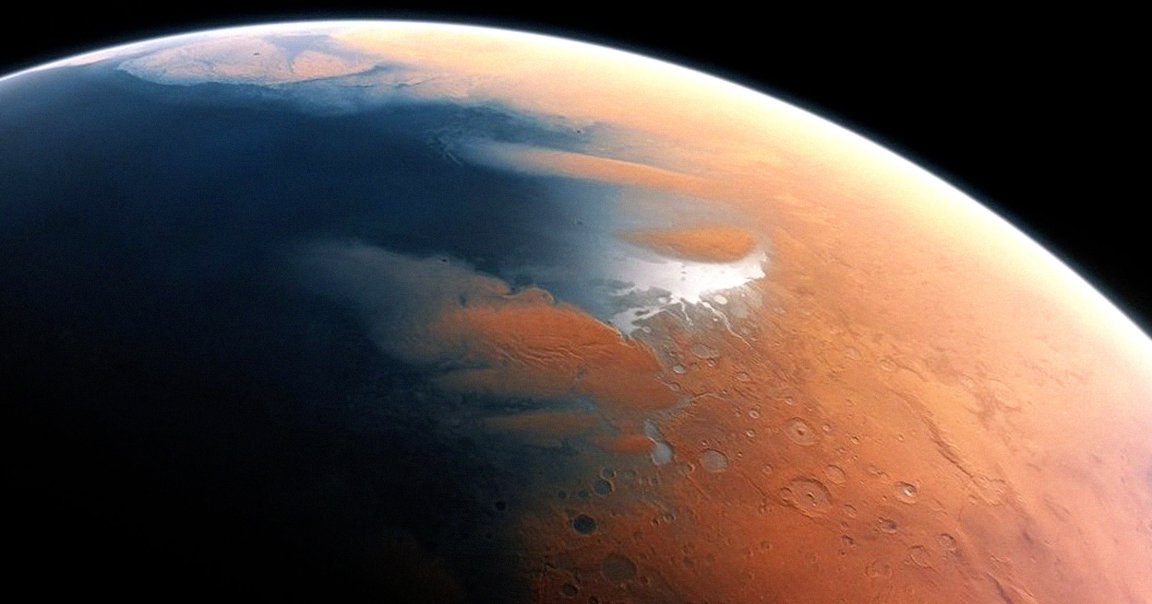
Scientists have long suspected that Mars was once teeming with water, a tropical oasis with vast river systems that may have been able to support life billions of years ago.
To get a better picture of what such a lush ocean world could’ve looked like, an international team of researchers used satellite data to simulate the sea level in a colossal geographic feature called Coprates Chasma, which is part of the Valles Marineris, the largest canyon in the entire solar system.
While examining the satellite imagery, the team concluded that the structures of the canyon closely resembled river deltas on Earth, supporting the theory that the Red Planet was once a “blue planet,” around three billion years ago.
As detailed in a study published in the journal NPJ Space Exploration, the team found geomorphologic structures in the vicinity of the Valles Marineris that closely resemble the mouth of a river where it flows into the ocean back on Earth.
They then inferred a sea level at the time when this river was still flowing, determining it dates back to a time in the planet’s history with the “largest availability of surface water on Mars.”
The team used data collected by the European Space Agency’s ExoMars Trace Gas Orbiter and Mars Express orbiter, as well as NASA’s Mars Reconnaissance Orbiter, for their investigation.
“The unique high-resolution satellite images of Mars have enabled us to study the Martian landscape in great detail by surveying and mapping,” said coauthor and University of Bern PhD student Ignatius Argadestya in a statement.
“When measuring and mapping the Martian images, I was able to recognize mountains and valleys that resemble a mountainous landscape on Earth,” he added. “However, I was particularly impressed by the deltas that I discovered at the edge of one of the mountains.”
The team compared the Martian “fan deltas,” which occur when a fan-shaped cone of sediment from a mountain stream empties into a standing body of water, to those that form back on Earth, and found that they mapped onto each other strikingly well.
“The structures that we were able to identify in the images are clearly the mouth of a river into an ocean,” coauthor and University of Bern geology professor Fritz Schlunegger explained.
From there, the team inferred that the ocean the delta flowed into was at least the size of the Arctic Ocean on Earth.
While Schlunegger admitted that he and his colleagues were “not the first to postulate the existence and size of the ocean,” their “reconstruction of the sea level” is “based on clear evidence for such a coastline,” including “high-resolution images.”
“With our study, we were able to provide evidence for the deepest and largest former ocean on Mars to date — an ocean that stretched across the northern hemisphere of the planet,” Argadestya added.
What implications the findings have for the search for ancient life on Mars remains unclear. But it’s an intriguing new glimpse into the planet’s ancient history when it was still teeming with water — a tantalizingly habitable spot far away from home.
More on Mars: Scientists Find Evidence of Ancient Tropical Oasis on Mars