

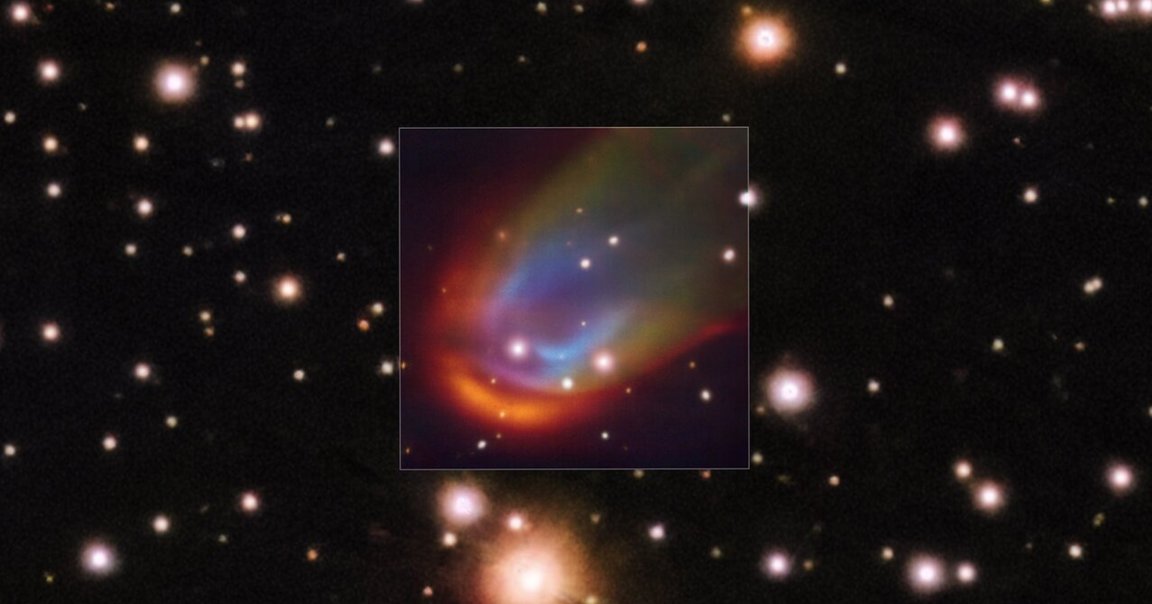
A dead star 730 light years away appears to be forming a powerful structure around itself — and despite their best efforts, astronomers aren’t sure how.
The cosmic corpse, designated RXJ0528+2838, is an incredibly dense stellar remnant known as a white dwarf, with a Sun-like star orbiting around it. This binary arrangement isn’t uncommon throughout the universe, but what is strange is the structure surrounding the former body: a highly energetic and luminescent cloud known as a nebula, even though there doesn’t appear to be anything that could be forming it.
“Our observations reveal a powerful outflow that, according to our current understanding, shouldn’t be there,” said Krystian Iłkiewicz, a researcher at the Nicolaus Copernicus Astronomical Center in Warsaw, Poland, and co-lead author of a new study published in the journal Nature Astronomy, in a statement.
White dwarfs are what’s left over when stars of moderate mass like our Sun exhaust all their fuel, shed their outer layers, and expose a dense core.
In many cases of binary systems, the white dwarf starts stealing material from its stellar companion. As it does so, the stolen matter forms a luminous ring around itself known as an accretion disc. Then, as the star slowly revolves around the galactic center and moves through space, it creates a shock wave in the nebula called a bow shock, which is a “curved arc of material, similar to the wave that builds up in front of a ship,” explained coauthor Noel Castro Segura, a researcher at the University of Warwick in the UK, in the statement.
RXJ0528+2838 defies this common understanding, however, because it doesn’t show any sign of having an accretion disc. Moreover, the team’s images taken with the European Southern Observatory’s Very Large Telescope also rules out that it was caused by a thermonuclear explosion called a nova that commonly occurs when enough stolen material accumulates on the white dwarf’s surface and explodes. Adding to the incredible nature, the size of the bow shock suggests that the white dwarf has been producing an outflow for at least 1,000 years, which seems improbable for a dead star.
“The surprise that a supposedly quiet, discless system could drive such a spectacular nebula was one of those rare ‘wow’ moments,” said co-lead author Simone Scaringi, an associate professor at Durham University in the UK, in the statement.
Everything points to the star siphoning material from its stellar companion but without forming a disc around itself. The researchers’ best guess is that this has something to do with the white dwarf’s powerful magnetic field somehow powering the outflows.
“Our finding shows that even without a disc, these systems can drive powerful outflows, revealing a mechanism we do not yet understand,” Iłkiewicz said. “This discovery challenges the standard picture of how matter moves and interacts in these extreme binary systems.”
More on space: Scientists Weirded Out by Cosmic Bones in Distant Space